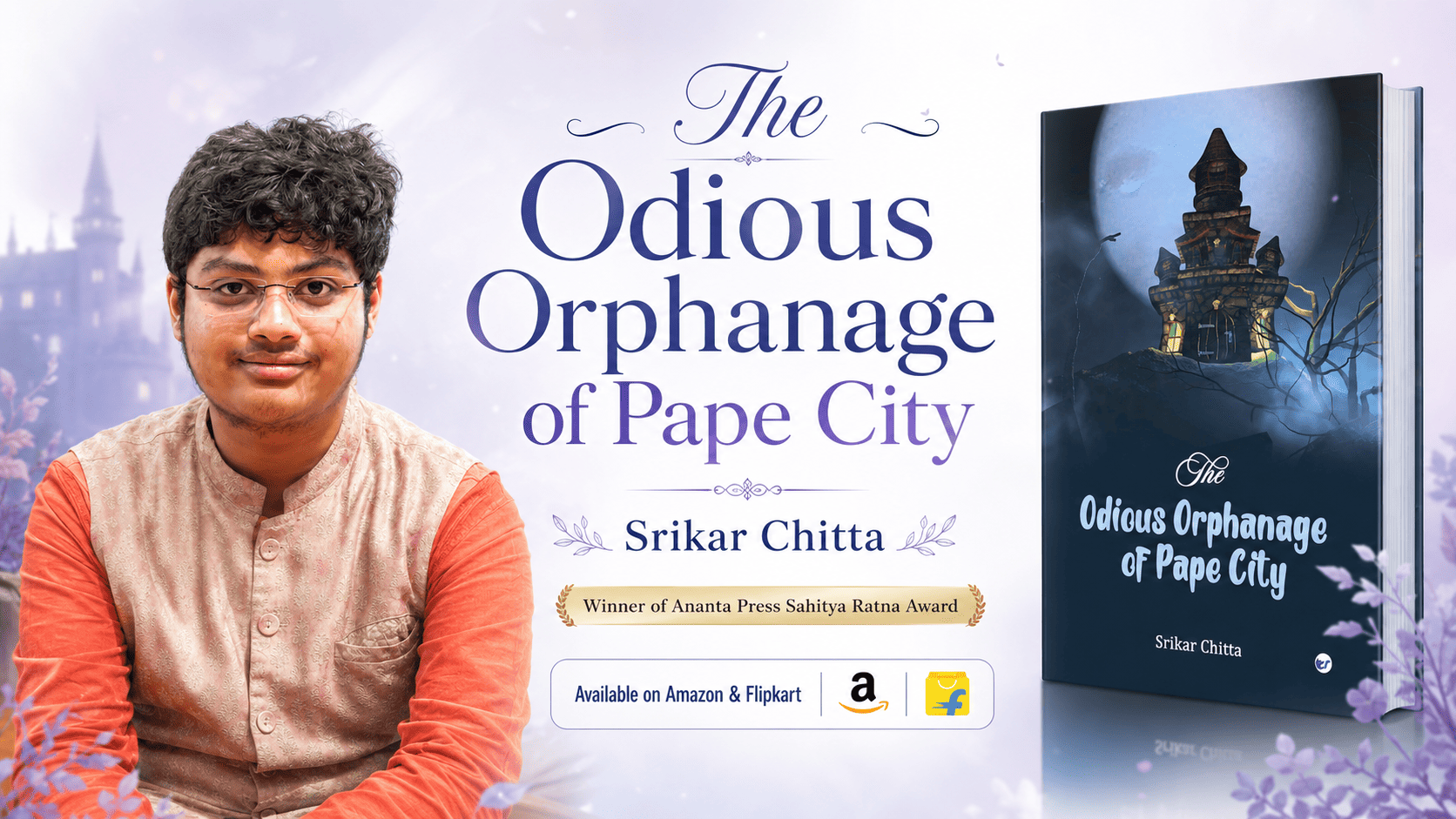
One of the first things that makes The Odious Orphanage of Pape City by Srikar Chitta so intriguing is the context of its creation. This is a suspense-driven work written by a young author, and that fact is not a novelty to be mentioned in passing—it is essential to understanding the book’s distinct energy. Srikar Chitta brings to the story a perspective that feels close to the emotional weather of childhood: intense, imaginative, uneasy, and fiercely alert to unfairness. The result is a thriller that feels genuinely tuned to the fears, frustrations, and inner strength of young readers. Rather than simply telling children a dark story, the book seems to think with them and through them.
The premise is immediately arresting. Chris, the young protagonist, is admitted to an orphanage known as the “House of Victory,” a name that suggests safety, possibility, perhaps even redemption. Instead, he enters a setting that is cold, punishing, and deeply menacing. An evil warden exercises harsh control. The children around him are unfriendly and, at times, hostile. The food is miserable, the routines are harsh, and the orphanage quickly reveals itself as less a home than a trap. From this foundation, the novel builds a tense and fast-moving narrative about survival, discovery, and escape.
What stands out most, however, is how directly the book channels the emotional logic of youth. Children often experience the world in high contrast: adults may appear all-powerful, rules may feel absolute, social rejection may feel devastating, and small comforts may become overwhelmingly important. Srikar Chitta captures this sensibility with notable skill. The disgusting potato soup is not a minor comic detail; it becomes part of the daily indignity of Chris’s life. The mean children are not a background obstacle; they intensify his isolation. The punishments are not simply scary; they symbolize the unpredictable and often arbitrary nature of the authority governing the orphanage. All of these elements combine to create an environment that feels believable at the level of emotion, even as the story operates in a heightened thriller mode.
The novel’s authenticity is one of its greatest strengths. Many books written for young readers succeed in plot but fail to fully capture the emotional scale at which children feel fear, hope, and injustice. This book does much better. It does not minimize Chris’s suffering, nor does it treat his anxieties as exaggerated. Instead, it enters into them. That choice gives the story both intimacy and urgency. Readers are not observing Chris from a detached position; they are meant to feel alongside him.
This closeness is enhanced by the book’s strong pacing. Because the novel is short, every scene matters. Srikar Chitta understands how to move quickly without losing focus. The narrative never drifts too far from the central tension: Chris is trapped in a hostile institution and must find a way to endure and respond. For younger readers, this is extremely effective. The story respects limited attention spans while also proving that brevity can coexist with meaningful stakes. For reluctant readers especially, that can be invaluable. A book that is easy to enter, hard to put down, and emotionally satisfying can become an important gateway to further reading.
The setting itself has a classic storybook darkness that recalls the tradition of children facing threatening institutions or adults. Yet the book does not feel derivative. What gives the setting life is its specific emotional texture. The “House of Victory” is not merely creepy; it is humiliating, exhausting, and oppressive. That detail matters. Horror in youth fiction often works best when it merges the dramatic with the recognizable, and here the recognizably unpleasant aspects of institutional life amplify the suspense. The orphanage is horrible not only because it is sinister, but because it is relentlessly unkind.
Chris functions as an effective protagonist because he is positioned as an ordinary child under extraordinary pressure. He is not made admirable through flashy heroics. Instead, he earns reader sympathy through endurance, observation, and the gradual assertion of will. This creates a story of agency that is both accessible and inspiring. For young readers, Chris offers an important model: courage does not require fearlessness or invincibility. Sometimes courage means continuing to think, hope, and resist when one feels small and overwhelmed.
The cruel warden, meanwhile, is a fitting antagonist for the book’s thematic aims. He symbolizes the abuse of authority in a way that is clear and unsettling. He is not just mean; he is the architect of an environment in which helplessness becomes routine. That is what makes Chris’s struggle more than a personal inconvenience. It becomes a confrontation with tyranny at a scale a young reader can understand. Through this conflict, the novel explores resilience in a concrete and memorable way.
Another point in the book’s favor is its tonal balance. While the story is dark, it remains readable and engaging rather than oppressive. This is important in books for younger audiences. Srikar Chitta knows how to create tension without losing narrative pleasure. The suspense draws the reader in, but the forward motion of the plot and the implicit promise of possible escape keep the reading experience exciting. The book never collapses into hopelessness. Even at its bleakest, it retains the emotional possibility of change.
The unique selling point of the book—a fast-paced thriller written by a youth for youth—is not just a marketing line. It accurately reflects what makes the work distinctive. There is an unfiltered quality to the narrative that gives it freshness. Rather than overcomplicating the story, the author focuses on strong emotions, vivid conflict, and quick turns in the plot. That directness is part of the book’s charm. It understands that young readers do not need over-explanation to care; they need a situation that matters, a protagonist worth rooting for, and enough suspense to keep their attention. This novel provides all three.
Srikar Chitta’s broader profile as a tech enthusiast, anthology contributor, and award-winning young storyteller adds further context to the book’s achievement. Yet even without that background, the novel would stand on its own because it reveals real instinct for storytelling. The sense of momentum, the confident use of atmosphere, and the emotional clarity all suggest a writer who already understands how narrative tension works. That is why the book feels more substantial than its length might suggest.
Readers who enjoy mystery, dark adventure, school-or-institution dramas, or survival stories will likely find The Odious Orphanage of Pape City rewarding. It is particularly well suited to middle-grade readers who want excitement and intensity without an overly demanding length. Educators and parents may also appreciate the book as an example of what young writers can create when they are encouraged to imagine boldly and write fearlessly.
In the end, what makes this book memorable is the combination of authenticity and suspense. The setting is frightening, the pacing is sharp, and the emotional core is sincere. Chris’s ordeal is gripping not just because dangerous things happen, but because the story understands what it means for a child to feel trapped, isolated, and determined all at once. The Odious Orphanage of Pape City demonstrates that Srikar Chitta is not merely a young author with promise; he is already a writer with a compelling voice. This book is an engaging, cleverly crafted thriller that deserves attention from young readers and from anyone interested in the emergence of fresh literary talent.
Amazon Link: https://www.amazon.in/Odious-Orphanage-Pape-City/dp/9394437614/