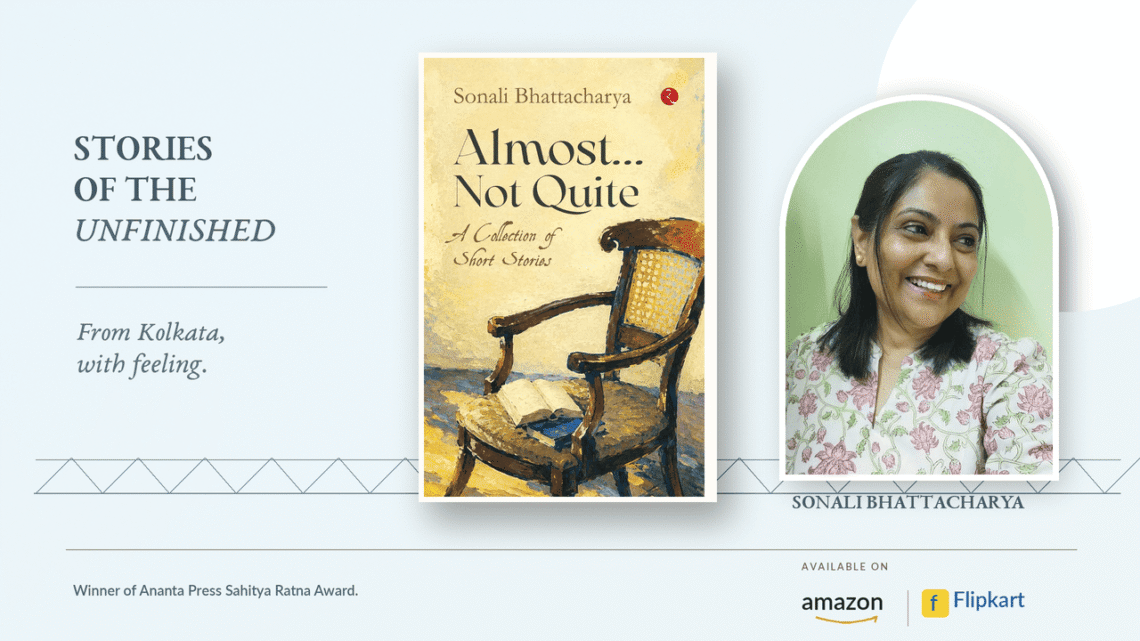
Every language holds certain emotions in a way that feels inseparable from the life of the place where it is spoken. A word can carry a history of families, neighborhoods, festivals, expectations and private disappointments that a dictionary definition will never quite reproduce. In Almost… Not Quite: A Collection of Short Stories, Kolkata-based writer Sonali Bhattacharya builds her central idea around one such expression: na pawa. It refers to something deeply longed for but never really received, yet its resonance exceeds the simple fact of not obtaining a wish. It can suggest remembrance, tenderness, frustration, ache, acceptance and an ongoing relationship with a possibility that has slipped away. This is a compelling starting point for fiction because it makes culture the means of discovering a shared human feeling, not an obstacle to it.
The collection gathers twenty-four stories set against Kolkata and towns across West Bengal. That regional grounding matters. A city becomes part of our emotional vocabulary long before we consciously begin telling stories about it. Streets may hold the memory of those who once walked beside us; a family house can represent more than architecture; a journey away from a hometown can feel like an expansion and a diminishment at once. Kolkata, with its layered histories and strong traditions of discussion, art, education and family life, provides a meaningful setting for questions of aspiration and belonging. Yet the book’s interest in towns beyond the metropolis signals that its emotional map is wider than one urban identity.
What makes na pawa an especially expressive concept is its refusal to force experience into the binary of success and failure. Consider the desire to return to a home that no longer exists in the same form. One may have prospered elsewhere, made friends and built a satisfying life, yet the old wish may remain. Was the move a success or a loss? Perhaps both. Or consider an ambition passed quietly from parent to child. A dream may never be completed by its original owner, but the longing can affect choices, opportunities and relationships across generations. Such experiences are familiar to many Indian families. They are also recognizable in every culture where migration, duty and changing circumstances influence what a person is able to pursue.
Bhattacharya’s work is particularly well situated to explore the conversation between traditional values and modern expectations. Her fiction, as described in her author profile, attends to contemporary Indian life and its everyday contradictions. These contradictions rarely appear as straightforward contests between an enlightened present and an outdated past. Family traditions can support a person while also limiting a cherished possibility. Career opportunities can create independence while demanding distance from home. Changing social roles may open doors at the same moment they complicate relationships with earlier generations. The emotional residue of these negotiations is exactly where the phrase na pawa becomes useful. It gives people a way to acknowledge what was sacrificed without denying what was gained.
The author’s own experience adds another layer of interest. A Jadavpur University engineering graduate with almost three decades in the technology industry, Bhattacharya has inhabited a professional world associated with rapid development and global connections. Her storytelling, by contrast, pays attention to emotional continuities that do not disappear because society modernizes. This contrast is not a contradiction; it is a recognizable condition of contemporary Indian life. People may lead international teams, work with the newest systems and communicate across time zones while still carrying an old school friendship, a family expectation or an unspoken regret from a particular lane in a particular city. The past does not vanish when the tools of the present become more sophisticated.
There is considerable literary value in letting a local expression remain visible rather than replacing it with a generic English label. Translating na pawa simply as “regret” would narrow its meaning. Regret sometimes implies a mistake for which one feels responsible. Na pawa may concern something no one could have controlled. “Disappointment” sounds too immediate for a feeling that can endure for decades. “Loss” often implies previous possession, while the book explicitly makes space for things never held in the first place. By keeping the Bengali phrase at the heart of an English-language collection, Bhattacharya invites readers into a more precise emotional vocabulary. A local word becomes a shared tool for understanding experiences that may have lacked a name.
The fact that the book draws on twenty-four stories also serves its regional purpose. One tale, however sensitive, could only portray a limited corner of society. A collection has room to acknowledge that the meanings of home, duty, opportunity and belonging differ across generations and circumstances. We should not assume specific plots or social groups beyond the published description, but the stated range of longings already points toward a diverse emotional field: memories of love, belated dreams, inaccessible homes and aspirations that take another form. This approach can keep regional writing from becoming an exercise in picturesque description. Bengal is not simply scenery to be admired; it is a lived context in which decisions are made and their consequences are felt.
One of the most attractive elements of the book is the three-part journey from The Echoes to The Storm to The Harvest. These titles feel at home in a collection about place and memory because they describe different relationships with time. An echo arrives from somewhere behind us, a storm overtakes the present, and a harvest requires seasons of waiting before we discover what remains. The movement offers a sense of emotional weather without imposing a strict timetable for recovery. One person may carry an old echo for years; another may reach a harvest only after the meaning of a loss has changed. The structure asks readers to consider how longing evolves rather than imagining that one decisive act can eliminate it.
For readers outside West Bengal, there is an opportunity here to encounter specificity without needing to treat the book as a cultural lesson. The strongest regional fiction does not explain every custom as if its audience were visiting an exhibition. It trusts that people can recognize fundamental emotions through particular lives. A reader in Delhi may associate na pawa with a childhood neighborhood that disappeared. A reader in London may think of a language no longer spoken daily. Someone in a small town anywhere might recognize the future they gave up to remain close to family. Each reader’s example will differ, and that difference is precisely why the local expression can travel so far. The book offers a point of connection rather than a claim that all experiences are identical.
It is important, however, not to romanticize unfulfilled longing simply because it is beautifully named. Absence can arise from painful inequality, restricted opportunities or decisions made under pressure. A dream that never came true may have been denied rather than freely relinquished. The book’s central premise becomes most meaningful when it allows such distinctions to remain. Its suggestion that na pawa sometimes shapes identity need not imply that deprivation is desirable. Recognizing a capacity for growth after disappointment is very different from declaring disappointment necessary for growth. This distinction gives readers a more responsible and substantial way to approach the collection’s hopeful undertone.
Bhattacharya’s earlier books, Safety Pin and The Broken Bridge, are described as part of her continuing interest in people and relationships. Almost… Not Quite extends that interest through a sharply defined emotional theme. The title speaks quietly, but its scope is ambitious: it asks readers to think about the difference between the externally visible biography and the invisible history carried inside it. On paper, we can list where someone studied, worked, married or moved. We cannot easily list the affection that was never expressed or the path that might have been taken. Fiction can acknowledge those missing lines without turning them into statistical data or moral verdicts.
A collection like this may be particularly welcome to readers of Indian literary fiction who want familiar emotional territory examined with a fresh vocabulary. It also speaks to the diaspora, to people navigating distance from their childhood communities and to anyone curious about how a place continues to live within someone after they have physically left it. Its ambition is intimate rather than monumental. The questions it raises are close to daily life: What does belonging mean when return is impossible? Can gratitude exist beside regret? Does an unfinished wish always need to be fulfilled to matter? These are the sorts of questions that reward reflection long after a short story ends.
Almost… Not Quite proposes that a Bengali feeling can become a doorway into a universal conversation. Its distinctiveness lies in the combination of regional roots, modern social awareness, the breadth of twenty-four stories and an emotionally nuanced understanding of what “not receiving” can mean. The collection does not need to make Kolkata stand for the whole world. Its value is in showing how one place, one language and one carefully considered phrase can help readers everywhere recognize something within themselves. If you enjoy fiction that lets culture deepen human experience rather than merely decorate it, Bhattacharya’s book is a meaningful title to put on your reading list.
Amazon purchase link: https://amzn.in/d/0bpjpD81