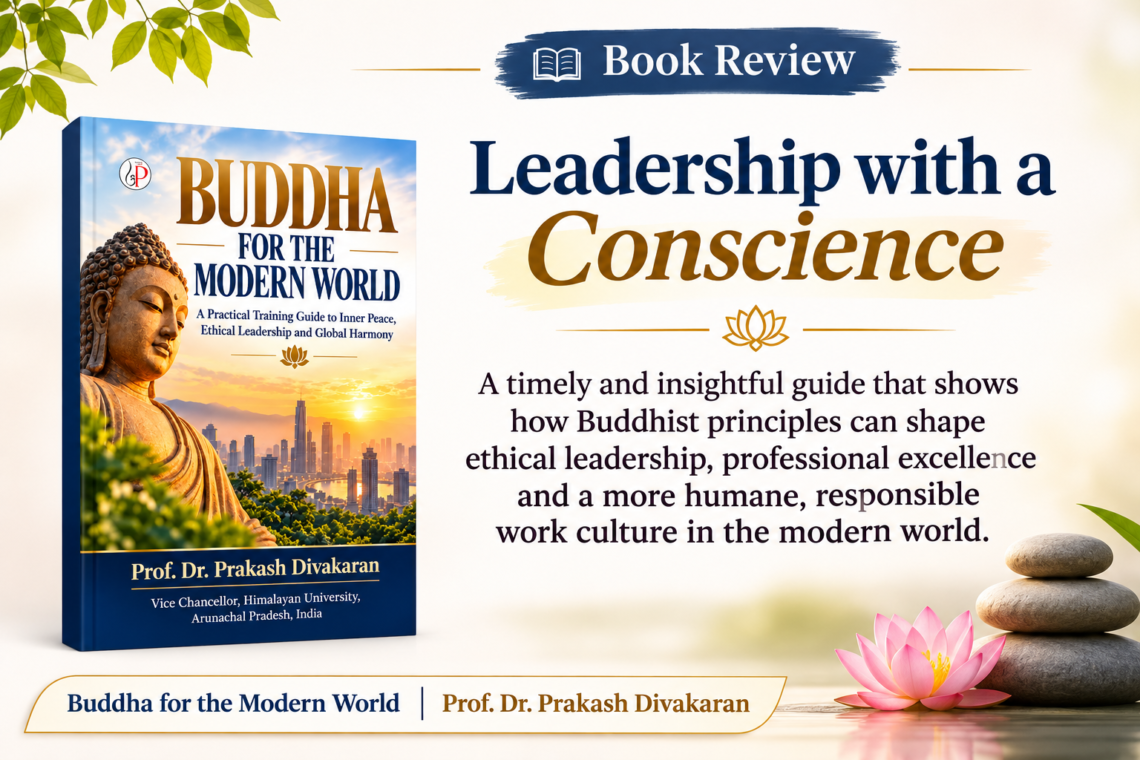
Buddha for the Modern World | Prof. Dr. Prakash Divakaran
What distinguishes a capable manager from a genuinely wise leader? Business education frequently answers through discussions of strategy, performance, efficiency and organizational growth. These are important, but they do not fully address how power is exercised, how difficult decisions affect people, or what happens when ambition becomes detached from ethical judgment. Prof. Dr. Prakash Divakaran’s Buddha for the Modern World offers an unusual response to this gap. Although its subject is the application of Buddhist wisdom to contemporary life, a significant portion of its thirty-eight chapters is concerned with leadership, communication, work, organizational ethics and sustainable responsibility. Its professional relevance is strengthened by the author’s background, described in the manuscript as including more than three decades across industry and higher education. The volume approaches leadership not solely as a collection of management techniques, but as a practice requiring attention, character and responsibility.
Leadership begins before the meeting
The book’s argument for ethical leadership is established well before its dedicated organizational chapters. Right View, for instance, asks people to investigate circumstances rather than allow immediate assumptions to become unquestioned conclusions. This has considerable significance for decision-makers. A leader may receive an incomplete report, interpret a colleague’s silence as agreement or mistake a delayed response for incompetence. In each instance, the judgment might seem reasonable within the leader’s existing narrative while remaining poorly supported by evidence. Bringing a more reflective approach to such moments can improve the quality of inquiry. The author links clear perception with responsible action, suggesting that the professional consequences of mistaken judgment can extend to many people. This is a compelling starting point because leadership is not only the ability to express decisions confidently; it is also the willingness to reconsider the understanding upon which those decisions depend.
Communication as organizational infrastructure
The chapter on Right Speech provides a practical foundation for a healthy professional culture. Organizations depend upon the transmission of information. If employees fear reporting problems, if colleagues embellish claims to protect themselves, or if criticism becomes a form of public humiliation, the quality of information deteriorates. Divakaran’s emphasis on truthful, considerate and useful speech addresses these problems at the level of daily communication. A manager can give clear feedback while avoiding unnecessary insult. A colleague can raise a concern without resorting to gossip. A team can discuss an error without making an immediate search for somebody to blame. Although the principles are simple to describe, applying them consistently when results are disappointing demands considerable discipline. The book’s exercises and reflection prompts are helpful because the subject is treated as an ongoing practice rather than an abstract statement of organizational values.
The professional significance of Right Livelihood is equally substantial. Work consumes a significant portion of adult life, and decisions made in pursuit of income can produce consequences far beyond the household that receives it. The chapter invites consideration of whether the nature of work and the methods used to conduct it are compatible with ethical responsibility. This provides an important counterweight to narrow definitions of success based only on compensation or advancement. A reader may consider whether a product causes foreseeable harm, whether a sales claim is accurate or whether an employment practice treats workers fairly. Such reflection is not always simple: people face economic obligations, competing interests and imperfect alternatives. A valuable feature of the author’s approach is the broader invitation to improve actual decisions rather than merely express moral ideals. Professionals can engage with questions of integrity even when the circumstances do not offer an immediately perfect answer.
The Four Noble Truths as a management lens
The interpretation of the Four Noble Truths through problem-solving language is particularly well suited to a professional readership. The book presents a progression from identifying a difficulty to understanding its causes, recognizing the possibility of improvement and choosing an appropriate course of action. In management, a superficial diagnosis can lead to expensive interventions that do not address the underlying issue. A team that repeatedly misses deadlines, for instance, may not require greater individual effort if its real difficulty involves contradictory priorities, inadequate resources or unclear responsibility. Applying the author’s framework would encourage an examination of these conditions before assigning a remedy. The method is accessible because it resembles familiar management reasoning while retaining an ethical and reflective orientation. Its limits should also be recognized: the Buddhist Four Noble Truths address a much wider spiritual question than operational performance. Nevertheless, the practical analogy is illuminating when that difference is respected.
Ethics when decisions are uncomfortable
The dedicated chapters on mindful leadership and ethical decision-making extend these foundational ideas into practical organizational questions. The author encourages reflection on the effects of choices, the motives guiding them and the degree to which they serve wider interests. These concerns become most revealing when there is a cost attached to ethical conduct. An organization may face pressure to conceal a mistake, make an exaggerated promise or protect short-term performance by passing burdens to weaker stakeholders. A leader’s capacity to consider harm and truthfulness becomes significant precisely at such moments. The book gives readers a vocabulary for discussing these dilemmas and invites them to cultivate habits of reflection before a crisis. While no short checklist can settle every conflict between obligations, a structured ethical inquiry can make the relevant interests more visible. It can also create a basis for explaining a difficult decision rather than merely demanding acceptance.
The treatment of compassionate teams is a particularly welcome addition. In the comparison between early and mature stages of team development, the book distinguishes environments where mistakes are hidden or blamed from those where mistakes can be shared and examined. It notes the importance of responding consistently to concerns, including encouraging participation and avoiding punitive reactions when somebody raises an unwelcome problem. The proposed practices are not intended to become compulsory performances of mindfulness. The author explicitly recommends voluntary participation and cautions against forcing people to share or treating kindness as avoidance of difficult topics. This demonstrates a recognition that well-intentioned organizational initiatives can be undermined by unequal power. Compassion must be expressed in everyday policy, feedback and accountability, not only in ceremonial activities. Managers who wish to create greater trust will find this discussion both practical and morally instructive.
From contest to constructive dialogue
Conflict Resolution and Mediation is another chapter with immediate practical relevance. Rather than beginning with the question of which participant is wrong, the author recommends exploring the conditions that sustain the dispute. Craving, aversion and confusion are translated into recognizable patterns, such as the need to win, the desire to reject an uncomfortable situation or assumptions about another person’s motives. A structured reflection asks participants to separate facts, emotions and underlying needs before a difficult conversation. The subsequent dialogue process emphasizes preparation and a shared intention. This is useful because professional conflicts frequently involve concerns about fairness, respect and security alongside the visible operational issue. An effective process must acknowledge those concerns without losing sight of the facts. The chapter gives readers a starting framework, although serious misconduct, harassment or legal disputes may require formal procedures rather than informal dialogue alone.
Interdependence and systems thinking contribute a broader analytical perspective. The performance of a department is rarely isolated from the choices of other parts of an organization. Customer satisfaction, product quality, staffing, procurement and environmental effects interact in complicated ways. Policies introduced to maximize one measure can inadvertently reduce another. By introducing the importance of conditions and relationships, the book encourages decision-makers to look beyond immediate outcomes. The chapter on sustainable and responsible business makes this viewpoint especially pertinent. Responsible leadership involves understanding how value is created and who bears its costs. This approach challenges a simplistic separation between ethical behavior and organizational effectiveness. A reputation built through fairness and transparency may be worth more than a short-lived improvement secured through misleading conduct. The discussion is not a substitute for specialist sustainability analysis, but it provides a useful foundation for asking better questions.
As a professional resource, the book’s strongest practical feature is its training design. Comparison tables, checklists and exercises allow readers to bring material into workshops, faculty development or individual reflection. The final ninety-day plan includes reviewing decisions for truthfulness, unnecessary harm and benefit to the wider group, as well as deliberate acts of service. These are accessible starting points for managers and educators. An important limitation is that individual mindfulness alone cannot repair unfair compensation, unsafe workplaces or inadequate governance. Organizations need policies and structures that reinforce the qualities this book advocates. Readers will derive the most value by combining its reflective practices with institutional accountability and sound professional standards.
Buddha for the Modern World is therefore a noteworthy contribution to the conversation about leadership with a conscience. It invites managers, teachers, entrepreneurs and other decision-makers to develop a more comprehensive understanding of professional excellence, one in which results are considered alongside the means through which they are obtained. Its interdisciplinary organization makes traditional Buddhist ideas relevant to familiar workplace situations without requiring a particular religious affiliation. Most importantly, it insists through its practical framework that responsible leadership can begin with everyday decisions: listening when a concern is raised, checking an assumption, correcting an error honestly and considering the consequences of a policy. Professional success becomes richer when it is accompanied by clarity, restraint and concern for those affected. Divakaran’s book offers a constructive guide to cultivating these qualities.