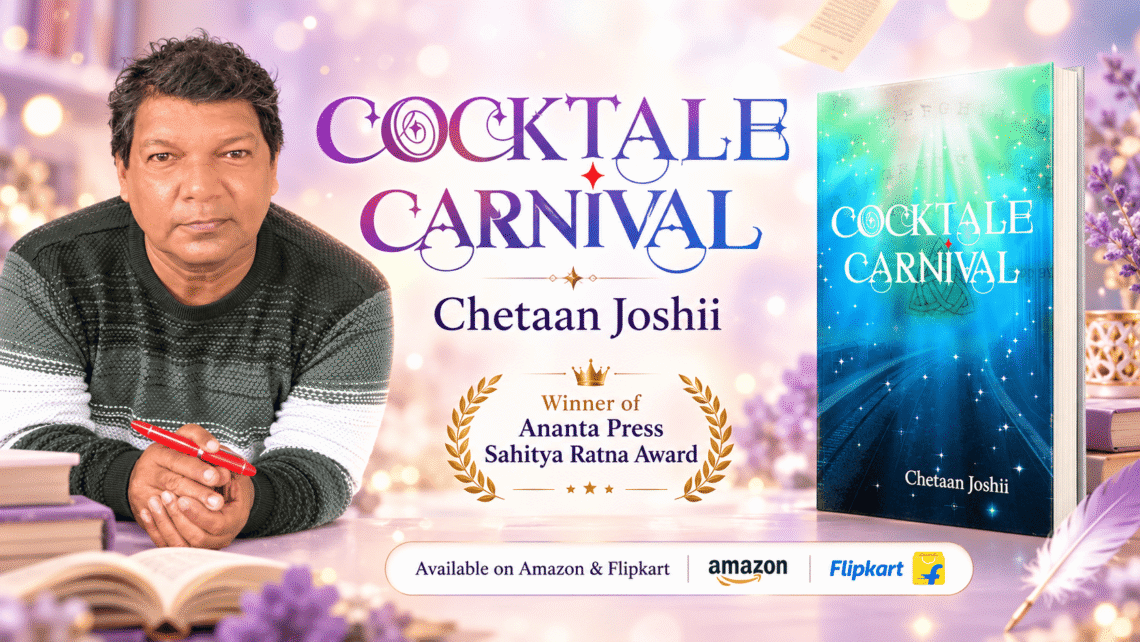
Some books are admired; some books are enjoyed; and some books manage to do both. CockTale Carnival by Chetaan Joshii belongs to the third category. It is a collection that invites the reader not into a solemn literary chamber, but into a lively, imaginative celebration. It is a book that seems to understand an essential truth about reading: people return to stories not only for meaning, but also for delight, curiosity, and emotional movement. In that sense, CockTale Carnival is wonderfully reader-friendly. It is full of unpredictable narrative flavours, and it keeps the reading experience animated from beginning to end.
What makes this book especially appealing is how effectively it speaks to the appetite of the modern reader. Many readers today seek variety. They want stories that do not all sound alike, themes that do not become repetitive, and books that can entertain without becoming trivial. This collection responds to that desire beautifully. Every tale offers a different kind of entry point. Some seem to be whimsical, some mysterious, some absurd, some touching, some possibly unsettling, and some deeply imaginative. The cumulative effect is that the reader never feels stuck inside one emotional lane. The book keeps shifting, and with every shift it renews interest.
The phrase “Stories that will shake and stir” on the cover is particularly apt. These stories do not seem designed merely to pass time. They are meant to provoke sensation and response. The reader may smile at one story, puzzle over another, feel unexpectedly moved by a third, and be caught off guard by the eerie or bizarre turn of a fourth. This emotional range is central to the book’s appeal. It creates a reading journey rather than a static reading experience. One of the pleasures of short story collections is that each story can deliver a distinct emotional impact, and CockTale Carnival appears to embrace that potential wholeheartedly.
The conceptual inventiveness of the book is one of its greatest joys from a reader’s perspective. There is an inherent charm in stories built around unusual premises. A man searching for a place that appears only sometimes, a writer entering his own story, a scientist who discovers love as if it were an element, a medium turning planchette into a murder weapon—these are the kinds of ideas that make a reader pause and think, “I want to know how this works.” That sense of anticipation is invaluable. It is what turns reading into an active act of discovery. The book seems constantly alive with such hooks.
Yet the collection’s strength lies not only in its ideas, but in the emotional dimensions behind them. A bizarre premise alone can entertain momentarily, but readers remember stories when those premises touch something human—desire, loneliness, vanity, fear, longing, creativity, or absurd hope. CockTale Carnival appears conscious of that. It promises humour and weirdness, but also pathos and surprise. That blend ensures the stories are not hollow experiments. They remain emotionally accessible. A reader can enter through the doorway of curiosity and emerge with a more resonant response.
Another highly attractive feature is the presence of humour. Literary humour can be difficult to sustain, especially when mixed with other moods, but when it works it creates great affection between book and reader. Joshii’s background suggests a long engagement with humorous writing and genre experimentation, and that spirit seems to energize this collection. Humour in such a book is valuable not just because it makes the reader laugh, but because it opens the imagination. Once a story establishes that it can be witty, irreverent, or tongue-in-cheek, it frees itself to make bold narrative moves. Readers then become more willing to follow it into unexpected spaces. This seems to be one of the secrets behind the charm of CockTale Carnival.
The animal stories mentioned in the synopsis deepen that charm further. A duckling sure he is not ugly, a peacock learning the significance of his own showmanship, and a mouse redefining the mousetrap signal stories that likely combine innocence, wit, and insight. Such tales often appeal across age groups because they operate on multiple levels. They can be enjoyed as imaginative narratives, but they can also be read as reflections on selfhood, perception, and social expectation. Their inclusion broadens the emotional and conceptual range of the collection and makes the book feel even more inclusive.
Readers who enjoy short fiction will also appreciate the pace of engagement that a book like this offers. In a novel, one often settles into a single world for an extended period. That can be rewarding, but it also requires a different kind of commitment. In CockTale Carnival, the reader receives repeated opportunities for renewal. Every story is a fresh beginning. Every premise creates a fresh question. Every tonal shift creates a fresh mood. This makes the book highly suitable not only for continuous reading, but also for leisurely reading across days. It is a book one can return to repeatedly, reading one or two stories at a time and still feel fully satisfied.
The collection also benefits from the personality of its author. Chetaan Joshii comes across as a writer deeply committed to creativity, originality, and the possibilities of language and storytelling. His broad body of work, his engagement with literature across forms, his role as a mentor, and his belief in Human Imagination all suggest a writer who sees storytelling as an adventure rather than a routine act. That spirit matters. Readers can often sense when a book has been written from habit and when it has been written from genuine curiosity. CockTale Carnival appears to belong firmly to the latter category.
There is something generous about a collection like this as well. It does not ask the reader to admire it from a distance. It invites participation. It says, in effect: come in, taste this, try that, here is something funny, here is something strange, here is something haunting, here is something tender. That open-handedness is one of the most pleasurable qualities a book can possess. It turns reading into companionship rather than performance. The collection feels designed to engage a broad spectrum of readers because it trusts the universal appeal of imagination.
What also deserves praise is the likely memorability of the stories. Collections rich in original ideas often remain in the mind because their premises are difficult to forget. One may not recall every line, but one remembers the writer who imagined a stolen heart detective or a radioactive love discovery. Such memorable invention is one of fiction’s greatest powers. It gives stories identity. In a crowded literary field, identity matters. CockTale Carnival clearly has one.
For readers who sometimes hesitate before short story collections, this book could be an especially strong recommendation because it shows how varied and immersive the form can be. For established short story readers, it offers the pleasure of encountering a writer unafraid of hybrid literary spaces. And for creative people in general, it offers inspiration: evidence that fiction still has infinite room for freshness, oddity, humour, and wonder.
In conclusion, CockTale Carnival is a genuinely enjoyable and imaginatively rich reading experience. It lives up to its promise of variety and keeps the reader engaged through surprise, wit, emotional texture, and conceptual originality. Chetaan Joshii has created a collection that celebrates storytelling in its many moods and shapes. This is a book for readers who love literary play, who appreciate range, and who value stories that can entertain the mind while also touching the heart. It is not just a collection to be read; it is a collection to be savoured.
Amazon Link:
https://www.amazon.in/dp/9382035176