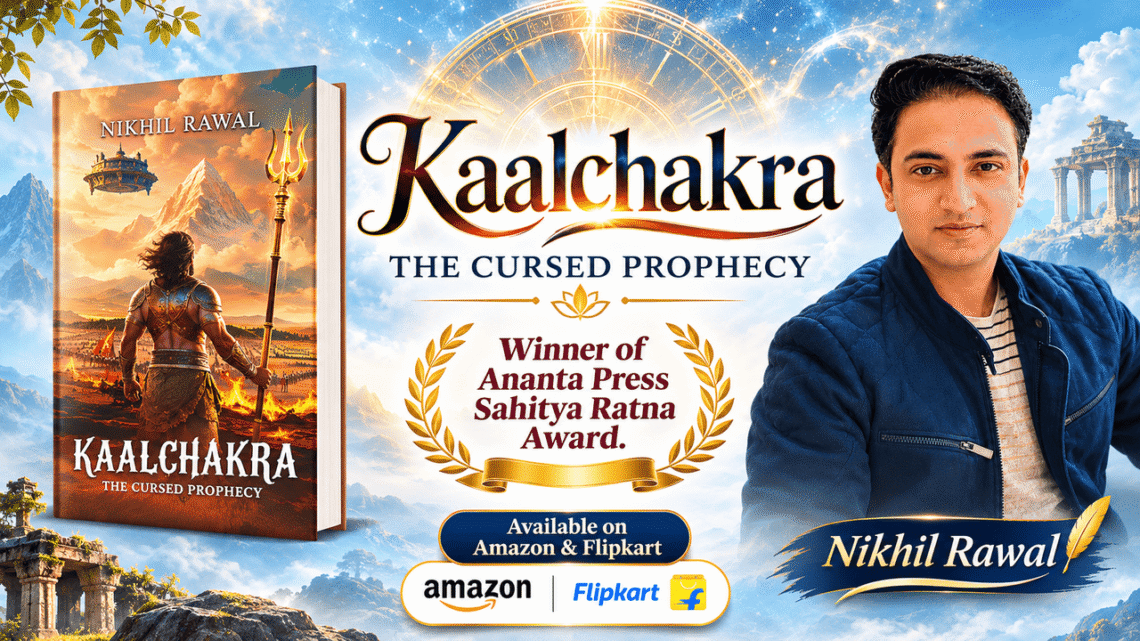
A prophecy presents a paradox. If it describes the future accurately, why should anyone struggle to change it? If it can be changed, in what sense was it destiny at all? Kaalchakra – The Cursed Prophecy places this paradox close to the heart of its appeal. Nikhil Rawal’s debut, as presented in the supplied synopsis, follows Vishwa into an inherited conflict reaching across ages, but its central question is not limited to which power will defeat another. It asks whether an individual’s choices can alter a reality apparently woven into creation itself. That makes the book an intriguing proposition for readers who enjoy speculative fiction as a place to test ideas. Mythology gives the dilemma grandeur; the protagonist’s personal losses give it urgency. Between them lies the philosophical challenge of being responsible for a future one may not have freely chosen.
It is easy to imagine fate as a script whose lines must be spoken. Under that model, a person may act, struggle, and suffer, but the result has effectively already been determined. Rawal’s premise resists the comfort of such simplicity by introducing free will alongside an ancient prophecy. The very act of asking whether Vishwa can alter the course of creation implies that his response matters. Perhaps the path is fixed but the meaning of walking it is not; perhaps a prophecy names a danger rather than a guaranteed outcome; perhaps attempting to escape the predicted event helps bring it into being. These are interpretive possibilities, not disclosures of how the unrevealed plot resolves. They show why the premise is intellectually engaging. A reader can approach the story with competing theories about time and agency, rather than merely waiting for the final battle.
The title’s cyclical image complicates matters further. A circle has no privileged starting point, and a wheel returns to positions it has previously occupied. Within a fictional universe organized around recurring ages, freedom might appear especially fragile. If entire patterns repeat, how could one person’s decision matter? Yet recurrence need not mean perfect sameness. A returning season does not grow the identical tree; a familiar moral crisis may be faced by someone who has learned from an earlier failure. This distinction is important because it shifts attention from controlling time to inhabiting time. Even in conditions that cannot be escaped, people may remain capable of choosing whether to protect, betray, endure, forgive, or resist. Kaalchakra’s premise invites the reader to examine the difference between freedom over circumstances and freedom within them.
Karma adds a second dimension to that inquiry. In popular conversation, karma is sometimes reduced to a simple mechanism in which reward follows goodness and punishment follows wrongdoing. Its philosophical associations are more complicated, involving action, consequence, intention, and responsibility. The synopsis lists karma among the novel’s central concerns, which makes sense in a story about an individual confronting the consequences of a legacy older than himself. Does responsibility travel through generations? Can an inherited burden be rejected? Must a person repair damage that was not personally caused? A narrative of prophecy and bloodline is especially well equipped to dramatize these questions. Its hero may be shaped by what came before him while still being judged by the choices he makes now.
Vishwa’s profession as an ordinary businessman adds an appealing tension to this philosophical scenario. In everyday work, people act on plans, estimates, contracts, risks, and expected outcomes. They assume that decisions influence results, even when uncertainty remains. The revelation of a cosmic prophecy threatens this assumption. If reality follows a prewritten design, the tools by which Vishwa once understood cause and effect may no longer seem sufficient. That disruption allows the extraordinary story to question habits of ordinary life. How much control do people really possess over families, fortunes, relationships, and time? A speculative tale gains force when its impossible events expose assumptions that readers recognize in their own decisions. The jump from business to cosmic responsibility is thus more than a change in scenery; it is a change in the scale of uncertainty.
The author-supplied poem The Wheel of Time makes this tension unusually explicit. Its concluding movement places an immortal figure before a choice that cannot be settled by longevity alone. The poem states, “every choice decides what we shall be,” a concise formulation of its ethical vision. The speaker may not control the wheel, but the speaker can still answer it. It is a useful distinction between destiny as a surrounding condition and character as an enacted response. The poem also imagines an opposing will that seeks to end creation because its corruption seems intolerable. That idea invites a philosophical challenge: when does the wish to eliminate suffering become a refusal of life itself? The poem does not establish the novel’s entire plot, yet it offers direct evidence of the questions Rawal associates with his fictional universe.
Immortality is perhaps the most provocative of those questions. Supernatural stories frequently offer endless life as the ultimate reward, allowing a hero to rise above mortality. But an immortal existence can also undermine familiar sources of meaning. Human urgency grows partly from limitation: relationships must be tended now, opportunities cannot always be postponed, and love becomes precious because it can be lost. Remove the boundary of death and one may discover that time is not merely something to possess. It is something through which commitments acquire weight. The poem’s voice treats endless existence as a burden rather than uncomplicated triumph. When that perspective sits beside the synopsis’s themes of immortality and sacrifice, the resulting premise asks whether there are moments when relinquishing power would require greater courage than keeping it.
Sacrifice, accordingly, need not be read as the opposite of freedom. It can be freedom expressed through a painful commitment. If an individual knows the cost of a decision and nevertheless chooses it for another’s sake, the act resists the notion that circumstance alone defines character. Yet sacrifice can also be demanded by manipulation or by an inherited duty that leaves no real room for consent. That ambiguity is what makes the word worth exploring rather than merely praising. The description of Kaalchakra promises a protagonist who must decide whether fate is unavoidable. A thoughtful reader may therefore ask a sharper question: what distinguishes an act that is freely offered from one that is extracted by prophecy? The answer would matter profoundly to the emotional credibility of any climactic choice.
The conflict around Dharma adds moral urgency without necessarily making every decision simple. Protecting the balance of creation sounds like an obvious good, but the synopsis has already introduced personal suffering as part of creation. Defending the world therefore means defending something imperfect. One might wish to erase grief, prevent every loss, or stop time before the next tragedy arrives. A force promising permanent stillness could exploit precisely those desires. Against such a temptation, the moral value of life may lie not in its freedom from pain but in its openness to relationships, renewal, and unexpected goodness. This is a possible philosophical reading suggested by the poem and synopsis. It demonstrates how a conflict conventionally labeled good versus evil can contain questions about the cost of any absolute solution.
A novel with such themes may work on two levels for its audience. One reader may follow the discoveries, dangers, and imagined realms primarily for excitement. Another may finish a chapter and turn over a question about whether a person can genuinely choose a path that was foretold. These experiences need not compete. Fantasy has long been capable of making abstract questions tangible through a dangerous journey or a seemingly impossible decision. Rawal’s mythological framework provides a vocabulary of cosmic time and moral order, while the ordinary beginnings of Vishwa’s life prevent the discussion from floating entirely into abstraction. The story’s theoretical concern remains anchored in the recognizable predicament of deciding what to do after circumstances have changed without permission.
This philosophical ambition also establishes a useful limit to critical judgment. The synopsis confirms the subjects the book sets out to explore; it does not demonstrate how nuanced the conversations are, how the characters embody opposing positions, or how the eventual resolution treats uncertainty. Those qualities require the complete novel. It would be easy to confuse impressive themes with proven philosophical accomplishment. A more accurate response is to value the seriousness of the questions while leaving their full artistic treatment open for assessment. As a debut concept, Kaalchakra displays an attractive willingness to put large ideas inside a popular narrative form. That is a meaningful quality in itself, especially for readers searching for genre fiction that gives the imagination and the conscience something to do.
The lasting attraction of Kaalchakra – The Cursed Prophecy is therefore contained in a deceptively simple question: if time is already moving, what can choice still change? Rawal’s materials suggest that the answer will not be found only in power, ancestry, or victory. It will have to involve the kind of person Vishwa becomes when confronted with a responsibility greater than his wishes. The novel’s mythic design invites readers to think about destiny not merely as something written over human life, but as something against which human life continually defines itself. For anyone drawn to stories where adventure opens into philosophy, that invitation provides an unusually thoughtful reason to enter the wheel of time.
AMAZON / BOOKSTORE LINK