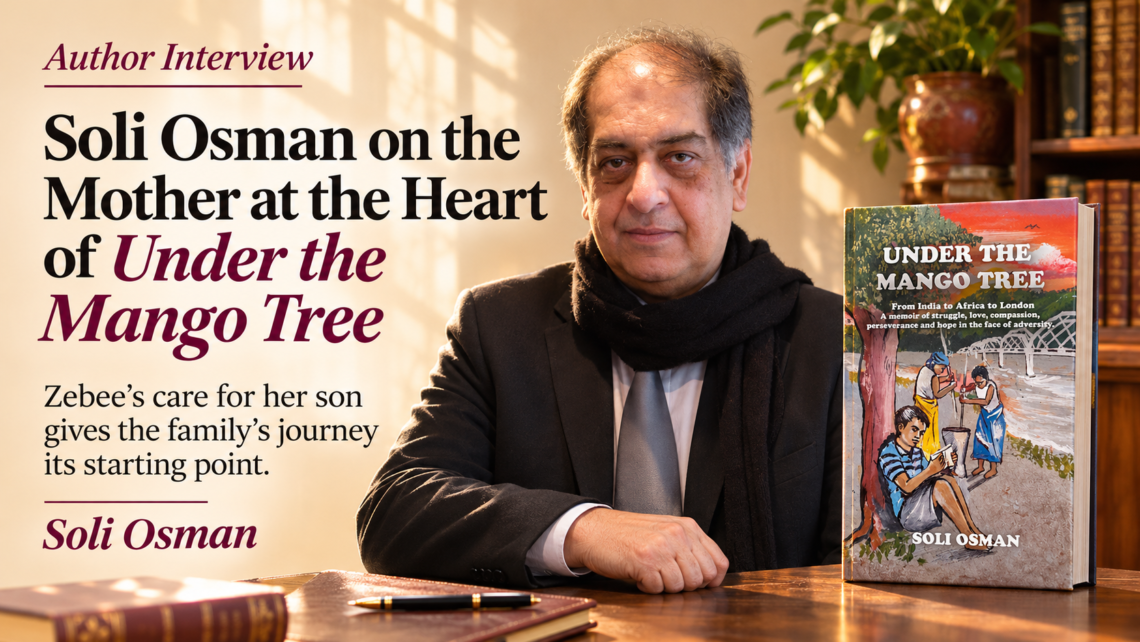
The first sound of Under the Mango Tree is the sound of a world already alive. Insects fill the night, people wait for news of a birth, and celebration gathers beneath a tree. When rain finally arrives, it carries relief for the surrounding community as well as a sense of possibility for the family. Soli Osman opens his memoir with a scene that invites us to enter a place before asking us to understand its history.
That attention to the physical world is one of the book’s lasting pleasures. The story moves across countries and through periods of serious hardship, but it repeatedly returns to things people can see, hear, taste, and hold. A train platform, a shared meal, a letter, or the warmth of a room gives memory a concrete shape. These details make the larger journey easier to follow emotionally.
A memoir told through scenes
Although the book is presented as a memoir, much of its narrative follows Zebee and Salman in the third person. It uses dialogue, described settings, and access to their thoughts to create the closeness often associated with a novel. Readers move between remembered family history and scenes of immediate anxiety, pleasure, or disappointment. This gives the book a broad storytelling character rather than the form of a brief personal record.
The approach is effective when an ordinary action carries more feeling than an explanation could. A boy watches what his mother eats. A young man studies a letter before opening it. A farewell becomes painful because a hoped-for gesture does not arrive. The emotional meaning emerges from the difference between what a person needs and what actually happens.
Salman’s departure for education abroad offers a good example. His mother’s embrace and his father’s restrained goodbye create sharply different experiences within the same event. The scene does not require a long argument about affection. The reader can feel what Salman has hoped for and understand why the absence of that reassurance continues to trouble him.
Places with texture and pressure
The African settings are particularly vivid. The Zambezi, the landscape around Chemba, the wildlife, and the routes travelled by road and rail establish a world of considerable beauty. Antonio Thuka’s outings with Salman give the child a way of learning through observation. The natural environment becomes part of his emotional education and part of what he later misses.
Yet these landscapes are not offered as an escape from social reality. Schools, shops, railway platforms, and official offices reveal who has power and who is exposed to humiliation. The combination gives the setting depth. A place can be loved for its beauty and remembered for its injustices at the same time. The memoir allows both feelings to exist together.
Britain brings a change in atmosphere. Boarding-school routines, public transport, rented rooms, libraries, and airport seating replace many of the open spaces of childhood. The shift helps readers feel Salman’s growing isolation. Weather and shelter become more than background. Cold, fatigue, and the difficulty of finding a private place affect his thinking and shape his choices.
The objects that carry a life
Letters are especially important throughout the book. They bring news, alter plans, and sometimes contain more pain than the recipient expects. They also allow Salman to manage what his mother knows about his experiences. The distance between a letter’s reassuring account and the hardship behind it becomes one of the memoir’s most effective sources of quiet sadness.
Food has a similar importance. It reveals the care within a household, the adjustments required by migration, and the vulnerability of someone with very little money. Familiar dishes can suggest comfort and belonging. An inexpensive meal can represent relief. Readers come to understand character through these modest details because eating is tied so closely to who provides, who shares, and who goes without.
The mango tree itself gains meaning through these changes of setting. It is present in the opening celebration and later becomes a place where Salman withdraws into thought. When he is far away, its absence registers. The title can be read as a connection to shelter and reflection, but the image remains rooted in the story’s actual places rather than functioning only as an abstract symbol.
A wide supporting cast
The people around Zebee and Salman give the memoir much of its range. Donna Maria brings moral clarity and knowledge of the world beyond the family. Antonio Thuka offers affection and practical wisdom. Aybee provides support while also revealing the difficult calculations facing the family in a changing political environment. Their roles help the narrative move beyond a single household’s viewpoint.
Vicky brings a different rhythm to the later chapters. Conversations, walks, meals, and shared plans create room for pleasure after long stretches of insecurity. These scenes matter because they restore ordinary possibility. Salman can begin to think about companionship and tomorrow rather than only the immediate demands of getting through the day. The emotional change is visible in the things he notices.
The memoir is also willing to leave discomfort in the picture. Family members can offer assistance while exercising control. Communities can provide support while making judgments. Salman can be sympathetic and still act in ways that trouble him. These tensions give readers more to consider than a simple division between generous people and unkind ones.
The reading experience
The book takes its time. Historical explanation and descriptions of family background sometimes interrupt the forward movement of a scene. Readers who prefer a spare memoir may find the scope expansive, and some explanatory passages tell us directly what surrounding events already suggest. A tighter treatment in those places could make individual moments stand out more sharply.
At the same time, the breadth allows the reader to spend sustained time inside this world. Its repeated concerns gradually acquire emotional force. Education means more after we have seen how difficult it is to maintain. A safe room matters more after nights of uncertainty. An affectionate welcome matters more after so many encounters in which Salman feels unwanted.
Readers are likely to remember:
- The vivid opening in Chemba and the arrival of the rain.
- The use of meals, journeys, and letters to reveal relationships.
- The change in atmosphere between childhood landscapes and insecure urban life.
- The small gestures through which friendship and love become visible.
Under the Mango Tree is a thoughtful choice for readers who enjoy immersive life writing with a strong sense of place. Its appeal lies in the accumulation of human detail across a wide journey. The book gives suffering its space, but it also preserves humour, beauty, curiosity, and affection. Those moments of ordinary life make the struggle worth following and leave the reader with people to remember, rather than only events to recall.
Find the book on Amazonhttps://www.amazon.in/UNDER-MANGO-TREE-Soli-Osman/dp/9378211313