This collection finds its most unsettling material in the borderland between folklore, trauma, evidence, and belief.
Not every haunting begins with a ghost
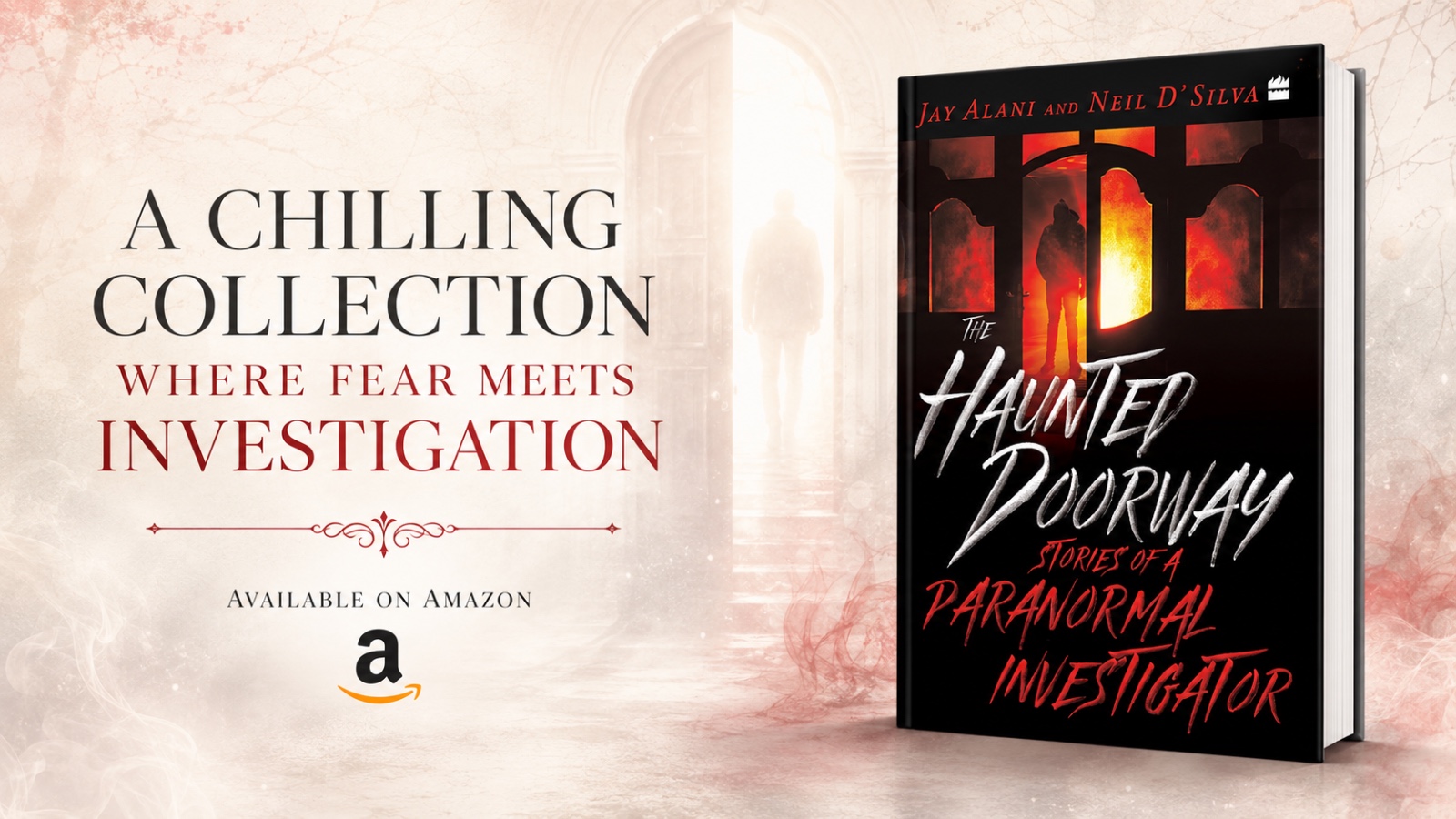
A shadow crosses a room. A person wakes unable to move. An object becomes associated with a series of misfortunes. Agrieving family hears a familiar sound. In conventional horror, these moments often serve as proof that somethingsupernatural has arrived. In The Haunted Doorway, they are beginnings rather than conclusions. Jay Alani and Neil D’Silvatreat each disturbance as a question. The collection’s ten stories are shaped by paranormal-investigation scenarios, but thebook’s real subject is interpretation: how people decide what has happened to them, how fear changes perception, and how cultural narratives fill gaps in evidence.
The paranormal and the psychological are not enemies
A major achievement of the collection is its balanced treatment of psychological explanations. The stories acknowledgethat the brain can produce vivid, terrifying experiences. Trauma can return through sensation and image. Grief can transformordinary spaces into emotionally charged environments. Sleep-related conditions can create paralysis, pressure, voices, andfigures that feel completely real. Anxiety can heighten pattern recognition until coincidence begins to feel intentional. Noneof this makes the witness weak. On the contrary, the book’s investigative perspective encourages compassion. A frightenedperson needs careful listening, not ridicule. The first responsibility is to understand what the person is experiencing and torule out dangers that can be addressed.
Why ambiguity is more frightening than certainty
Horror often loses power when everything is explained too neatly. If every case is supernatural, the reader learns the ruleand waits for the ghost. If every case is debunked, the stories become puzzles with predictable answers. The HauntedDoorway sustains interest by allowing different outcomes. Some disturbances can be approached through psychology ormaterial evidence. Others contain elements that remain unresolved. That variation creates trust. The reader senses that theinvestigator is not committed to proving one conclusion in every case. Uncertainty is preserved because uncertainty issometimes the most honest result.
Field experience gives the stories weight
Jay Alani’s biography is inseparable from the collection’s appeal. With more than fifteen years in paranormal investigationand over 1,500 investigations across different locations, he brings a large archive of observed behaviour, recurring claims,environmental patterns, emotional responses, and cultural beliefs. Fiction allows those realities to be reshaped withoutturning private cases into spectacle. It also allows multiple experiences to be combined into a story that communicates a largertruth. The result is not a case file, documentary transcript, or academic report. It is storytelling informed by fieldwork.
Neil D’Silva turns investigation into narrative momentum
Experience alone does not automatically create fiction. A story requires selection, pacing, character, escalation,atmosphere, and an ending that feels emotionally earned. Neil D’Silva’s role as co-author and storyteller is therefore central.The narratives move with the efficiency expected from popular suspense while retaining investigative detail. Exposition isgenerally attached to an active question: What is happening? Who is in danger? Which belief is controlling the situation? Whatdetail has been overlooked? This keeps research from becoming a lecture and allows each concept to intensify the plot.
The Demonic Doll and the power of an object
Readers frequently single out The Demonic Doll as one of the collection’s most frightening entries. Dolls have longoccupied an uncomfortable place in horror because they imitate human presence while remaining lifeless. They can absorbprojection: affection, resentment, guilt, memory, and fear. In a paranormal-investigation story, an allegedly dangerous objectcreates additional questions. Does the object have a history? Are people reacting to suggestion? Has a rumour changed thebehaviour of everyone who encounters it? Is someone manipulating the legend? Or is there an element that cannot beexplained by expectation alone? The story’s appeal lies in this layered unease.
Dead Man’s Fingers and the horror of the natural world
The response to Dead Man’s Fingers demonstrates how the book makes knowledge part of fear. A reader can encounter anunfamiliar term, search for it, and discover that the real world already contains forms more grotesque than invented monsters.Fungi, decay, infection, darkness, and abandoned places have biological realities that horror can use without exaggeration. Thisform of fear is especially effective because it destabilises the boundary between the ordinary and the uncanny. The thing thatlooks supernatural may be natural, but that does not necessarily make it comforting.
Cultural mythology expands the meaning of fear
The collection moves among Indian, Arabian, European, and Western traditions, demonstrating that supernatural beliefis both universal and locally specific. A spirit, witch, double, dream visitor, possessed object, or avenging presence may carrydifferent meanings across cultures. These meanings influence how a witness describes an experience and what kind of help issought. By incorporating multiple traditions, the book avoids presenting one mythology as the default. It also shows howglobal horror has become: films, podcasts, social media, family stories, religious practices, and urban legends now overlap inthe modern imagination.
A responsible challenge to superstition
The Haunted Doorway is entertaining, but it also has a corrective function. It challenges the reflex to label everydisturbing event as paranormal. That reflex can delay medical care, intensify family conflict, encourage exploitation byfraudulent practitioners, or worsen an existing mental-health crisis. A responsible investigator must be willing to say that anexperience has a possible psychological or physical explanation. At the same time, the book does not mock belief. Peopleinterpret fear through the language available to them. The investigator’s task is to separate observation from assumptionwithout humiliating the witness.
Indian horror with contemporary relevance
The collection arrives at a moment when paranormal content is highly visible through podcasts, short videos, livestreams,haunted-location challenges, and dramatised investigations. Jay Alani’s podcast Paranormal Reality, which has crossed 20million streams, demonstrates the scale of public curiosity.
That audience is not looking only for monsters; it is looking for stories, explanations, debate, and the
emotional thrill of approaching the unknown from a safe distance. The book translates that appeal into fiction while adding theintimacy of reading. The reader controls the pace, but the images continue to form privately in the mind.
Women, vulnerability, and the politics of belief
Several of the story titles highlighted by readers place women at the centre of disturbing experiences: The Woman WhoWas Molested by a Demon, The Red Lady’s Ghost, The Woman with the Stone Eyes, and Qarinah, The Wonder Witch ofDreams. These titles raise an important issue in paranormal fiction.
Women’s fear has often been sensationalised, dismissed, or interpreted through moral judgement. A responsible narrativemust examine who is believed, who is blamed, and how supernatural language can conceal violence, trauma, or socialcontrol. The investigative approach of The Haunted Doorway creates room to question the story surrounding a frightenedwoman rather than treating her distress as entertainment. Is a community using a paranormal explanation because it iseasier than confronting abuse? Is a witness being isolated by superstition? Is a myth offering symbolic language for anexperience that cannot safely be spoken? These questions give the collection contemporary relevance. Horror becomes morethan the appearance of an entity; it becomes an examination of power, credibility, and the cost of refusing to listen.
Final verdict
The Haunted Doorway goes beyond jump scares because it understands that fear is not an isolated sensation. It isconnected to culture, memory, bodily experience, social pressure, unresolved grief, and the human need to explainuncertainty. The book’s best moments do not force a conclusion; they place rational inquiry and supernatural possibility inthe same room and let the tension grow between them. Readers seeking Indian horror that is accessible, varied, andpsychologically aware will find much to appreciate. It is a collection that can unsettle the believer, intrigue the sceptic, andremind both that certainty is often the least interesting doorway.
Buy Now: https://www.amazon.in/Haunted-Doorway-Stories-Paranormal-Investigator/dp/936989652X