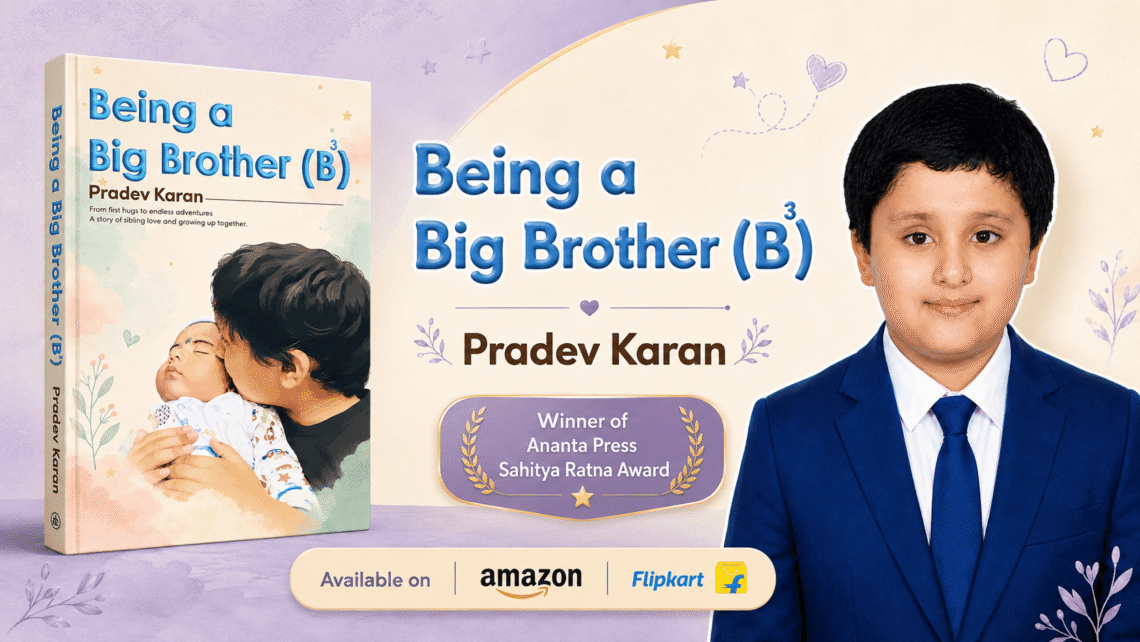
The most striking fact about Being a Big Brother is not simply that its author, Pradev Karan, is eleven years old. It is that he uses authorship to claim ownership of his own experience. Instead of waiting for an adult to interpret his childhood, he writes it himself. Instead of choosing an imaginary hero, he examines the role he knows intimately: that of an elder brother. This decision gives the book a rare freshness and makes it an important contribution to writing by young people.
Children are natural storytellers. They recount incidents with dramatic detail, repeat family jokes, invent explanations, and notice things adults overlook. Yet published accounts of childhood are often filtered through adult memory. Adults write about what childhood used to feel like, or they create child characters according to adult ideas of innocence, difficulty, or growth. Pradev’s book offers something different. His voice comes from inside childhood. The events are not distant memories but part of a life still unfolding.
This immediacy is central to the book’s appeal. The experience of becoming a big brother is not treated as one dramatic moment followed by a neat conclusion. It is a continuing education in relationships. A younger sibling changes how an older child sees himself. He may become protector, companion, helper, competitor, teacher, and friend, sometimes within the same day. Pradev’s stories of family adventures, disagreements, funny incidents, and ordinary memories capture this shifting identity. He is learning what brotherhood means by living it.
The book’s nonfiction form is significant. At a young age, many writers are encouraged to begin with fantasy because imagination is considered the natural territory of children. Pradev certainly possesses imagination, but he directs it toward observation. He recognises that real life contains stories worth preserving. This is an artistic choice as much as a personal one. To write nonfiction well, an author must select moments, understand why they matter, and communicate their emotional meaning. The everyday world becomes literature through attention.
That attention is evident in the book’s emphasis on small moments. Family life is made of details that can appear unimportant from the outside. A brief disagreement, a shared journey, a laugh, or a caring gesture may last only minutes, yet shape how people understand one another. By writing these experiences down, Pradev demonstrates an instinct for emotional significance. He invites readers to reconsider their own lives and ask which ordinary moments have quietly changed them.
The author’s youth also creates a valuable relationship with young readers. A child who sees another child’s name on a book cover receives a powerful message: writing is not reserved for adults. Publication is not a distant possibility available only after decades of education. A young person can observe, reflect, revise, and contribute now. Pradev’s achievement therefore has an inspirational dimension beyond the content of the book. It expands what children may imagine for themselves.
Yet the book’s importance should not be reduced to the novelty of a young author. Age attracts attention, but the work’s lasting value comes from its sincerity. Being a Big Brother engages with themes that matter at every stage of life: love, responsibility, empathy, patience, conflict, resilience, and belonging. The child’s perspective does not make these themes smaller. It makes them immediate. Adults may use more sophisticated language to discuss relationships, but children experience those relationships with equal intensity.
Pradev’s voice appears to be one of the book’s defining qualities. It is described as simple, genuine, playful, and emotionally direct. Such a voice is appropriate not only because of the author’s age but because of the subject. Family memories can lose their warmth when expressed in language that is overly formal or self-conscious. A straightforward style allows affection and humour to emerge naturally. It creates the impression of a young person speaking to the reader rather than performing for the reader.
This authenticity may be especially meaningful to parents. Adults often want to understand what children think but may unintentionally guide their answers. A book written independently by a child provides a less controlled view. It can reveal how children organise memories, what they consider important, and how they interpret family relationships. Parents reading Pradev’s work may become more curious about the untold stories within their own homes.
The book also challenges the assumption that childhood writing must be perfect to be valuable. The power of a young voice lies partly in its openness. Children are still forming their views of the world. They ask direct questions, admit strong feelings, and move quickly between seriousness and humour. Rather than smoothing away these qualities, Being a Big Brother celebrates them. It presents growth not as a finished product but as an active process.
Pradev’s background as a student and community volunteer enriches this process. His involvement in awareness programmes and community initiatives has exposed him to ideas of service, protection, compassion, and leadership. These experiences likely strengthen his ability to notice the needs of others, while his family environment has encouraged education and purpose. Still, the book’s achievement remains his own: he transforms those influences into a personal narrative about siblinghood.
The presence of his younger sister, Preetha, as the central inspiration gives the work emotional clarity. The book is not an abstract discussion of brotherhood. It emerges from one particular bond. That specificity makes the themes more universal, not less. Readers connect with broad ideas most strongly when they are embodied in real relationships. Pradev’s affection for his sister, along with the challenges of growing beside her, becomes the pathway through which readers consider their own families.
From a literary perspective, the book belongs to a valuable tradition of autobiographical childhood writing. Personal narratives help individuals understand themselves by arranging experience into story. For a young writer, this can be an especially powerful act. Writing creates distance from an emotion without denying it. A disagreement can be reconsidered. A happy memory can be preserved. A lesson can be recognised. The author becomes both participant and observer.
This dual position gives Being a Big Brother an educational purpose that never feels imposed. Children can learn about empathy because they see it develop through experience. They can understand responsibility because it is connected to a relationship. They can recognise resilience because the family continues through difficult moments. The lessons are persuasive because they emerge from life rather than being attached at the end of a fabricated tale.
The book can also inspire creative activities. Young readers may begin journals about family life, write letters to siblings, record a meaningful memory, or describe a time they changed their mind. Schools can use Pradev’s example to celebrate student voices and encourage nonfiction writing. Parents can invite children to tell stories in their own words without correcting every detail. In each case, the book becomes more than something to read; it becomes permission to speak.
Being a Big Brother is unique because it joins personal affection with creative courage. Pradev Karan does not present childhood as preparation for a more important future. He shows that childhood already contains stories worth publishing and ideas worth hearing. His debut book honours his sister, reflects on his own growth, and offers other children a visible example of what their voices can accomplish. It is a warm family narrative, but it is also a statement about authorship: experience belongs to the person who lives it, and even the youngest among us can transform that experience into meaningful literature.
Purchase the book on Amazon: https://amzn.in/d/0bT3hytF