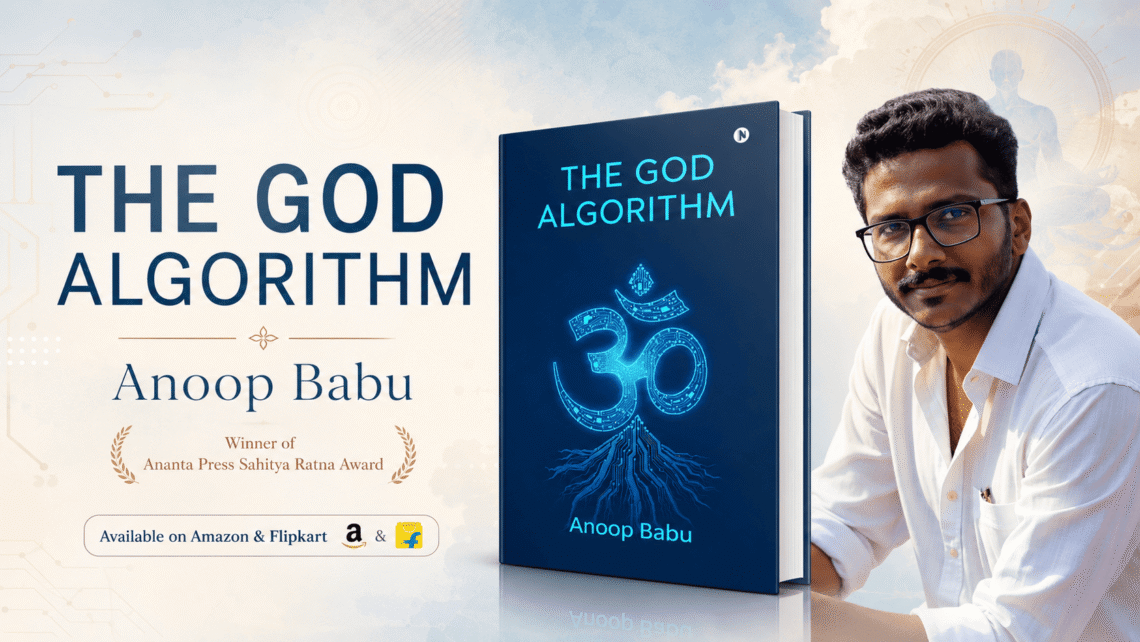
THE GOD ALGORITHM | Anoop Babu | Fiction (General)
Every significant literary innovation eventually raises the same uneasy question: does the new method deepen human expression, or does it merely advertise novelty? The God Algorithm by Anoop Babu enters this question directly because artificial intelligence is both part of the novel’s subject and part of its creative history. The book is described as a collaboration between a human author and an AI co-author, while its story explores whether ancient human wisdom and new machine intelligence can—or must—work together to navigate a dangerous future. This alignment between form and content gives the novel a rare conceptual coherence. It does not discuss human-AI collaboration from a safe distance. It performs the collaboration it asks readers to examine.
That makes The God Algorithm more than a techno-thriller with philosophical decoration. It is also a literary experiment about authorship, agency, and the future of storytelling. The human author brings biography, cultural memory, moral concern, intention, and lived experience. The AI brings computational patterning, linguistic generation, rapid association, and the strange capacity to reflect vast amounts of human-produced language without possessing a human life. Their interaction creates a text that asks readers to consider where meaning comes from. Is meaning located in the sentence, in the creator’s intention, in the reader’s response, or in the ethical process through which the work is shaped?
The title captures this ambiguity brilliantly. An algorithm is often understood as a procedure for producing an outcome. God, by contrast, is associated with ultimate origin, purpose, knowledge, and moral order. To join these terms is to ask whether procedure can become purpose and whether calculation can claim authority over values. It also hints at a modern temptation: when a system becomes sufficiently complex, people may treat its outputs as revelations. “The algorithm decided” can sound like an explanation even when it hides human choices about data, design, ownership, and deployment. The novel’s title therefore turns a technical word into a theological and political problem.
The narrative premise intensifies this problem by bringing a set of historically resonant human archetypes into a contemporary college. The saint, scientist, poet, warrior, rebel, ascetic, and non-violent resistor represent different modes of knowing and acting. None is reducible to data. The saint may understand compassion through spiritual discipline. The poet may perceive emotional truth through metaphor. The scientist may demand testable evidence. The rebel may recognize injustice before institutions admit it. The warrior may act when hesitation becomes dangerous. The ascetic may expose the role of desire. The non-violent resistor may insist that the means used to secure a future become part of that future.
Artificial intelligence confronts these temperaments with an uncomfortable mirror. AI can imitate poetic style, summarize scientific knowledge, model strategic conflict, reproduce spiritual language, and generate arguments for rebellion or peace. Yet imitation is not equivalent to commitment. A machine can produce a sentence about sacrifice without being capable of sacrifice. It can calculate consequences without fearing death. It can describe injustice without suffering humiliation. The God Algorithm appears interested in the gap between linguistic competence and moral existence. That gap is one of the defining questions of the AI era.
At the same time, the novel’s collaborative origin prevents it from dismissing machine intelligence. Anoop Babu does not stand outside AI and condemn it as alien. He works with it. This is an important ethical and creative stance because it replaces abstract panic with practical encounter. Collaboration requires selection, correction, direction, and judgment. It reveals both possibility and limitation. An AI system may generate unexpected connections, but the human collaborator must decide whether those connections are meaningful, responsible, and consistent with the work’s purpose. The process can therefore become an education in authorship rather than an escape from authorship.
The author’s background makes this experiment especially appropriate. Babu’s professional life as a Senior Auditor in Kerala’s Department of Cooperation is grounded in accountability, structure, evidence, and careful examination. His literary life began in Malayalam poetry, a form associated with compression, emotion, rhythm, and cultural memory. These two identities—auditor and poet—already place him at the meeting point of system and imagination. AI collaboration extends that duality. The God Algorithm can be understood as the work of a writer accustomed to asking both whether a structure functions and whether it means something.
The book’s philosophical foundation is equally important. Its engagement with Indian thought, especially the moral and existential concerns associated with the Bhagavad Gita, offers a counterweight to purely technological narratives. The Gita is centrally concerned with action, duty, confusion, consequence, selfhood, and the search for right direction amid crisis. These concerns translate naturally into a story about AI power. The problem is not simply whether an action can be performed, but whether it should be performed, by whom, in what spirit, and with what responsibility for the result. In this sense, the novel’s ancient references are not nostalgic ornaments. They are tools for examining modern agency.
The techno-thriller structure gives these questions urgency. Philosophical reflection can become abstract when no decision is required. A thriller forces choice. Time narrows, stakes rise, information remains incomplete, and characters must act without certainty. That is precisely the environment in which moral principles reveal their strength and weakness. A commitment to non-violence is easy in comfort and difficult under threat. Faith in reason is easy when evidence is clean and difficult when systems can manufacture convincing falsehoods. Detachment is easy as an idea and difficult when people one loves are endangered. The genre framework therefore serves the philosophy rather than distracting from it.
Mar Athanasius College of Arts provides a contained environment in which the collaboration of ideas can be dramatized. A campus is itself a hybrid system. It contains hierarchy and rebellion, tradition and experimentation, individual ambition and collective identity. Students learn from formal syllabi, but their deepest education often comes through relationships and conflict. By beginning with a small group and expanding toward a decision affecting humanity, the novel emphasizes the scale-changing power of ideas. Global futures are often determined by choices first made in ordinary rooms among people who do not yet understand their historical significance.
One of the most interesting implications of the book is that AI may force humanity to define what it has previously taken for granted. When machines could not write plausible prose, creativity seemed easy to identify. When they could not generate images, artistic production appeared uniquely human. When they could not converse, language felt like sufficient evidence of mind. As those boundaries become less stable, the question changes from “What can machines do?” to “What do humans value about doing?” The God Algorithm contributes to this discussion by placing human traditions of wisdom beside computational capability. It suggests that speed, scale, and fluency do not automatically produce direction.
The collaborative method also makes the reader an evaluator. Some readers may approach AI-assisted literature with excitement; others with suspicion. Both responses are useful. The novel can encourage readers to notice voice, coherence, emotional truth, philosophical depth, and ethical framing more consciously than they might in a conventionally authored work. Instead of accepting or rejecting the book solely because AI participated, the reader can ask better questions: Does the story create genuine reflection? Are its characters alive beyond their concepts? Does the collaboration expand the author’s vision? Is accountability clear? These are literary questions, not merely technological ones.
The book’s originality lies in refusing to separate the debate about AI from the act of creating with AI. Many novels predict a future relationship between humans and machines. The God Algorithm participates in that relationship now. Many books invoke ancient wisdom to criticize modernity. This novel seeks a conversation rather than a simple opposition. Many thrillers use technology to create danger. Here, technology also creates the book. These layers give the work an unusual self-awareness.
Naturally, experimental fiction must still succeed as fiction. A concept cannot replace emotional engagement, and an innovative production method cannot excuse weak storytelling. The novel’s promise depends on whether the human characters retain complexity, whether philosophical dialogue emerges naturally from conflict, and whether suspense grows from meaningful choices. Yet the premise is designed to support these demands. The ensemble of contrasting temperaments creates conflict; the campus creates intimacy; the AI threat creates urgency; the philosophical traditions create depth.
The God Algorithm deserves attention because it stands at a genuine cultural threshold. It is a book about a civilization deciding how to relate to intelligence it has built but may not fully understand. It is also an example of an author deciding how to use that intelligence without surrendering human purpose. By making its method part of its message, the novel becomes a conversation not only between characters, or between past and future, but between two kinds of creative agency. The most important achievement of this approach is not that it proves AI can write. It is that it asks what humans must continue to choose.
Purchase on Amazon: https://amzn.in/d/0h5eoaSK