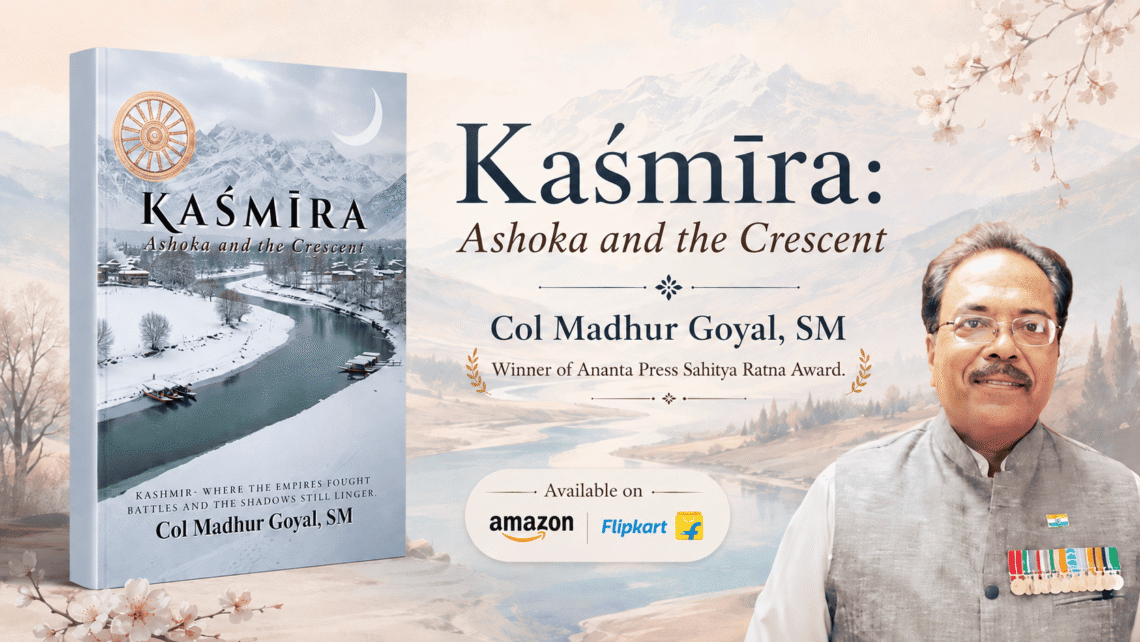
Book: Kaśmīra: Ashoka and the Crescent | Author: Col Madhur Goyal, SM
Kaśmīra: Ashoka and the Crescent becomes especially distinctive when read through the background of its author. Col Madhur Goyal, SM is not approaching Kashmir only as a commentator looking at maps, documents and headlines from a safe distance. His Army career placed him in some of the most demanding operational environments associated with India’s security history, including counter-insurgency duties, Siachen and multiple tenures in Kashmir. In 2002, during an anti-terrorist operation in Budgam district, he was awarded the Sena Medal for Gallantry. That experience gives the book a particular perspective: Kashmir is simultaneously history, terrain, strategic problem and lived memory.
This matters because military geography is often misunderstood by general readers. On a political map, distances seem manageable and borders appear as clean lines. On the ground, especially in the Himalayas, a few kilometres can involve altitude, glaciers, unstable weather, narrow approaches and immense logistical difficulty. Kaśmīra begins with the physical land before moving into political history, which is exactly the right order for a work that later enters Siachen, Aksai Chin, Kargil and other theatres where geography dictates possibilities.
The chapter concept of the “Frozen Battlefield” is one of the strongest examples. Siachen has become synonymous with high-altitude soldiering, but the phrase can become abstract unless the reader understands what survival at such heights means. In the book’s framing, soldiers confront an environment in which frostbite, avalanches and severe cold can be as dangerous as an armed adversary. This reorients the reader’s understanding of war. Courage is not limited to moments of direct combat. It also includes endurance: maintaining a post, moving supplies, remaining alert, protecting equipment and keeping the human body functioning in a place fundamentally hostile to ordinary life.
A veteran author’s perspective is particularly valuable here because it naturally draws attention to the soldier behind the strategic vocabulary. “Deployment,” “sector,” “front,” “line” and “operation” are terms that can sound impersonal. But every one of them contains individuals dealing with fear, fatigue, separation from family and uncertainty. Col Goyal’s broader autobiographical writing speaks repeatedly about how soldiering shapes identity and how memories of fallen comrades remain long after operations end. Kaśmīra carries that sensibility into a wider history of the region. Even when discussing national strategies, the human cost remains close to the surface.
The book also understands that Kashmir’s military story did not begin or end with one campaign. It moves through the conflict of 1947, the wars of 1965 and 1971, the militancy that intensified from 1989, the Kargil War and later security developments. This continuity is important. Military institutions learn from previous conflicts, but adversaries also adapt. Terrain remains, yet technology changes. Political conditions shift, but historical memory continues to influence planning and public attitudes. By placing different conflicts in sequence, the book encourages readers to see security challenges as evolving rather than isolated.
The discussion becomes still more interesting when the narrative expands eastward to Aksai Chin and the legacy of the 1962 war with China. Here the strategic picture changes substantially. Kashmir can no longer be understood through an India-Pakistan binary alone. China’s territorial and infrastructure interests introduce a third major actor, while the China-Pakistan Economic Corridor adds new strategic and economic routes to the equation. The book’s metaphor of the “Dragon’s Shadow” captures this widening contest. A region often discussed as a bilateral dispute is revealed as part of a larger Asian security architecture.
This triangular framing is one of the book’s strongest analytical ideas. India, Pakistan and China do not enter Kashmir with identical objectives. Each carries a different historical narrative, security doctrine and strategic ambition. Col Goyal symbolically describes these competing visions as “Ashoka,” “Crescent” and “Dragon.” The simplification is deliberate but useful: it gives the general reader memorable anchors for understanding a highly complex strategic environment. Importantly, the book also acknowledges that Kashmiri voices cannot be absorbed entirely into the projects of surrounding states. The people who live in the region possess their own diverse memories, political expectations and identities.
Another strength is the way the book connects local conflict to global power politics. Washington and Beijing, in the book’s framing, are not distant observers without interests. Kashmir intersects with wider questions of South Asian stability, nuclear-armed rivals, China-US competition, trade routes and regional alignments. This does not mean every global event is “about” Kashmir; rather, it demonstrates how a contested region can acquire strategic value because it sits at the meeting point of several national security systems.
The historical chapters are equally necessary because a purely military account would risk turning the region into a permanent battlefield. Kaśmīra deliberately goes back to ancient dynasties, religious traditions and the valley’s cultural evolution. That broader foundation prevents the reader from mistaking security history for total history. The armies are part of Kashmir’s story, but not the whole of it. Buddhism, Hinduism, Sikhism, Islam, Sufism, sacred sites, kingdoms and communities existed long before contemporary lines of control. This reminder gives the strategic analysis moral proportion: the land being fought over is also a home and a civilisation.
The twentieth-century political transition around Maharaja Hari Singh and Partition receives attention because it is the bridge between older princely-state history and modern military conflict. The wars that followed scarred the map, but they also hardened narratives on all sides. Later militancy and the exodus of Kashmiri Pandits added new layers of trauma. A serious security history has to include these human consequences, and Kaśmīra’s concept makes room for them rather than treating them as footnotes.
What makes this book unusual among general non-fiction treatments is the combination of strategic breadth and operational sensitivity. Col Goyal is able to move from ancient history to high-altitude warfare, from religious identity to military logistics, and from local insurgency to the strategic influence of China. That range could easily become fragmented, but the recurring role of geography provides coherence. The mountains that shaped ancient movement are the same mountains that constrain modern armies. The passes that connected cultures are also routes of strategic concern. The land is the thread tying centuries together.
Readers should also appreciate the book’s closing question because it prevents the narrative from ending in military triumphalism. “Can a land of faith and fire ever find peace beyond the shadows of history?” is not a soldier’s question alone. It is a historian’s, a citizen’s and a human being’s question. Military power can defend positions, deter adversaries and respond to violence, but it cannot by itself erase inherited grievances or produce mutual trust. By ending on peace rather than victory, the book recognises the limits of a purely strategic answer.
For students of defence studies, international relations and modern Indian history, Kaśmīra offers a broad gateway into connected questions of terrain, war, insurgency, borders and great-power rivalry. For civilian readers, its value may be even greater because it translates strategic geography into human terms. It helps explain why a glacier matters, why a barren plateau matters, why a road corridor matters and why historical memory matters in military planning.
Ultimately, Kaśmīra: Ashoka and the Crescent stands out because its author writes about contested ground with the memory of having served in that world. That does not remove the need for readers to compare interpretations and consult multiple perspectives on a deeply contested subject. What it does provide is a serious, experience-shaped lens through which military realities become tangible. The book asks readers to understand Kashmir not as a frozen dispute but as a dynamic intersection of history, terrain, identity and security. In doing so, it transforms strategic complexity into a narrative that is both accessible and deeply consequential.
Amazon: https://amzn.in/d/2VeZbFr