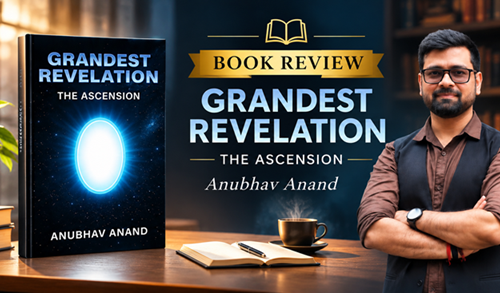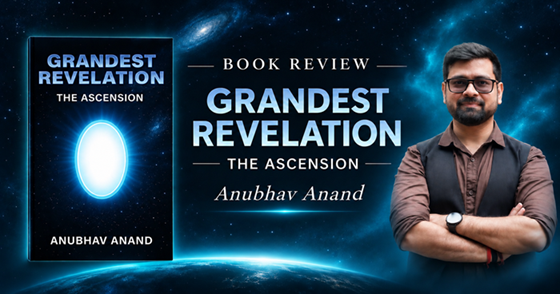
Book review | Grandest Revelation: The Ascension by Anubhav Anand
The most revealing place in Anubhav Anand’s Grandest Revelation: The Ascension is not necessarily an alien world. It may be the shared campus whose residents struggle to feel at home after the death of Arthur Kane Davis. Known as Káymargue, it is both a practical refuge and a reminder of a missing mentor. That double function gives the novel a human point of entry: before its survivors can imagine saving the universe, they have to discover whether they can still belong to one another.
This is a sequel to Grandest Revelation: The Exordium, and it does not disguise its dependence on an established history. A recap and character glossary introduce the star-human Demistars, their powers and the factions involved in the war. These are helpful navigational tools, particularly because several characters have celestial names as well as familiar ones. Even so, readers beginning here should expect some initial adjustment. The novel starts among consequences rather than at the clean beginning of an adventure.
Davis’s absence registers differently in different people. Mark Jones attempts to keep the group together but must endure unfavourable comparisons with his predecessor. Grisha channels bereavement into an appetite for retaliation. Others carry conflicting desires for security, companionship or a life beyond constant warfare. These reactions make the group more interesting than a uniformly determined band of heroes. Shared danger does not erase private need, and the characters do not always become their most generous selves simply because their cause matters.
The device called the Maize separates them into different settings, allowing the narrative to explore those needs away from the familiar group. Ethan’s time with Melissa is especially useful in this respect. She challenges the idea that possessing extraordinary power is, by itself, an adequate reason to fight. Asking him to identify a purpose presses beneath the conventions of the chosen warrior. The exchange makes commitment something that needs examination, rather than a duty that ancestry automatically settles.
Grisha’s strand gives the book a harsher emotional temperature. Her capability in combat coexists with grief, anger and an unreliable sense of safety. The novel repeatedly places trust under pressure, and her encounters show how difficult it can be to recognise danger when it arrives through apparent assistance. Without disclosing the major reversals, this is a story in which an initial impression of another person may need substantial revision. That uncertainty is more engaging than a simple division between admirable protagonists and obviously wicked opponents.
There is also warmth in the ensemble. Meals, embraces, awkward conversations and the hope of a reunion interrupt the warfare. These scenes give the reader a reason to care about the survival that the action continually demands. The return to ordinary gestures after extraordinary experiences is particularly effective: characters want to ask questions, but not everyone is ready to explain what has happened. Anand recognises that a safe arrival and emotional recovery are not necessarily the same event.
The universe surrounding these relationships is abundantly imagined. Celestial parentage, specialised weapons, alien marketplaces and vast creatures offer plenty for readers who like fantasy built from a large vocabulary of places and powers. Science-fiction imagery is part of the texture, but the governing mode remains mythic and fantastical. The descriptions of cosmic origins should be read as the book’s invented cosmology, not as an attempt to teach astronomy. Their function is to enlarge wonder and uncertainty around the characters’ existing beliefs.
The manuscript is less consistently controlled at sentence level. Explanatory passages sometimes repeat what a scene has already established, and emotions are frequently named after dialogue or action has made them evident. Long, heavily qualified sentences can weaken urgency. The rapid movement among characters and locations also means that a promising emotional moment may give way to another stream of information. Readers who favour a quieter, more concentrated character study may find the book’s abundance both its attraction and its obstacle.
Its tone requires another distinction. Despite the presence of young characters, this is not an uncomplicated youthful quest. Violence is graphic, language is often strong, and sexual content and sexual abuse make the personal trauma disturbing. These features should be part of a reader’s decision about the book, not an unexpected discovery after approaching it as a light escape. The continuing-story structure also matters: the ending develops fresh questions instead of offering comprehensive closure.
The Ascension is ultimately most compelling when it links the vastness of its conflict with the fragility of belonging. Its characters can cross unimaginable distances, yet still struggle to make themselves understood across a dinner table. The novel would gain from tighter prose and greater trust in implication, but its emotional concerns remain clear beneath the lore. For readers willing to enter a dark, expansive saga already in motion, Anand offers not only battles and revelations but a group of survivors trying to decide what, and whom, they are surviving for.
Amazon Link:https://www.amazon.in/GRANDEST-REVELATION-ASCENSION-ANUBHAV-ANAND/dp/9373351095