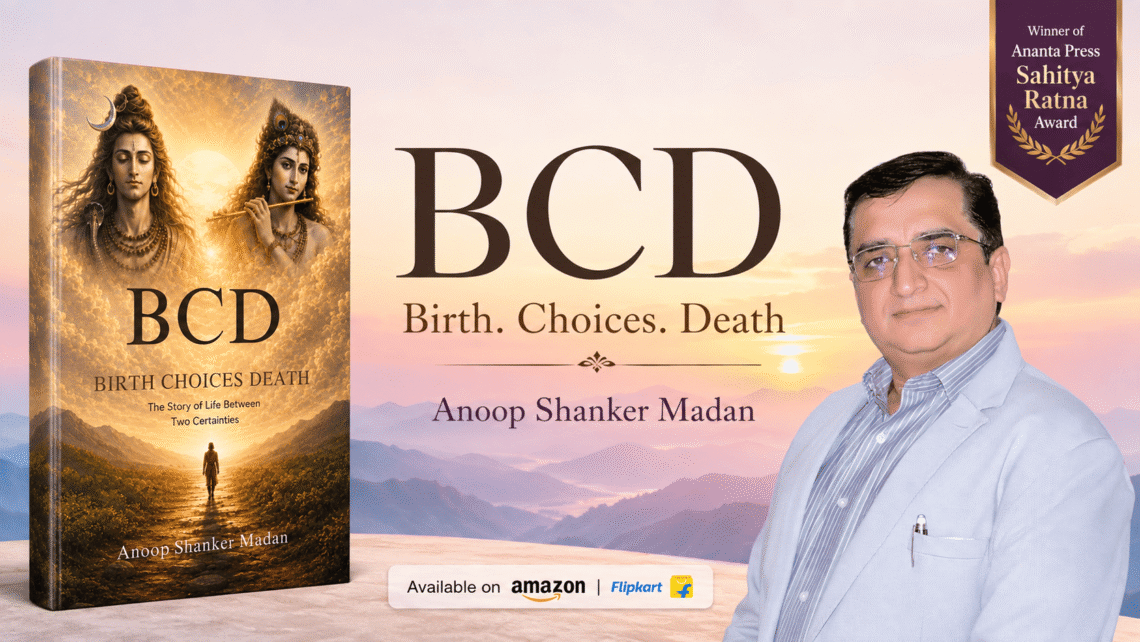
Anoop Shanker Madan’s B.C.D – Birth, Choices, Death: The Story of Life Between Two Certainties approaches spirituality from an unusually grounded direction. Instead of beginning with transcendence, enlightenment or escape from worldly concerns, it begins with the ordinary human condition. We are born without choosing the terms of our arrival. We move toward death whether or not we wish to think about it. Between those two realities, we live among relationships, responsibilities, habits, fears, desires, conflicts and decisions. The spiritual question, in Madan’s framework, is not how to leave this field behind. It is how to live within it more consciously.
This is what makes B.C.D particularly interesting as spiritually informed nonfiction. Its central philosophy does not separate inner life from practical life. Birth and Death define the boundaries of the journey, while Choices determine how the journey is inhabited. The word choice here carries more than the meaning of preference. It refers to the possibility of awareness entering action. A choice can become spiritual when it is not merely a reflex of ego, fear or conditioning but a response that has passed through reflection.
The book’s use of Shiva and Krishna gives this idea a specifically Indian symbolic depth. Shiva is associated with stillness, inward awareness and the capacity to witness. Krishna is associated with conscious action within responsibility. These are not presented as competing ideals. On the contrary, their relationship becomes one of the book’s strongest philosophical insights. Stillness without action can remain private experience. Action without awareness can become impulsive, ego-driven or mechanical. The two need each other. Inner quiet creates the possibility of seeing clearly; conscious action carries that clarity into life.
This framing is especially relevant because spirituality is often misunderstood as a refuge from difficulty. A person may seek peace through meditation, silence or withdrawal, yet the real test begins when ordinary life resumes. Does the calm survive disagreement? Does awareness remain present when pride is challenged? Does meditation influence the way one speaks to family, employees, colleagues or strangers? Does spiritual practice change how fear, anger, jealousy or disappointment are handled? B.C.D asks questions of this kind, and in doing so it moves spiritual discussion from experience to embodiment.
The distinction between meditation and reflection is particularly thoughtful. Meditation may quieten mental noise, but reflection asks what the quiet reveals. If anger repeatedly returns in the same pattern, what is its root? If a person keeps blaming others, what discomfort is being avoided? If fear controls decisions, what belief gives that fear its authority? If ego reacts defensively, what identity is being protected? Reflection turns stillness into inquiry. Without it, peace can remain temporary relief rather than understanding.
The book’s insistence on reflection also prevents spirituality from becoming passive. Awareness is not treated as an end point. It creates a space in which a different response may be possible. This is where choice acquires moral and psychological significance. The choice may be small: to remain silent for a moment, to listen before defending oneself, to admit a mistake, to continue a discipline, to leave a harmful pattern, to act despite fear or to decline the easy comfort of blame. Yet repeated small choices alter the direction of a life.
This gradual view of transformation is one of the book’s most persuasive qualities. Spiritual literature can sometimes create unrealistic expectations of sudden awakening or permanent serenity. B.C.D is more modest and therefore more believable. It suggests that awareness is tested repeatedly. Ego returns. Fear returns. Old habits return. Circumstances remain imperfect. What matters is whether the individual becomes increasingly capable of noticing the pattern and choosing differently. Growth is not a single event but a recurring practice.
The BCD framework also carries echoes of classical questions about karma and free will without requiring the reader to enter doctrinal debate. We are given conditions we did not choose, yet our responses generate consequences. Some consequences are immediate; others become visible only after patterns have formed. The book does not need to make metaphysical claims in order to show that repeated action shapes the world one inhabits. A harsh response affects a relationship. Avoidance strengthens fear. Discipline builds capacity. Responsibility increases trust. Ego may protect pride in the short term while damaging connection in the long term. Choice creates consequence, and consequence becomes part of the next circumstance.
This makes the book’s treatment of responsibility especially nuanced. Responsibility does not mean believing that everything that happens is our fault. That would be both simplistic and unfair. Instead, responsibility means distinguishing between what was given and what can now be done. The first cannot always be changed; the second remains open. This distinction can be liberating because it releases the reader from two extremes: helplessness and total-control thinking. We are neither omnipotent nor powerless.
Death deepens the spiritual dimension of the book. Mortality is not used as a threat but as a source of clarity. Death makes time visible. When we remember that the journey has a boundary, certain questions become harder to avoid. What are we postponing? Which relationships need attention? Which conflicts no longer deserve to dominate the mind? Which habits are consuming years that cannot be returned? What do we want our actions to have meant? In this sense, awareness of death becomes a discipline of presence.
The title’s phrase, The Story of Life Between Two Certainties, captures this beautifully. Birth and death are events, but life is the story between them. A story is made from movement, response, tension, decision and consequence. This gives B.C.D a narrative quality even though it is nonfiction. The reader is encouraged to see his or her own life as something being written continuously, not through fantasy but through action. Every day adds lines to that story.
What distinguishes the book from many spiritual titles is its refusal to remove the reader from ordinary responsibilities. The symbolic Krishna dimension is crucial here. Conscious action does not wait for perfect conditions. It happens in the middle of duty, uncertainty and relationship. This makes the book potentially valuable to professionals, entrepreneurs, parents, students and anyone whose spiritual questions arise inside busy modern life rather than outside it. The message is not to abandon the world in order to become aware, but to bring awareness into the world one already inhabits.
Anoop Shanker Madan’s own background in entrepreneurship adds credibility to this practical orientation. His questions emerge from decision-making, uncertainty, responsibility and interaction with people. The result is a philosophy that understands that real life does not pause while we work on ourselves. Bills, deadlines, expectations, disagreements, ambitions and losses continue. The challenge is to become more conscious within that movement.
The language of the book appears designed to keep this conversation open to a wide audience. Shiva and Krishna are used symbolically rather than as demands for religious identification. Readers can engage with the ideas as philosophical archetypes: stillness and action, awareness and responsibility, witnessing and participation. This broadens the book’s appeal while retaining its rootedness in Indian thought.
Another important quality is that B.C.D asks questions rather than pretending to close them. The reader is invited to examine whether inner practices are changing behaviour, whether choices are conscious, whether peace survives contact with conflict and whether mortality is changing priorities. Such questions are not answered once. They become ongoing companions. In that sense, the book’s usefulness may increase after reading, because its framework can be applied repeatedly.
For readers drawn to reflective spirituality, B.C.D offers a compelling synthesis. It does not reject meditation, but it asks meditation to become understanding. It does not reject action, but it asks action to become conscious. It does not deny circumstances, but it asks the individual to locate the remaining space of agency. And it does not avoid death, but uses mortality to make life more immediate.
The book’s deepest message may be that spirituality is not elsewhere. It is present in the quality of the next choice. The sacred may be found not only in silence but in the pause before anger, the courage to accept responsibility, the discipline to honour a commitment, the humility to admit error, the awareness to see ego at work, and the willingness to act with clarity. Birth gives the journey its beginning. Death gives it a limit. Choices reveal how consciously the journey is lived. B.C.D turns that simple structure into a thoughtful invitation to make inner awareness visible in the way we move through the world.Amazon Purchase Link: https://amzn.in/d/0136zluj