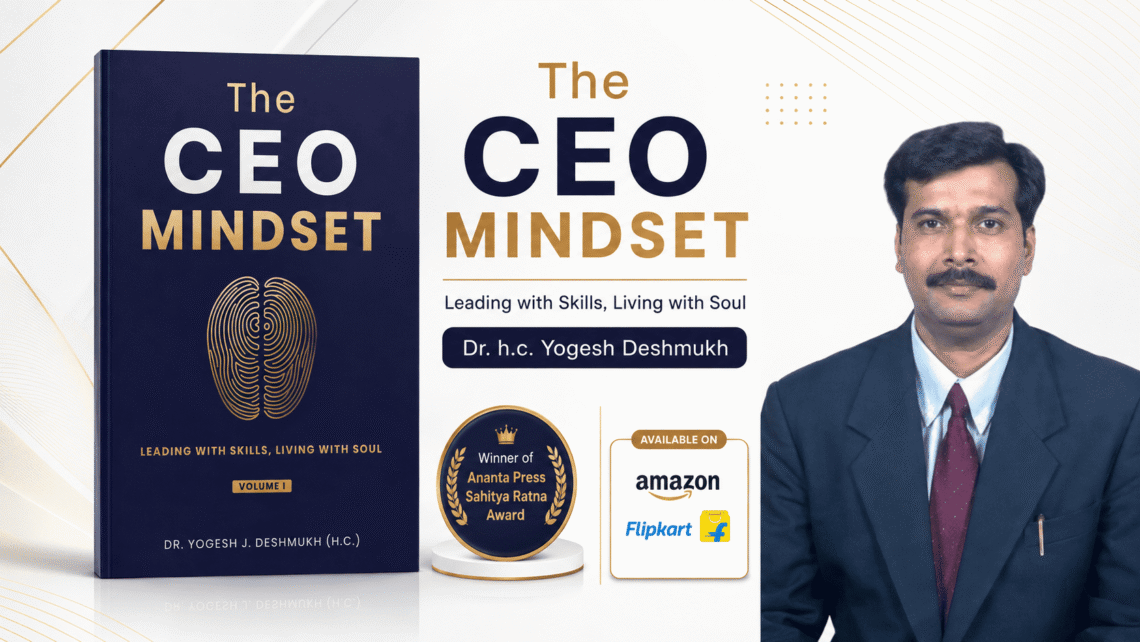
What does a chief executive actually lead? The obvious answers are a company, a strategy, a portfolio, a market position, a balance sheet, or a transformation agenda. The CEO Mindset: Leading with Skills, Living with Soul, Volume I asks readers to add another answer: a human environment. Dr. h.c. Yogesh Deshmukh’s book is most powerful when read as an exploration of the emotional and ethical climate created by leadership. It argues that executives do not merely direct work. Through their behaviour, they establish what people believe is safe to say, acceptable to challenge, worthwhile to care about, and possible to become.
This focus makes the book particularly relevant to a period in which organisations speak frequently about culture but still struggle to understand how culture is formed. Posters about values do not create trust. Leadership retreats do not automatically create openness. A statement about innovation means little if employees are punished for intelligent failure, and a statement about integrity means little if inconvenient information is quietly discouraged. Deshmukh’s leadership philosophy is grounded in a more demanding idea: culture is built in repeated moments of behaviour, especially when pressure is high.
The book’s examples of such moments are revealing. A late-night meeting, an exhausted team, an unexpected failure, or a courageous employee speaking an uncomfortable truth may seem less glamorous than a major strategic announcement, yet these moments often determine whether people trust leadership. A CEO can speak beautifully about empowerment and still destroy it with one dismissive reaction. Conversely, a leader can strengthen an entire team by responding to a difficult problem with composure, curiosity, and fairness. The CEO Mindset pays attention to this micro-level reality of leadership, and that attention gives the book emotional credibility.
At the heart of the book is a rejection of executive invulnerability. The traditional corporate hero is expected to be certain, relentlessly driven, emotionally controlled, and always several moves ahead. Deshmukh does not dismiss decisiveness or ambition, but he exposes the cost of pretending that leaders are somehow beyond ordinary human limitations. Leaders experience stress, doubt, fatigue, disappointment, ego, fear, and the need for recognition. Ignoring those realities does not make them disappear; it merely makes them harder to manage consciously. A more mature leader is not one who has no emotions, but one who can recognise emotions without allowing them to govern every response.
That distinction matters because emotion travels through hierarchy. When a senior leader becomes defensive, entire teams can become cautious. When a leader reacts angrily to bad news, information begins to arrive late or softened. When a leader demonstrates calm accountability, people are more likely to discuss errors honestly. Emotional intelligence is therefore not simply about being pleasant. It affects information quality, risk visibility, collaboration, and organisational learning. The book is valuable because it frames human awareness as part of leadership effectiveness rather than an optional interpersonal skill.
Trust receives similar treatment. Trust is often discussed as though it were a vague feeling, but in organisations it has practical consequences. Do employees believe promises will be kept? Do they expect consistent standards? Can they question a decision without harming their career? Will credit be shared fairly? Will mistakes be examined for learning or used primarily for blame? Leaders answer these questions through patterns of action. The CEO Mindset’s emphasis on transparency, ethical decision-making, and integrity speaks directly to this architecture of trust.
The author’s professional background makes his attention to trust especially interesting. Dr. Yogesh Jayant Deshmukh has worked for more than thirty years in demanding technical environments involving railways, high-speed rail, metro systems, software, and large-scale infrastructure. These are settings where collaboration is not a sentimental preference. It is essential. Complex projects depend on specialists whose expertise cannot simply be replaced by executive intuition. The leader must therefore know how to create conditions in which expertise can surface, disagreement can be processed constructively, and people can coordinate across boundaries.
The book’s idea of the CEO as a custodian of culture captures this responsibility well. A custodian does not “own” culture in the sense of controlling every interaction. Instead, a custodian protects the conditions that allow a healthy culture to develop. This includes setting ethical boundaries, modelling behaviour, selecting priorities, designing accountability, mentoring people, and intervening when patterns become destructive. It also means recognising that organisational culture is inseparable from leadership character. The more power a person holds, the more their unexamined habits can become institutional habits.
This is where the phrase “living with soul” gains depth. It can initially sound philosophical, especially in a management category dominated by measurable outputs. Yet the book uses the concept to ask practical questions about meaning and alignment. What is the purpose of leadership beyond personal advancement? What values remain non-negotiable when pressure rises? How should a leader behave when the easiest decision is not the most ethical one? What kind of people and institutions are being shaped by the pursuit of success? These questions are not opposed to performance. They help determine whether performance is sustainable and whether success deserves to be called success.
One of the book’s most attractive features is its balanced treatment of strength. In some leadership discussions, empathy is presented as a corrective to toughness, as though the leader must choose between demanding standards and caring about people. Deshmukh’s perspective suggests that the best leaders combine them. Empathy without accountability can become avoidance; accountability without empathy can become fear. Strategic ambition without ethics can create damage; ethics without courage can remain merely aspirational. Mature leadership integrates qualities that are often falsely separated.
The book also encourages readers to reconsider mentorship. A CEO is not only a decision-maker but a multiplier of capability. When leaders mentor well, they do more than solve the current problem; they help others become better at solving future problems. This is crucial in complex organisations where no single individual can carry all knowledge. Leaders who hoard decisions create dependency. Leaders who develop judgment in others build resilience. The CEO Mindset’s people-centered philosophy naturally supports this developmental view of authority.
Another important element is humility. In business literature, humility can be misunderstood as lack of confidence, but the book positions it closer to intellectual honesty. A humble leader can say, in effect, “My position does not guarantee that my interpretation is correct.” That mindset allows expertise to enter the room. It makes learning possible. It also reduces the risk that status will distort decisions. Combined with courage, humility becomes a powerful leadership discipline: the courage to decide when needed, and the humility to revise when evidence changes.
Readers who manage teams will likely find themselves reflecting on their own behavioural signals. How do I respond when someone disagrees with me? Do people tell me bad news early? Does my urgency energise the team or create anxiety? Do I listen to understand, or only long enough to prepare a response? Do I reward the person who identifies a hidden risk as much as the person who presents an optimistic plan? Such questions make the book useful even when the reader is far from the CEO title. Leadership culture begins wherever someone has influence over the experience of others.
The CEO Mindset is unique because it takes the language of soul seriously without abandoning the realities of management. It is not a retreat from strategy, systems, metrics, or execution. It is an argument that these elements operate inside a human context and that ignoring that context weakens them. Deshmukh’s career across technical and infrastructure domains prevents the book from becoming vague idealism. He knows that projects must be delivered, systems must be safe, and decisions must stand up to scrutiny. His point is that the path to those outcomes often depends on the quality of relationships and the integrity of leadership.
For organisations seeking healthier cultures, this book offers an important reminder: culture change begins with leadership behaviour before it becomes a programme. For individual readers, it offers a mirror. The central question is not simply, “How can I become a more successful leader?” It is, “What does my leadership make possible in other people?” That shift from self-image to human impact is the book’s deepest contribution.
By treating trust, empathy, courage, humility, and ethical consistency as executive capabilities, The CEO Mindset enlarges the meaning of professional excellence. It suggests that the highest form of leadership is not demonstrated by standing above others, but by creating an environment in which people can bring their intelligence, honesty, energy, and dignity to shared work. That is a demanding standard, but it is also a hopeful one—and it makes this volume a thoughtful addition to modern management reading.
Purchase on Amazon: https://www.amazon.in/dp/9371399201