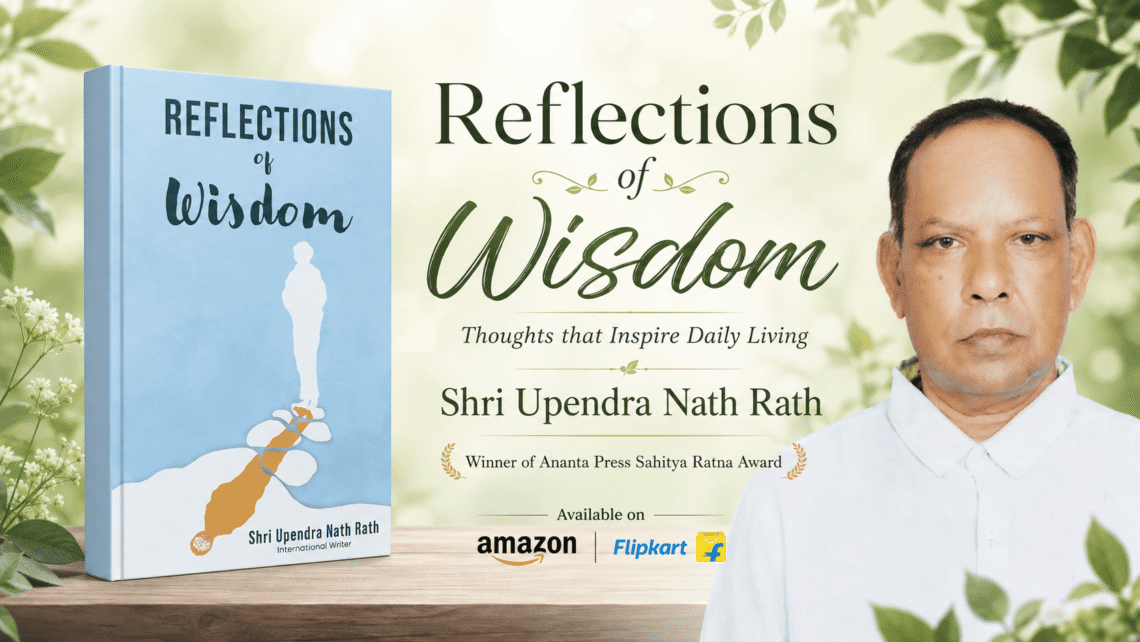
Reflections of Wisdom can be read as more than a general nonfiction book about lifestyle and behavior. It can also be understood as the extension of an educator’s lifelong classroom into the wider world. Shri Upendra Nath Rath spent thirty-six years teaching English in Kendriya Vidyalaya, and his broader life has included Scout leadership, social service, environmental action, student support, training programs, writing, public awareness work, and community leadership. Against that background, a book concerned with healthy lifestyle, manners, ways of living, and social behavior feels like a natural culmination of a long educational journey.
The most interesting educational books are not always textbooks. Some books teach by asking readers to examine the way they live. Reflections of Wisdom appears to belong to this category. Its themes are not restricted to academic knowledge; they concern the habits and attitudes that make knowledge useful. A student may know grammar, history, science, or mathematics, but education remains incomplete if that student does not also learn respect, discipline, responsibility, empathy, and healthy habits. Adults face the same challenge. Degrees and professional experience do not automatically produce wisdom. Character requires continued learning.
This makes the title particularly effective. Reflection is one of the central processes of education. A learner experiences something, thinks about it, recognizes patterns, adjusts behavior, and grows. Wisdom is what emerges when knowledge is combined with judgment and experience. By naming the book Reflections of Wisdom, the author signals an interest in this deeper educational process. The goal is not merely to tell readers what to know but to help them consider how to live.
Shri Upendra Nath Rath’s academic journey is itself unusually broad. He studied English, History, Political Science, Education, and Human Resource Development. Each discipline provides a different lens on human development. English encourages sensitivity to language and expression. History shows how individuals and societies are shaped by choices over time. Political science explores citizenship and public responsibility. Education focuses on learning and formation. Human Resource Development examines motivation, leadership, and people within institutions. A book about social behavior and way of living can draw naturally from the intersections of these fields.
His long career in Kendriya Vidyalaya is equally relevant. Kendriya Vidyalayas serve students from varied linguistic, regional, and family backgrounds, often within highly mobile communities. Teaching in such an environment requires more than subject competence. It requires adaptability, communication, fairness, cultural sensitivity, and the ability to create shared norms among diverse learners. These are precisely the qualities connected with healthy social behavior. A teacher who works for decades in such settings accumulates observations about what helps people cooperate and what causes relationships to weaken.
The author’s experience in Scouts and Guides further strengthens this dimension. Scouting is a form of education through action. Young people learn responsibility by being given responsibility, service by serving, discipline through routine, and cooperation through group experience. Values become meaningful because they are practiced. Reflections of Wisdom seems to echo this principle. Healthy living is not a definition; it is a pattern of choices. Manners are not a lecture; they are habits of interaction. Social responsibility is not a slogan; it is participation.
For educators, this is one of the book’s strongest possible uses. Schools today are under pressure to produce measurable outcomes. Examinations, rankings, competitive admissions, and professional preparation dominate public conversation. Yet teachers and parents know that some of the most important outcomes are difficult to measure: resilience, kindness, integrity, self-control, teamwork, cleanliness, respect for others, and willingness to contribute. A book that brings these areas into discussion can help restore balance to the meaning of education.
The author’s own activities show how education can move beyond the classroom. He has organized plantation programs, cleanliness campaigns, anti-polythene efforts, unity rallies, and support for vulnerable communities. He has helped disadvantaged students academically and participated in community welfare. These activities demonstrate an educational philosophy in which students and citizens learn through engagement with real problems. Planting trees teaches environmental responsibility. Helping those affected by disaster teaches compassion. Cleanliness campaigns teach respect for common spaces. Unity activities teach cooperation. Such experiences turn values into memories and habits.
Reflections of Wisdom is therefore especially suited to readers who believe that character education still matters. The phrase “character education” can sound formal, but the underlying idea is simple: what kind of human being is education helping someone become? A person can be successful and still be inconsiderate. Intelligent and still undisciplined. Articulate and still disrespectful. Ambitious and still unhealthy. The book’s focus on manner and way of living asks readers to consider these gaps.
The healthy lifestyle dimension is equally important in educational life. Students and professionals are increasingly exposed to irregular sleep, screen dependence, sedentary routines, pressure, comparison, and fragmented attention. Young people often receive advice about performance without enough guidance about balance. Adults repeat the same pattern in work life. A reflective approach to health can encourage readers to see well-being not as an occasional correction but as a daily structure.
What is valuable here is the connection between health and discipline. Discipline is sometimes associated only with obedience, but mature discipline is self-management. It means regulating time, habits, speech, emotions, and commitments in a way that supports long-term goals. A healthy lifestyle requires this kind of self-discipline. Good manners require it as well because courtesy often means controlling the impulse to interrupt, insult, dominate, or react carelessly. Social behavior depends on the ability to balance personal desire with consideration for others.
The author’s relationship with nature adds another educational layer. His biography describes a deep affection for flora, fauna, birds, animals, and rural life, while his service record includes major plantation drives. Nature has always been a powerful teacher because it places human beings within a larger system. It teaches patience, interdependence, cycles, limits, and stewardship. By bringing an environmentally conscious life experience into a work about healthy living, the author implicitly broadens the idea of health from the individual body to the surroundings that sustain life.
The book’s themes can also support intergenerational dialogue. Parents and teachers often complain that younger generations have changed; young people often feel that older generations do not understand new realities. A book built around universal values can create a common space between them. Respect, health, responsibility, empathy, cleanliness, and social awareness do not belong to one generation. Their expression may change, but their importance remains.
Another strength of Reflections of Wisdom is that it appears to value ordinary conduct rather than dramatic achievement. Education frequently celebrates exceptional results—top ranks, awards, promotions, public recognition. Those achievements are meaningful, but everyday behavior determines the quality of ordinary life. How does a person treat a classmate who is struggling? How does a teacher speak to a weak student? How does a professional behave with junior staff? How does a family care for elders? How does a citizen respond to litter, waste, or public inconvenience? These are small moments, yet they reveal education more accurately than certificates alone.
The author’s own recognitions—including appreciation for peace promotion, teaching-related honors, and international acknowledgment—add context without needing to become the central reason to read the book. More important is the pattern behind those recognitions: sustained participation in education and public service. The credibility of Reflections of Wisdom rests in this continuity. Its subject is supported by a life that has repeatedly engaged with teaching, discipline, community, and welfare.
For students, the book can function as a guide to personal formation. For teachers, it can offer themes for discussion and reflection. For parents, it can serve as a reminder that values are taught most effectively through example. For professionals, it can encourage a reconsideration of workplace manners and personal balance. For community members, it can reinforce the importance of civic behavior. This adaptability is a major strength.
The uniqueness of Reflections of Wisdom lies in the way it treats wisdom as something practical and social. Wisdom is often romanticized as profound speech or philosophical insight. But in daily life, wisdom may look like getting enough rest, controlling anger, speaking respectfully, keeping promises, caring for public spaces, helping someone in need, or choosing cooperation over ego. By focusing on these areas, the book makes wisdom accessible without making it trivial.
It is also a book that can reward repeated reading. Reflective nonfiction becomes most useful when readers connect ideas with current circumstances. A thought that seems simple at one stage of life may become deeply relevant later. A lesson about discipline can change meaning when one becomes a parent or leader. A reflection on health may become urgent after years of neglect. A point about social behavior may take on new significance after conflict. In this sense, the book’s value can grow with the reader.
Reflections of Wisdom deserves attention as an educator’s contribution to lifelong learning. It extends education beyond the classroom and beyond the years of formal schooling. It reminds readers that everyone remains a student of life, and that some of the most important lessons are repeated daily. Healthy habits, good manners, thoughtful living, social sensitivity, and service are not subjects to be completed and forgotten. They are practices to be renewed.
Shri Upendra Nath Rath’s life as a teacher, trainer, nature lover, social worker, and community participant provides a fitting foundation for these reflections. The book stands as an invitation to learn in the broadest sense: to observe oneself, improve one’s conduct, care for one’s well-being, and become a more responsible presence in the lives of others. That is education at its most human.Amazon / Purchase Link: https://share.google/vXOiJuSkHlGvVx2ny