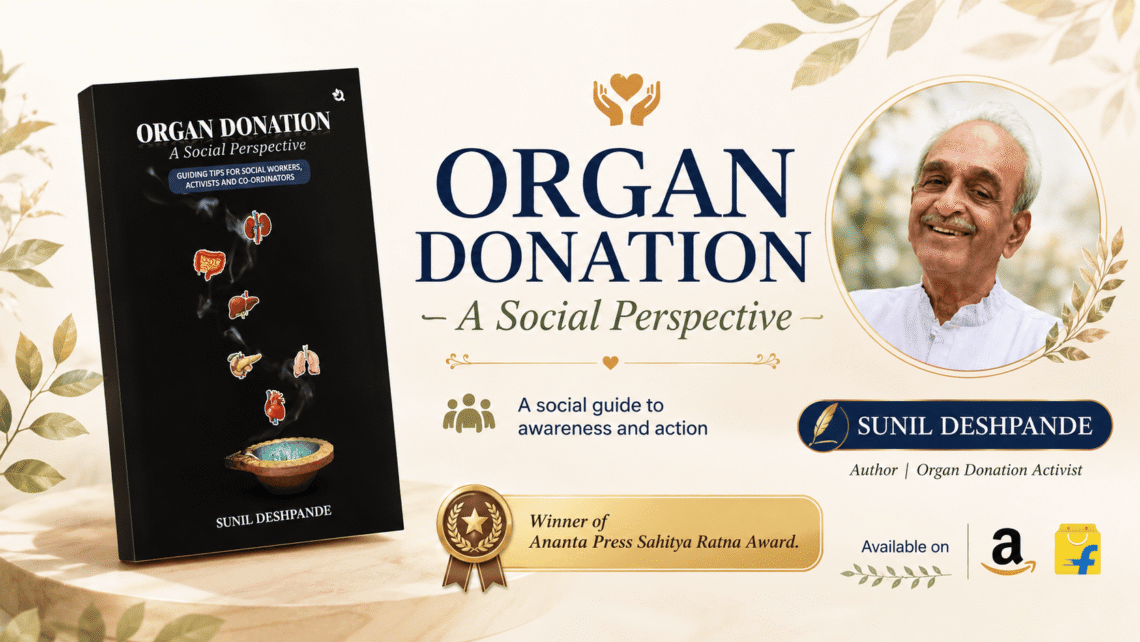
Some books are written after research. Others are written after a life has been spent inside the subject. Organ Donation – A Social Perspective belongs much more to the second category. Sunil Ranganath Deshpande approaches organ-donation awareness not as an observer looking in from the outside, but as a campaigner who has spent years walking, speaking, organizing, writing, listening, and working within the network of institutions and volunteers that support the cause. That background gives the book a character that is difficult to manufacture: it feels rooted in service.
The most striking fact about Deshpande’s journey is not a designation, although he has held several important ones. It is the physical scale of his outreach. Through four Avayavdaan Vaari padayatras between 2016 and 2020, he covered roughly 4,000 kilometres across Maharashtra. These were not recreational walks with a symbolic message attached to them. They were awareness campaigns that moved through urban and rural communities, accompanied by hundreds of programs and direct engagement with tens of thousands of people. Anyone who has worked in public awareness knows how much is hidden inside those numbers: planning, permissions, local coordination, travel, repetition, fatigue, cultural differences, difficult questions, skepticism, and the need to keep the message clear from one audience to the next.
That experience matters enormously when evaluating a book intended for social workers, activists, and coordinators. These readers do not primarily need a distant commentary on organ donation. They need guidance that respects the conditions in which awareness actually happens. A community meeting rarely unfolds like a textbook example. People ask unexpected questions. Some listeners are curious, some fearful, some indifferent. Local myths may be deeply rooted. Families may have moral or religious concerns. Terminology can create confusion. A volunteer must know how to stay accurate without sounding technical, persuasive without becoming pushy, and compassionate without becoming sentimental. A book shaped by long field experience is well placed to address such realities.
This is why the words A Social Perspective are central to the value of the book. The title signals a deliberate shift from transplantation as a purely medical matter to donation as a shared social process. The medical part of transplantation is performed by trained specialists, but the social conditions that make donation possible are built far earlier. Awareness must exist before a crisis. Families must have heard the subject discussed before they are asked to make decisions. Citizens must know that organ donation is lawful, structured, and meaningful. Communities must be able to distinguish fact from rumor. Social workers and activists therefore play a preventive role: they create understanding before the moment of urgency arrives.
Deshpande’s institutional experience deepens the book’s perspective. He has served as Director of the Mrutyunjay Organ Foundation in Nashik, Vice President of the Federation of Organ and Body Donation in Mumbai, and as a member of the Divisional Authorisation Committee for Organ Transplantation under the Government of Maharashtra. He has also held Rotary leadership responsibilities related to organ-donation work. These roles place him at several points along the journey from public awareness to organizational support and official procedure. The book benefits from an author who understands that social activism does not exist separately from systems. Effective awareness must connect responsibly with institutions.
One of the most interesting aspects of his public contribution is the Marathi organ-donation pratidnya, or pledge, drafted by him and approved by the Government of Maharashtra for official use. This achievement reveals something essential about his approach: he understands the power of language. Public causes often fail not because they lack importance but because they are explained badly. A message can be medically correct and still fail to connect. It can be legally precise and still feel intimidating. It can be emotionally moving and still leave people without practical understanding. Communication therefore becomes a form of infrastructure. Deshpande’s work in developing an official pledge suggests that he has spent considerable time thinking about how to express organ-donation values in language that people can remember and repeat.
The book’s subtitle, Guiding Tips for Social Workers, Activists and Co-Ordinators, is another indication of its field orientation. It does not claim to replace medical manuals or legal regulations. Instead, it serves a different group of readers: the people who carry knowledge from formal systems into society. This is precisely what makes the book unusual. Public-health literature often recognizes doctors, patients, and policymakers, but the importance of community communicators can be underestimated. Deshpande places them at the centre.
For students of social work, the book can be particularly useful because it demonstrates how a social issue becomes a long-term practice. Organ donation is not presented as a one-day campaign topic. Deshpande’s own example shows that awareness requires continuity. Four padayatras across several years, hundreds of programs, books in multiple languages, lectures, organizational roles, and creative awareness efforts such as a musical album all point to one lesson: people rarely change their understanding because of a single message. Public education works through repetition and trust.
This is also where the book gains motivational value without needing to become a motivational book. The author’s age and continued engagement are themselves powerful. At seventy-six, with years of activism behind him, Deshpande represents a model of sustained civic participation. Younger activists reading the book may take away not only tips about organ donation but also a larger lesson about commitment. Social causes are often demanding because results are not immediate. One may conduct a program and never know exactly whose thinking changed. One may speak to a village where only a handful of people respond. Yet awareness accumulates. The author’s journey embodies that patience.
The book also stands out because the subject is handled through an Indian social lens. Organ donation is a global issue, but public response is always shaped by local realities. India’s linguistic diversity, large rural population, differences in health literacy, strong family decision-making structures, and varied cultural beliefs make community communication especially important. Deshpande’s campaigns, with approximately eighty percent of awareness programs reportedly conducted in rural areas, give him a perspective that is especially relevant to this environment. A guide rooted in such experience can speak to the realities of outreach beyond metropolitan hospitals.
Another strength is the continuity between the author’s activism and his writing life. Deshpande has published several books in Marathi and has also contributed to works in Hindi and English related to organ donation. His Marathi book Manasi Samvad received a prestigious Maharashtra Sahitya Parishad award in 2026. This literary recognition does not automatically make an awareness guide effective, but it does suggest that he approaches writing as more than a secondary activity. Communication has been part of his public work for years.
Readers should also appreciate the book for what it does not try to be. It is not presented as a sensational account of transplantation, nor as an emotional collection of miracle stories. Its identity is instructional and social. That restraint is a quality. Organ donation deserves emotion, but it also deserves seriousness. Social workers need reliable orientation, not exaggerated messaging. Activists need practical clarity. Coordinators need language that helps them connect with communities while respecting professional boundaries.
The potential impact of the book therefore lies in multiplication. If one trained activist uses the book to improve ten awareness sessions, and each of those sessions helps a group of people understand donation more clearly, the value of the text expands far beyond the individual reader. This is the nature of a field guide. Its success is not measured only by how much a person enjoys reading it, but by what the reader is able to do afterwards.
Organ Donation – A Social Perspective deserves attention because it brings lived activism into written form. It takes lessons gathered on roads, in meetings, in institutions, and in conversations and directs them toward the next generation of people carrying the cause forward. In doing so, it becomes more than a book about organ donation. It becomes a document of applied social experience: a reminder that policy needs people, medicine needs trust, and awareness grows when committed individuals are prepared to take knowledge directly into society.