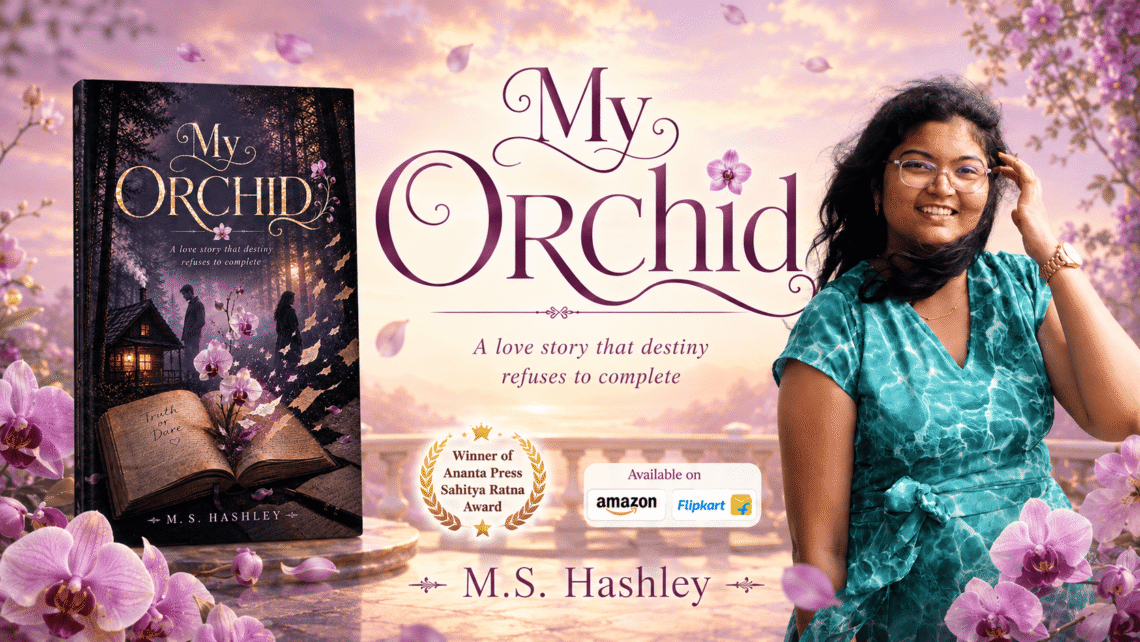
The most memorable thing about My Orchid is its central storytelling mechanism: a diary called Truth or Dare. In a genre where messages, dating apps, accidental meetings, and social media often drive modern romance, M.S. Hashley goes in the opposite direction. The book places a handwritten diary inside a secluded cabin and allows two people to build intimacy through a deliberately slow, almost old-fashioned exchange. That creative choice gives the novella a playful identity and also supports its deeper themes about attention, privacy, vulnerability, and the difference between knowing someone’s face and knowing their inner world.
Hardhik arrives at the cabin after a difficult breakup and a period of emotional self-destruction. He wants to write, but he also needs distance from the version of himself that has been drinking, arguing, and spiraling. The cabin therefore functions as more than a romantic setting. It is a reset space. Surrounded by trees, books, quiet, and a slower rhythm of life, Hardhik is separated from the habits that keep him reactive. When he discovers the diary, he is curious enough to follow its instructions. The early clues feel almost like a treasure hunt: books, coordinates, word puzzles, songs, physical locations, and hidden notes turn reading into an activity rather than a passive exchange.
This puzzle-based courtship is a clever way to characterize Hardhik. He wants to become an author, so language itself becomes part of his romantic life. The diary challenges him to interpret, decode, remember, and respond creatively. He is not simply trying to impress a stranger; he is learning to communicate with precision. The anonymous girl is equally playful. She does not surrender her identity immediately, which means Hardhik cannot rely on appearance or social status. He has to decide whether he likes the person behind the handwriting.
The anonymity also creates a productive tension. Both characters reveal personal truths while still withholding basic identifying information. That sounds contradictory, but emotionally it makes sense. It can sometimes be easier to tell a stranger the truth because the stranger has not yet become part of the social world that can judge us. The diary gives Hardhik and Orchid permission to be emotionally honest before they are socially known. Their bond develops in that unusual gap. They know each other’s fears, ambitions, family disappointments, tastes, and regrets before they know each other in an ordinary public sense.
One of my favorite aspects of this device is the way the book links romance with small acts of noticing. The messages are not generic declarations of attraction. They contain clues that depend on previous conversations. Gifts correspond to letters. Doodles on a dusty window become private symbols. A palm print, a heart-shaped flower, a book manuscript, a dare to sing, and a carefully chosen sequence of objects all become part of a shared language. The title “My Orchid” is built through that language. This makes the romance feel less like instant chemistry and more like a pattern the characters construct together.
The diary also works thematically because both Hardhik and Orchid are writers. Hardhik wants to become an author and has previously hidden his work under a pen name. Orchid has written Drifting Away but lacks confidence because the people whose approval she wanted most—her parents—did not give her the attention she hoped for. Their relationship therefore becomes a place where writing is not only profession or hobby; it is evidence of being seen. Hardhik reading Orchid’s work matters because he validates the part of her she has protected. Orchid encouraging Hardhik matters because she helps him move toward claiming his own identity as an author.
There is a nice meta quality to all of this. My Orchid is a book about people who express themselves through books, diaries, and stories. Hardhik’s romantic growth and creative growth happen together. When he becomes more emotionally honest, he becomes more willing to write honestly. When Orchid becomes more trusting, she becomes more willing to let her work be read. Their literary ambitions are not background decorations; they deepen the central question of the novel: what happens when another person reads the pages we usually keep hidden?
The diary device also helps the pacing. The story begins with heavier material involving Sana and Ro, then the cabin section introduces curiosity and play. Each clue gives the reader a small question to follow. Who is writing? How does this person know so much? What will the next dare reveal? Will the two finally meet? This creates a gentle mystery inside the romance. The book is not a thriller, but the anonymous exchange gives it forward motion beyond simple attraction.
Once Hardhik and Orchid meet, the story changes mode. The mystery of identity begins to give way to the harder question of whether emotional intimacy can survive real life. Orchid is afraid of relationships because of the damage caused by a broken friendship. Hardhik wants to believe that fear should not control the future. Their conversations around this are some of the most relatable parts of the book because they reflect a common modern problem: people can deeply want connection while also fearing the vulnerability that connection demands. The diary made intimacy feel controlled. Real life removes that control.
The later revelation that Orchid’s family is connected to Ro’s past is where the structure becomes especially satisfying. The book has spent many chapters teaching the reader that people are more complicated than the stories others tell about them. Hardhik thinks he knows Ro’s history, but he only knows a rumor. Orchid thinks she knows what heartbreak will do to her future, but she is predicting tomorrow based on yesterday. Lavanya has lived with her own incomplete understanding. The diary’s central rule—ask, answer, reveal—quietly becomes the moral opposite of all these years of silence.
Stylistically, My Orchid is very conversational. The prose is not distant or heavily polished into formal literary language. Hardhik narrates with jokes, exaggeration, insecurity, impulsive reactions, and the occasional dramatic thought. Some readers will especially enjoy this because it feels close to spoken contemporary Indian English and gives the book a youthful personality. The shifts into diary entries create contrast, often allowing the characters to be softer and more reflective on the page than they are in conversation.
The novel eventually becomes much more emotional than its playful middle suggests. The subtitle signals that destiny will interfere, and the final act delivers a tragic turn. Yet the diary remains important even after the game is over because it represents the way the couple learned to know each other. Their connection survives in remembered details, handwritten words, objects, and stories. The romance is therefore not erased by the ending. The very medium that brought them together becomes a metaphor for memory: a page remains even after the person who wrote it is gone.
For me, this is the book’s most original contribution. Anonymous romance itself is not new, and diary-based storytelling has a long history, but My Orchid combines the format with interactive clues, creative dares, literary ambition, and a family mystery in a way that feels distinctly its own. The diary is not simply a gimmick used to make two characters meet. It shapes their personalities, their trust, the pacing, the symbolism, and ultimately the emotional meaning of the story.
If you enjoy romances where the courtship is built through language and imagination, this is the strongest reason to pick up My Orchid. The book reminds us that attraction can begin in the mind, that being remembered can feel more intimate than being admired, and that sometimes the most revealing version of a person is the one who writes when no one is watching. The diary asks “Truth or Dare?” but the deeper challenge is always the same: dare to tell the truth. That idea gives the novella its charm and its emotional backbone.
Amazon Purchase Link