There are books that invite us to examine the world around us, and others that encourage us to look more closely at the world within. Karmic Medicine: 38 Years of Healing Wisdom by Dr. Renu immediately suggests a journey into the second category. Through its evocative title and deeply symbolic presentation, the book introduces an intriguing idea: healing may be understood not only through the physical body but also through the experiences, emotions, beliefs, and patterns that shape human existence.
The title itself brings together two powerful concepts. Karma, within many Indian philosophical traditions, is associated with action, consequence, responsibility, and the interconnected nature of existence. Medicine, meanwhile, represents the human desire to understand suffering, restore balance, and improve well-being. Their combination creates a compelling starting point for reflection on the relationship between individual choices, lived experiences, and the search for healing.
What makes this premise particularly interesting is the possibility of exploring healing as a multidimensional experience. Modern discussions of well-being increasingly recognise that physical health, emotional circumstances, social relationships, and psychological resilience can influence one another. Spiritual perspectives offer another way of interpreting the human experience, often giving individuals language through which to understand meaning, suffering, acceptance, and personal growth.
Karmic Medicine appears positioned at this intersection of spiritual inquiry and personal reflection. Its subtitle, 38 Years of Healing Wisdom, suggests that accumulated experience forms an important part of the author’s perspective. Such a substantial period naturally raises questions about the lessons a person may gather while observing human vulnerability, resilience, hope, and transformation.
The value of experience-based wisdom lies not simply in the number of years accumulated but in the depth of understanding those years can produce. Encounters with different people, circumstances, challenges, and turning points can gradually reshape an individual’s understanding of life. Readers may therefore approach this book with an expectation of considered reflection rather than merely abstract philosophical discussion.
One of the most compelling themes suggested by the title is the concept of personal responsibility. Karma is sometimes misunderstood as a rigid system of reward and punishment. More nuanced interpretations emphasise the significance of intentional action, ethical conduct, and the consequences of choices. Understood in this way, karma becomes a framework for self-awareness rather than fatalism.
This distinction matters, especially in discussions involving healing. Illness and suffering should never be interpreted as proof that someone has acted wrongly or deserves their circumstances. Medical conditions can arise through complex biological, genetic, environmental, and social factors. A responsible exploration of karmic philosophy can acknowledge these realities while encouraging readers to consider how their responses to adversity may influence their sense of agency, relationships, and emotional well-being.
Another meaningful area for reflection is emotional healing. Human beings carry memories that affect how they understand themselves and relate to others. Unresolved grief, regret, disappointment, and difficult experiences can influence behaviour, often in ways that remain unnoticed. Spiritual reflection may help individuals recognise recurring emotional patterns, examine their assumptions, and consider healthier ways of responding.
Forgiveness is especially relevant to this discussion. It is frequently described as a process of releasing resentment, although it does not require excusing harmful behaviour or restoring unsafe relationships. Forgiveness may instead represent a gradual decision to reduce the power of past experiences over one’s present life.
From this perspective, karmic reflection can become a means of examining one’s relationship with the past. Rather than endlessly revisiting what cannot be changed, an individual may begin to ask what can be understood, accepted, or approached differently.
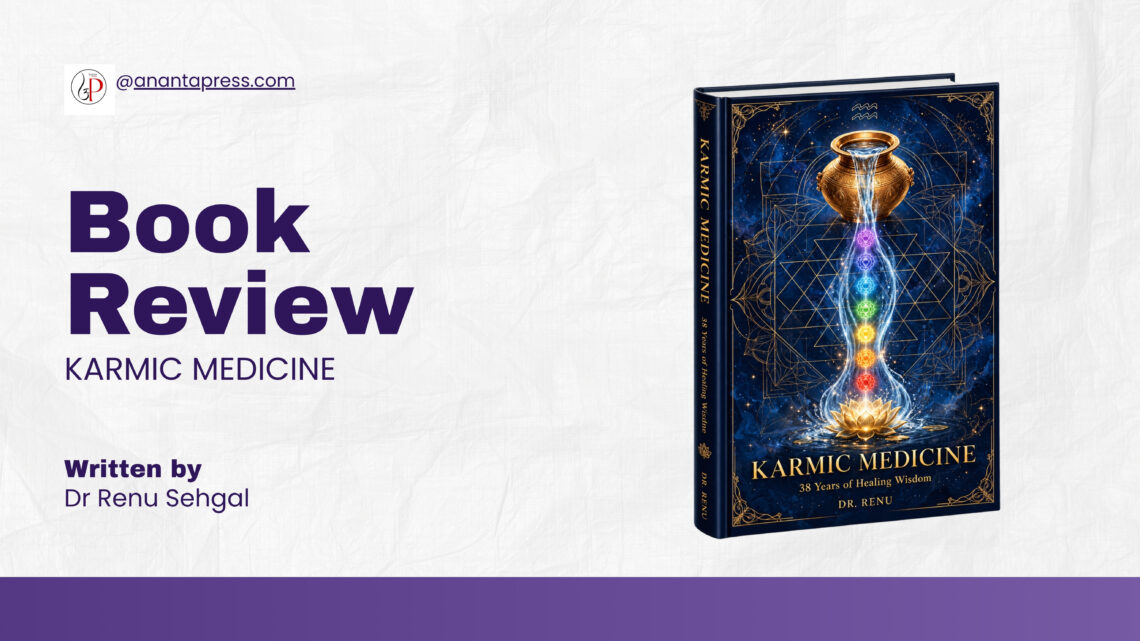
The book’s cover reinforces its spiritual orientation through powerful imagery. A golden vessel releases a flowing stream of luminous energy, while a sequence of coloured chakra symbols leads toward a radiant lotus. These elements immediately evoke Indian spiritual symbolism, suggesting transformation, renewal, interconnectedness, and the movement toward inner harmony.
The chakra system occupies an important place in various yogic and tantric traditions. Within such frameworks, chakras symbolise aspects of spiritual and energetic experience. Although claims about chakras as measurable medical structures or treatments are not scientifically established, their symbolic use can provide a meaningful language for meditation, self-examination, and spiritual practice.
The lotus, similarly, carries profound cultural significance. Its association with purity, growth, and awakening makes it an especially appropriate visual metaphor for a book concerned with healing. Emerging from muddy water, the lotus is frequently interpreted as a symbol of the human capacity to develop clarity and beauty despite difficult circumstances.
These visual choices give Karmic Medicine a distinctive identity. Rather than presenting healing as an entirely technical subject, the cover approaches it through beauty, symbolism, and philosophical possibility.
The relationship between spirituality and science also deserves careful consideration when approaching a work with this title. Contemporary medicine depends upon evidence, clinical evaluation, and established methods of diagnosis and treatment. Spirituality, on the other hand, may address questions of personal meaning, values, connection, hope, and inner experience.
These approaches need not be positioned as enemies, provided their boundaries remain clear. Personal spiritual beliefs can offer emotional comfort and support, but they should not replace necessary medical care. The most constructive understanding of holistic well-being respects the role of evidence-based healthcare while acknowledging the importance of emotional and existential concerns in a person’s life.
That balance is essential for the subject suggested by Karmic Medicine. Its potential literary and reflective appeal rests on exploring how people understand suffering and healing without reducing complex health conditions to spiritual explanations.
The title also invites consideration of relationships. Actions rarely affect only the individual performing them. Our words, decisions, attitudes, and habits influence families, communities, and social environments. In this sense, karmic reflection can encourage ethical awareness and a more deliberate approach to human connection.
A reader might reflect on the consequences of anger, the value of compassion, the importance of honesty, or the responsibility involved in making difficult decisions. These questions extend the meaning of healing beyond individual comfort. They suggest that emotional maturity and ethical conduct can become part of a wider process of personal growth.
Equally interesting is the possibility of examining acceptance. People frequently struggle with circumstances they cannot control. Loss, ageing, uncertainty, and unexpected change may challenge even the strongest sense of personal stability. Philosophical reflection offers one means of distinguishing between external events and the attitudes or actions available in response.
Acceptance is not the same as resignation. It need not mean abandoning practical solutions or tolerating injustice. Instead, it can involve recognising present reality clearly enough to respond constructively.
The subtitle’s reference to nearly four decades of wisdom gives this theme additional resonance. Long periods of experience can reveal the limits of certainty and the importance of patience. They can also teach that healing is not always linear. Some experiences leave lasting effects, while others become easier to understand over time.
A particularly appealing quality of the book’s concept is its potential accessibility to different readers. Those interested in Indian philosophy may be drawn to its karmic themes. Readers engaged with spirituality may appreciate its symbolism. Others exploring emotional resilience, personal growth, or the meaning of suffering may find the central questions relevant to their own lives.
This breadth also presents an important challenge: complex ideas require careful explanation. Terms such as karma, healing, energy, consciousness, and transformation can carry different meanings depending on their philosophical, religious, psychological, or medical context. Distinguishing among these meanings would be especially valuable in a work addressing an interdisciplinary subject.
Ultimately, Karmic Medicine: 38 Years of Healing Wisdom presents a thoughtful and visually compelling invitation to reconsider what healing can mean in the broader context of human life.
Its central promise, suggested by its title, is not simply relief from suffering but a deeper examination of how individuals interpret their experiences, respond to challenges, and pursue personal growth. The combination of karmic philosophy, the language of healing, and decades of accumulated wisdom gives the book an intriguing conceptual foundation.
For readers who appreciate reflective spiritual literature, this is a subject worthy of attention. Its greatest potential lies in encouraging introspection, compassion, responsibility, and thoughtful engagement with life’s uncertainties.
Karmic Medicine reminds us of an important possibility: while not every circumstance is within our control, the search for understanding can itself become a meaningful part of the human experience.