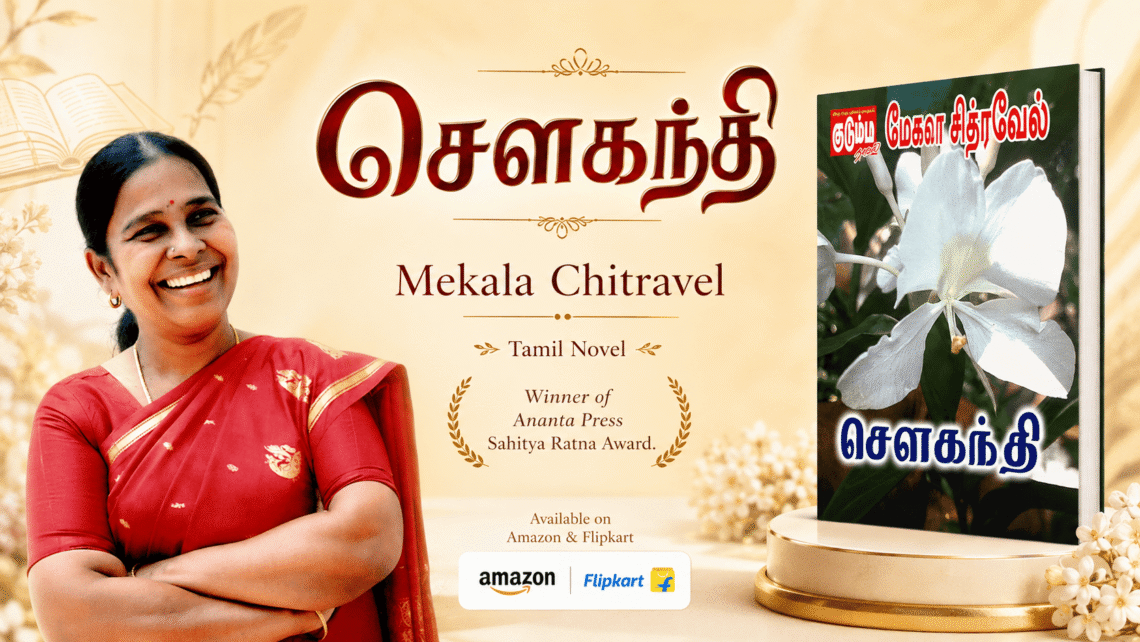
When I think about Sowganthi, I keep returning to the relationship between its two central figures: Sowganthi, the mother, and Rishi, the son who loves and cares for her. The premise is wonderfully direct, but it opens the door to a surprisingly rich question: what makes a good son? Literature often defines memorable characters through ambition, conflict, romance, or rebellion. Rishi is interesting for a different reason. His defining quality is relational. We understand him through the way he responds to the woman who raised him. That makes his character a useful reminder that maturity is not only about independence; it is also about the capacity to recognise the sacrifices of others and to return love with responsibility.
Sowganthi, in turn, represents a hope that many mothers rarely state openly. Parents may say they want their children to be educated, successful, healthy, or financially secure. Beneath all those wishes, however, there is often a simpler one: “Do not forget me.” A mother does not necessarily expect her grown child to repay every sacrifice. Love cannot be calculated that way. What she may hope for is continued affection, respect, attention, and a sense that her importance has not ended once the child becomes independent. The novel’s description of Sowganthi as a “lucky mother” because Rishi loves and cares for her is emotionally revealing. It acknowledges that such reciprocity is deeply desired and not always guaranteed.
This makes the novel particularly relevant to contemporary family life. Modern adulthood encourages people to build a separate identity quickly. Careers may take children to other cities or countries. Marriage can create new priorities. Technology makes communication easier but does not automatically make it meaningful. In this environment, caring for parents can become something scheduled rather than spontaneous. A book centred on Rishi’s affection asks readers to reconsider the relationship between personal progress and family gratitude. Success is not only where we reach; it is also how we treat the people who helped us begin.
I like the fact that Rishi’s role allows the novel to explore masculinity through care. Men in fiction are frequently expected to prove themselves through strength, achievement, authority, or emotional restraint. A son who is openly attentive to his mother offers a more humane model. Care is not weakness. Tenderness does not reduce maturity. In fact, the ability to remain affectionate and responsible toward a parent may reveal a deeper strength than outward dominance ever could. This is one reason the book’s theme can be valuable for younger readers as well. It presents emotional responsibility as a quality worthy of admiration.
Sowganthi’s character is also enriched by the meaning of her name. The author associates “Sowganthi” with a divine flower mentioned in the Mahabharata, brought by Bhima for Panchali from heaven. The image of a rare, fragrant flower suits the emotional position of the mother. A mother’s presence often becomes part of the atmosphere of a home. Like fragrance, it may be difficult to measure but impossible to forget. Her care is woven into meals, routines, encouragement, correction, worry, celebration, and countless acts that may seem ordinary in the moment. Naming the mother after a heavenly flower subtly suggests value: she is not background scenery; she is precious.
There is another possible way to read the flower symbolism. Rishi’s love itself can be seen as the flower he gives his mother. The old epic image is transformed from a physical quest into an emotional one. A son does not need to journey to heaven to prove love. He can show it through presence, patience, and care. This interpretation gives the novel a lovely cultural continuity. An ancient story about bringing something rare to a loved one becomes a modern reminder that the most valuable gifts inside a family are often intangible.
The author, Mekala Chitravel, brings considerable life experience to this subject. She has completed one hundred Tamil books and has written in many forms, including novels, children’s literature, cookery, folk stories, spiritual books, biographical writing on Indira Gandhi, works related to kolam, and eleven books about MGR. Such a varied bibliography suggests a writer accustomed to observing life from many angles. It also suggests an ability to communicate with different types of readers. A children’s writer must value clarity and imagination; a spiritual writer must engage with meaning; a biographical writer must work with personality and memory; a novelist must understand emotion and human motivation. Those skills can meet naturally in a family story like Sowganthi.
Her career outside writing is equally relevant. She has been a stage debater on nearly a thousand stages, a storyteller, and an educator who ran a matriculation school and taught hundreds of students. Public speaking and teaching require close attention to people. A teacher sees the gap between what young people say and what they feel. A school leader watches the expectations of parents and the development of children over many years. A debater learns how values are defended and questioned. A storyteller learns how to hold an audience emotionally. These experiences create a broad human background from which to write about a mother and son.
The fact that university scholars have completed doctoral research on her novels is also worth noting. It means her work has generated enough literary and social interest to sustain formal academic study. That context makes Sowganthi interesting not only as a sentimental family tale but as part of a larger body of Tamil writing. Readers interested in regional literature often look for authors whose work reflects lived cultural values rather than merely following fashionable themes. Mekala Chitravel’s long career places her in that category.
What makes this novel unique for me is its refusal to treat filial love as secondary. In many stories, the mother exists mainly to explain the hero’s childhood or to provide emotional motivation. Here, the bond itself becomes the subject. That changes the emotional hierarchy of the story. The mother is not simply the person the protagonist leaves behind while pursuing a “larger” life. Her relationship with her son is itself large enough to deserve the reader’s attention. This is a meaningful choice, especially in societies where mothers perform enormous amounts of invisible work.
The novel can also be read as a book about gratitude. Gratitude is easy to admire but difficult to practise consistently. We may feel thankful for our parents while still failing to give them time. We may speak respectfully about motherhood in public and remain impatient with our own mother in private. Rishi’s value as a character lies in closing that gap between feeling and action. Love becomes convincing when it is visible in behaviour. That principle extends beyond the novel to every close relationship.
Another strength is the positive emotional space the story creates. Not every meaningful novel has to leave the reader disturbed. There is a legitimate place for fiction that restores faith in human relationships. A mother receiving sincere love from her son can produce a kind of emotional relief. It reminds readers that family bonds can survive change, that affection can be returned, and that ageing does not have to mean emotional abandonment. For readers who have experienced the opposite, the book may even feel aspirational – a picture of the kind of family relationship they wish existed more often.
At the same time, the central theme naturally invites readers to examine themselves. Sons may ask whether they express enough care. Daughters may reflect on their own relationships with parents. Parents may think about the balance between expectation and freedom. Teachers and older readers may see generations of family experience reflected in the premise. That ability to stimulate personal reflection is one of the best qualities a family novel can have.
Sowganthi is therefore more than a story about a “good son.” It is a reflection on how love matures. A child begins by receiving. Adulthood offers the chance to become a giver in return. Rishi’s care for Sowganthi represents that transformation from dependence to responsibility, while Sowganthi represents the emotional dignity of a mother whose love is recognised rather than forgotten. The divine-flower symbolism adds cultural beauty, and Mekala Chitravel’s long experience as writer, educator, debater, and storyteller gives the work an especially interesting background. For readers who value emotional sincerity, family-centred fiction, and Tamil cultural sensibility, Sowganthi offers a warm and thoughtful reading experience.Amazon Purchase Link: https://www.amazon.com/%E0%AE%9A%E0%AF%8C%E0%AE%95%E0%AE%A8%E0%AF%8D%E0%AE%A4%E0%AE%BF-Tamil-Megala-chitravel-ebook/dp/B08QHXX1YX/ref=sr_1_1?crid=14UCY7JUZSG76&dib=eyJ2IjoiMSJ9.T9HpY4IwtsVh4EPOLSOJOw.elPq1AOHf0OkGkPQwJUvaX8h39c6ftPIQISOfgKV5A4&dib_tag=se&keywords=megala+chitravel&qid=1779947276&s=books&sprefix=megala+chitravel%2Cstripbooks-intl-ship%2C366&sr=1-1