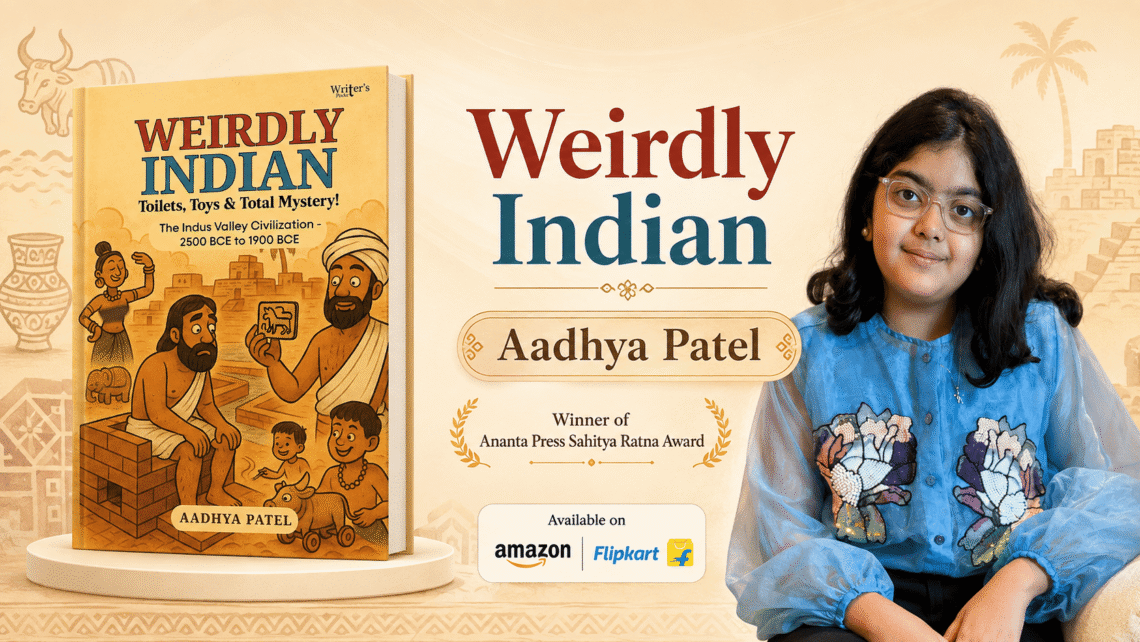
The most impressive civilizations are often introduced through their largest achievements: monumental buildings, military victories, famous rulers, or vast territories. Weirdly Indian – Toilets, Toys & Total Mystery! makes a much more interesting choice. It asks readers to look down rather than up—to look at drains, bathrooms, bricks, toys, seals, jewellery, farming tools, and the practical objects of ordinary life. Through that lens, the Indus Valley Civilization becomes not only impressive but believable. Aadhya Patel’s book shows that the genius of an ancient society can be visible in the details of how people actually lived.
The emphasis on sanitation is a perfect example. Toilets may seem like a comic entry point into history, particularly for children, but they are also a serious archaeological clue. A functioning urban sanitation system requires planning. Drains need routes. Homes must connect to larger systems. Builders need shared standards. People need an understanding of space, waste, water, and maintenance. By beginning with something that children may laugh about, the book leads them toward questions about civic engineering and organised city life. This movement—from funny to fascinating—is one of the book’s signature strengths.
Toys perform a similar function. They may be small, but they carry enormous imaginative power. A toy with moving parts tells a young reader that children thousands of years ago were not simply “ancient people”; they were children. They played, watched objects move, copied animals, invented games, and experienced delight. Toys collapse historical distance. They transform an archaeological culture into a world containing families and childhoods. For a children’s book, that connection is invaluable because it allows identification without inventing fictional characters or pretending to know more than the evidence supports.
Patel’s treatment of everyday life broadens naturally into other areas. Jewellery points toward craftsmanship and aesthetics. Farming tools lead toward food production and settlement. Trading goods suggest routes, exchange, and relationships across regions. Seals hint at administration, identity, commerce, symbolism, or belief. Carefully planned homes and streets suggest collective organisation. Each object becomes a small doorway into a larger system. The book therefore teaches an important historical principle almost invisibly: material culture can reveal structures that written records cannot.
This is particularly important for the Indus Valley Civilization because its script has not been deciphered. We cannot simply open a long surviving document and read the society’s own narrative in the way we can with some later civilizations. The material remains matter enormously. Weirdly Indian turns that limitation into a source of excitement. The unread script becomes one of the greatest mysteries in the book, but it also explains why archaeologists must reason from objects, buildings, patterns, and comparisons. Young readers are introduced to a past that has to be reconstructed rather than simply quoted.
The book’s structure reflects that process of reconstruction. It moves from the civilization’s emergence near the Indus River through the development of organised urban centres such as Harappa and Mohenjo-daro, explores what discoveries suggest about everyday life, and then examines how the civilization itself was rediscovered by modern archaeology. The story of railway workers using ancient bricks without realising what they were is especially memorable. It demonstrates that history can be physically present and yet invisible when people do not recognise its significance. It also creates a useful sense of urgency around preservation.
What makes the book especially suitable for young readers is that it does not overload this structure with academic terminology. The civilization remains complex, but the language of discovery keeps the reader moving. Instead of telling children that they must care about urban archaeology, Patel shows them why an ancient toilet, a mysterious seal, or a moving toy is worth caring about. This is a fundamental difference between information delivery and engagement.
Humour plays an important role here, but it never becomes a substitute for substance. The funny observations create permission to enjoy the subject. They lower the barrier that sometimes surrounds “important” history. Yet beneath the playful surface is a strong respect for evidence. The reader is not encouraged to believe every imaginative possibility. The book repeatedly distinguishes what has been discovered from what remains unknown. In that sense, it balances wonder with intellectual honesty.
This balance is most visible in the treatment of unresolved questions. Who ruled? How exactly was authority organised? What do the symbols mean? Why did the civilization decline? Patel does not smooth these uncertainties away. Instead, she frames them as the exciting edge of knowledge. Young readers are invited to think like investigators and perhaps propose their own theories, while recognising that a theory is not the same thing as a proven fact. That distinction is a valuable lesson at any age.
The focus on the ordinary also challenges a narrow idea of what counts as historically important. In many school narratives, “important” means royal, military, or monumental. Weirdly Indian suggests that a bathroom can be historically important. A child’s toy can be historically important. A drainage channel can be historically important. A small seal can be historically important. This expands the reader’s sense of evidence and also subtly democratises history. The story of the past is not only the story of famous leaders. It is the cumulative story of how communities ate, worked, built, cleaned, traded, decorated, played, and solved practical problems.
There is also an appealing contrast between the civilization’s sophistication and the uncertainty that surrounds it. Readers can see evidence of carefully organised cities and advanced practical systems, yet still face huge gaps in knowledge. That contrast prevents the civilization from becoming a neat progress story. It remains both knowable and unknowable. We can admire what survives while recognising how much has disappeared.
Aadhya Patel’s young authorial perspective is a natural match for this material. Her questions feel grounded in the kinds of things children notice. She does not approach the subject with the assumption that formal topics are automatically more important than quirky ones. That freedom allows her to notice exactly the details that can make a young audience care. It is a perspective that an adult writer might imitate, but Patel inhabits it more naturally because she is part of the readership she addresses.
The book’s illustrations further support this everyday-life approach. Ancient civilizations can become visually monotonous when presented only through site photographs or dense diagrams. Illustrations can reconstruct the human scale of streets, homes, objects, and interactions without claiming documentary certainty. In a book that relies on curiosity and imagination, the visual dimension helps readers move from artifact to possible lived experience.
Parents and educators may particularly value the book for the conversations it can generate. A chapter on sanitation can lead to a discussion about engineering and public health. Toys can lead to questions about what childhood means across cultures. Seals can introduce writing systems and communication. Trade can lead to geography. The undeciphered script can spark an activity in codes and symbols. The decline of the civilization can introduce climate, migration, environmental change, or the difficulty of explaining large historical transformations. In this sense, the book is not only a reading experience; it is a launching point.
Its broader message is that the past is not remote when we know where to look. A four-thousand-year-old civilization can suddenly feel close because somebody needed to wash, cook, play, build, travel, decorate, trade, and solve the ordinary problems of living together. Those ordinary acts are precisely what make the society extraordinary.
Weirdly Indian – Toilets, Toys & Total Mystery! is unique because it turns the overlooked into the unforgettable. It finds intelligence in drainage, tenderness in toys, complexity in seals, and suspense in missing answers. By giving everyday life the attention it deserves, the book helps young readers understand that civilization is not only what people build for glory. It is also what they build so that life works.
That may be the most memorable lesson the book offers. The Indus Valley Civilization impresses not because it can be reduced to one famous ruler or monument, but because thousands of small signs point toward a deeply organised, inventive, and human world. Patel gives those signs the spotlight, and in doing so creates a history book that feels both unusually entertaining and genuinely enlightening.Amazon Purchase Link: https://amzn.in/d/0aBM1ljI