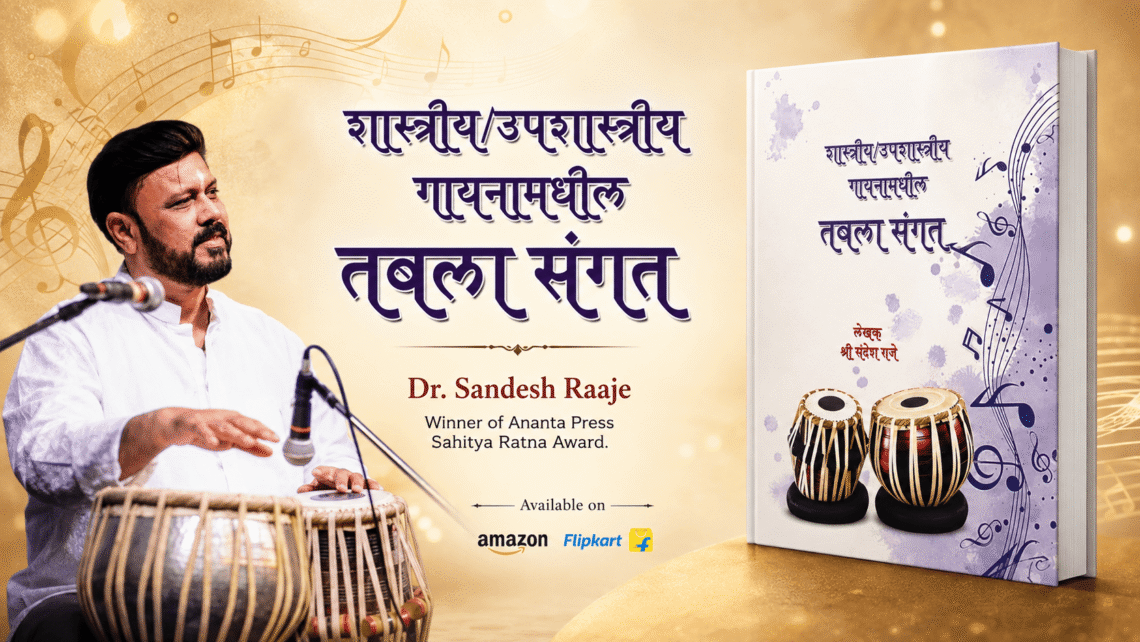
For a tabla student, one of the most challenging transitions is the movement from learning rhythmic material in isolation to using that material intelligently in performance. “Shastriya/Upashastriya Gayanamadhil Tabla Sangat” by Dr. Sandesh Raaje addresses that transition directly by focusing on the role of tabla in Hindustani classical and semi-classical vocal music. This makes the book especially valuable as a practical resource for learners who want to understand not only what to play, but how, when, and why to play it while accompanying a singer.
The distinction is crucial. In the practice room, the learner can focus on clarity of bols, balance of hands, speed, theka, kayda, rela, tukra, tihai, and other rhythmic forms. These elements build technique and vocabulary. On stage, however, the accompanist enters a shared musical environment. The vocalist controls melodic development, textual expression, raga elaboration, and many of the major structural choices. The tabla player must remain fully alert to those choices and shape the rhythmic contribution accordingly. A technically impressive phrase can be musically wrong if it arrives at the wrong moment or overwhelms the singer. Accompaniment therefore demands a kind of practical wisdom that is different from solo performance.
This is the area in which Dr. Raaje’s book finds its strongest purpose. Rather than writing another broad introductory volume on tabla, he chooses to examine accompaniment as a specialized discipline. He acknowledges that many respected stalwarts have already contributed books on tabla’s evolution, construction, structure, compositions, and related subjects. His decision to concentrate on accompaniment allows the book to address a gap that students frequently experience. The instrument may be well documented, but the art of using it in relation to a vocalist requires its own attention.
Students can benefit from this focus because accompaniment is built from layers of awareness. First comes tala stability: the cycle must remain dependable. Then comes sensitivity to lay and tempo. After that comes the ability to hear the singer’s phrasing, understand the composition’s design, recognize important points of arrival, and adjust texture and volume. Beyond all of this lies aesthetic judgment—the capacity to know when a plain theka is perfect, when a subtle variation adds energy, and when a stronger rhythmic statement is appropriate. These are not merely technical choices. They are musical decisions.
The author’s long training under Pt. Bhai Gaitonde gives the book an important foundation. Dr. Raaje studied with the legendary maestro for twenty-eight years and also received fellowship support connected with his guru. A prolonged guru-shishya relationship is particularly relevant to accompaniment because much of its knowledge is demonstrated rather than announced. A guru may correct the weight of a stroke, the shape of a phrase, the placement of an accent, or even the student’s tendency to play too much. Over years, such corrections become musical instinct. When a senior practitioner attempts to write about the role of tabla in vocal music, readers gain access to reflections shaped by this kind of accumulated experience.
The author also comes from a family with a rich tradition of tabla and pakhavaj. That background broadens the cultural context of the book. Rhythm is not treated as an isolated academic subject but as a living inheritance. The author’s association with many artists, combined with his formal training and qualifications, appears to have deepened his sense of responsibility toward the field. The book is therefore motivated not simply by a desire to explain, but by a desire to contribute.
From a student’s perspective, one of the most important ideas raised by the subject is listening. Tabla education can sometimes become visually and physically focused: where the hand strikes, how the bol sounds, how fast a pattern can be played, how cleanly a composition can be reproduced. Accompaniment forces the player to turn outward. The student must listen continuously to melody, words, tempo, breathing, dynamics, and emotional direction. In that sense, accompaniment is an advanced form of ear training. It teaches the tabla player to become part of an ensemble rather than remain centered on the instrument alone.
The book’s coverage of both classical and semi-classical vocal music adds another practical advantage. Accompanying a vilambit khayal, a faster composition, or a semi-classical form can require different approaches. A mature accompanist develops flexibility instead of relying on one habitual style. The player’s touch, density, use of variation, and overall rhythmic character must fit the genre. Students who understand this early are less likely to confuse virtuosity with universality.
The work can also help young accompanists think about stage etiquette and musical hierarchy. In a vocal concert, the tabla player is neither an invisible timekeeper nor the central soloist. The role is collaborative. There are moments when the accompanist may respond creatively and moments when the best contribution is stability. This constant adjustment requires confidence and humility at the same time. A book devoted to the subject sends a healthy message to learners: accompaniment is not secondary work. It is a demanding art that deserves serious preparation.
Another reason the book is useful is that it can be studied alongside recordings. A student can read about the role of accompaniment and then listen to different vocal performances, asking specific questions: How does the tabla player establish theka in the opening section? How are dynamic changes handled? What happens when the vocalist increases rhythmic activity? How is sam supported? When does the accompanist respond, and when does the accompanist remain simple? Comparing several performances can reveal that there is rarely only one correct answer. The principles guide the player, but musical personality and context influence the final choice.
This makes the book suitable for teachers as well. A tabla teacher could use sections as prompts for demonstrations, classroom conversation, or concert analysis. A vocal teacher could also use the ideas to help singers understand how to communicate with accompanists. Young musicians often learn their own part without fully understanding the needs of the ensemble. A text centered on accompaniment can encourage mutual respect across disciplines.
Dr. Raaje’s formal qualifications reinforce the educational character of the work. He holds a Master of Performing Arts from Shivaji University, Kolhapur; a B High grade from All India Radio; Sangeet Alankar from ABGMV; and recognitions including the Rashtriya Gaurav Award and an honorary doctorate in Music and Performing Arts. Together with his family heritage and long discipleship, these achievements reflect a broad musical journey. The book benefits from the meeting of institutional learning and traditional mentorship.
Its originality lies in practical emphasis. Tabla students already have access to abundant material on talas, bols, compositions, and solo structures. What many need is guidance on artistic application. By centering the book on the accompanist’s role, Dr. Raaje turns attention toward judgment, balance, sensitivity, and communication. These qualities are harder to write about than fixed compositions because they depend on context, but that is exactly why they deserve discussion.
The book also has value for music lovers who want to hear concerts more deeply. Once listeners understand the accompanist’s task, they begin to notice the invisible architecture of rhythm. A steady but responsive theka, a carefully placed accent, a tasteful answer, or a controlled rise in energy can transform a performance without calling attention to itself. The listener begins to appreciate that refinement is often more difficult than display.
Most importantly, the book encourages a mature definition of tabla mastery. Mastery is not simply the ability to play more material or to play it faster. It is the ability to choose the right material for the right moment and to make the entire performance feel coherent. For a student who hopes to accompany vocalists professionally, that lesson is essential.
“Shastriya/Upashastriya Gayanamadhil Tabla Sangat” is therefore a relevant and purposeful book for tabla students, performing accompanists, teachers, vocalists, and dedicated music lovers. It fills an educational need by bringing attention to the point where technique becomes musicianship. Dr. Sandesh Raaje’s experience, lineage, and sense of contribution give the work authenticity, while the subject itself gives it long-term value. For anyone serious about tabla, the study of accompaniment should not be an afterthought, and this book offers a strong reason to place it at the center of musical training.