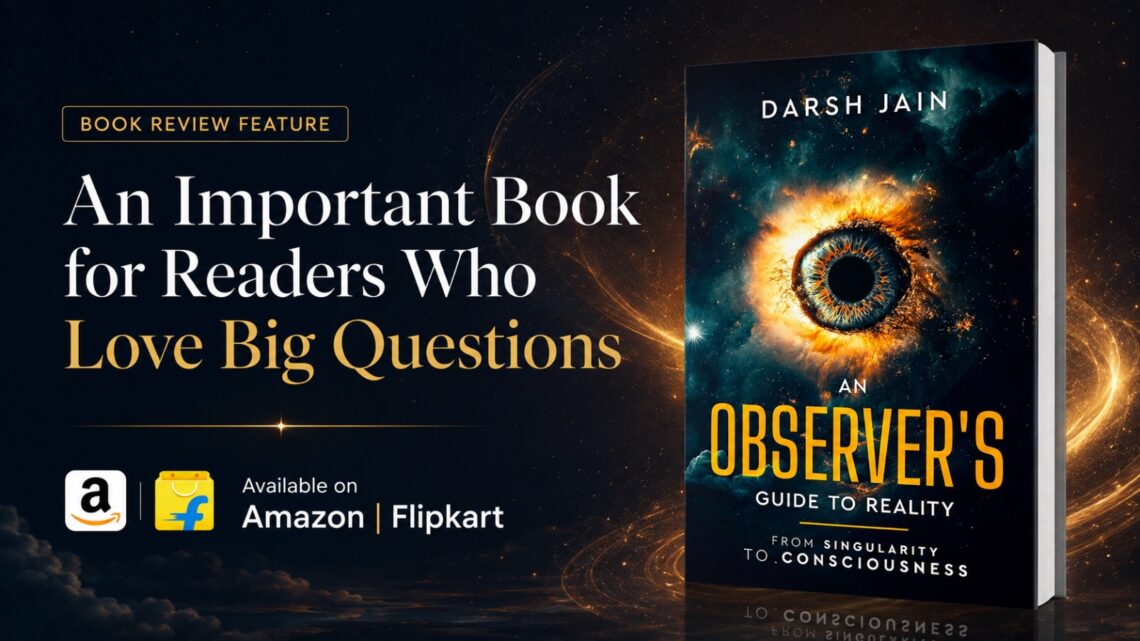
An Observer’s Guide to Reality becomes most intimate when it stops asking what the universe is made of and starts asking what the reader is made of. By the time Darsh Jain reaches The Illusion of Self, the book has already described billions of years of cosmic and biological change. That history now enters the brain. The central question is simple to ask and difficult to answer: who is the “I” that seems to be living behind our eyes? We speak as though there is a single inner owner who thinks, decides, remembers, loves, regrets, and controls the body. The book challenges that picture. It suggests that the self may be less like a permanent object and more like a story continuously built by neural activity, memory, language, sensation, and emotion.
This is one of the reasons the book is important. The sense of self feels so obvious that most of us rarely examine it. We wake up and assume that the same “me” from yesterday has returned. But the mind changes constantly. Memories are edited. Moods alter perception. Hormones influence desire. Stress changes decision-making. Injury can change personality. Language gives shape to thought. Social feedback affects identity. The book gathers these observations into a larger argument: what we call the self may be the brain’s way of creating continuity across many changing processes. Readers do not need to accept the idea completely to find it useful. Even questioning the stability of the self can create a more flexible understanding of personality and behaviour.
The chapter’s treatment of language is especially thought-provoking. Words such as love, justice, freedom, success, or failure have no physical meaning to a cell. They are sound patterns or visual symbols that the brain learns to connect with experiences and emotions. Human language is powerful because it allows one brain to transmit structured meaning to another. Yet once we learn a word, it can begin to feel like a thing. We say “I am a failure,” “I am successful,” “I am angry,” or “I am this kind of person,” and the sentence can harden into identity. Jain asks us to notice that language may describe experience without being identical to experience. That distinction can be psychologically valuable.
The discussion of free will follows naturally. We usually feel that our choices begin in a conscious self. The book asks us to look beneath that feeling. A decision may involve genetic tendencies, childhood conditioning, learned habits, hormonal states, emotional circuits, environmental cues, memories, and the work of the prefrontal cortex. Much of this happens without conscious control. Even the ability to pause and consider an action depends on brain development and neural systems we did not choose to possess. Jain therefore questions whether free will exists in the strong sense of an independent inner agent operating outside cause and effect.
This argument can sound fatalistic, but the book tries to move in a different direction. Understanding causes does not have to make us passive. It can make us more intelligent about change. If anger is not a moral stain but a biological and learned response, we can study its triggers. If a habit is built through repeated neural pathways, we can change the environment that reinforces it. If fear involves ancient survival circuits, we can learn why the body reacts before the reflective mind catches up. The book’s most useful idea is that understanding the machinery of behaviour may be more practical than blaming a mysterious inner self for failing to control everything.
This also changes the way we see other people. Modern culture often explains behaviour through labels: lazy, selfish, weak, evil, talented, disciplined, foolish. Jain encourages a deeper question: what produced the behaviour? A person may have a reactive nervous system, a history of trauma, a particular childhood environment, a set of cultural beliefs, or years of learned reinforcement. None of this automatically excuses harmful actions. The book is careful to move toward understanding, not toward the idea that consequences do not matter. But it asks us to replace quick moral judgment with curiosity about causes. That shift can produce more compassion without removing responsibility for protecting others.
The neuroscience is presented in accessible language. The prefrontal cortex, limbic system, amygdala, memory networks, and neural communication are not treated as a collection of labels to memorize. They are brought into familiar experiences. Sudden fear can activate older circuits before reflective thought has time to respond. A person can feel an emotion in the body before consciously naming it. Self-control requires communication between systems involved in impulse, prediction, and planning. The inner voice depends on learned language. Through these examples, the book turns the brain from an anatomical diagram into an active participant in everyday life.
Consciousness remains the deepest mystery. Jain does not claim to solve it. Instead, he asks whether consciousness is a separate witness or an emergent pattern created when biological systems become complex enough to represent the world and themselves. The book plays with the idea that matter has become capable of observing matter: atoms arranged into a brain that can study atoms. That image is powerful because it preserves wonder without requiring a supernatural explanation. The universe may be indifferent, but through conscious organisms it contains local pockets of experience—beings that can feel beauty, pain, love, curiosity, and fear.
The final movement toward “observe the observer” gives the self discussion a practical purpose. If thoughts arise from many causes, perhaps we do not have to identify with every thought. If anger appears, we can observe it. If jealousy appears, we can observe it. If fear appears, we can notice the body, the story, the memory, and the prediction involved. Observation does not make emotion disappear, but it can reduce the speed with which emotion becomes action. The book’s idea of freedom is therefore subtle. Freedom may not mean escaping causality. It may mean understanding enough of our own processes to respond with greater clarity.
This section is particularly valuable for readers interested in psychology, neuroscience, meditation, philosophy of mind, or personal development. Unlike many self-help books, An Observer’s Guide to Reality does not begin by telling the reader that they can simply choose a new identity through willpower. It first questions how choice works. That can be refreshing. It can also be uncomfortable. The book removes some of the flattering stories we tell about complete control, but it replaces them with a more realistic respect for biology, environment, and learning. Growth becomes less about commanding the self and more about understanding conditions.
Readers should approach these chapters with openness rather than fear. The claim that the self is an illusion does not mean that life is unreal or that feelings do not matter. An illusion can be a real experience produced by a system. The sense of a stable self may be useful for memory, planning, relationships, and social life even if it is not a separate substance. The question is what happens when we stop treating that self as sacred and fixed. Perhaps we become less defensive. Perhaps we become more willing to change. Perhaps we see that another person’s mind is also a history in motion. That possibility is why the book’s exploration of consciousness and free will deserves attention: it turns a philosophical puzzle into a mirror, and the reader becomes the subject being observed.
Why readers should consider this book
- It makes difficult debates about self, consciousness, and free will approachable.
- It links everyday emotions and decisions with biology and brain function.
- It encourages more compassionate thinking about the causes behind behaviour.
Book link: https://www.amazon.in/dp/934747276X