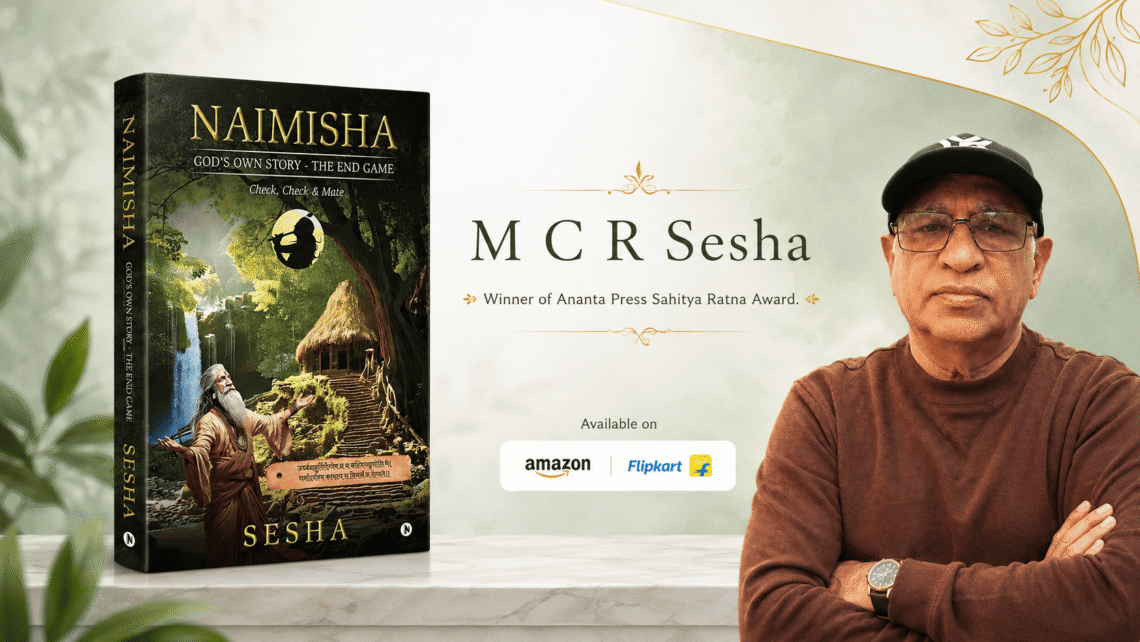
Naimisha – God’s Own Story – The End Game – Check, Check & Mate is best understood not merely as the third installment in a series, but as the final movement of a large narrative composition. M C R Sesha’s Naimisha Trilogy has been built around a world that draws from the Mahabharata while also making space for fictional lives of its own. The third book carries a heavy responsibility: it must bring legendary characters toward known destinations, allow original characters to complete less predictable journeys, portray major wars with enough energy to satisfy lovers of historical fiction, and still preserve the philosophical questioning that gives an epic retelling lasting value. The book’s description makes clear that this is the volume in which those ambitions converge.
For readers who enjoy endings, this is an especially interesting premise. Endings reveal what a writer believed the story was really about. A final battle can make a work look like an adventure. A final reconciliation can make it look like a family drama. A final insight can turn the entire series into a meditation. The phrase “philosophical undertones” is therefore central to understanding the identity of The End Game. Its subject matter includes Kurukshetra and the wars of Ashwamedha, but war appears to function as a crucible in which larger questions are tested. What survives a battle? Which beliefs remain intact? What does duty cost the person who fulfils it? How much control do individuals truly possess when history, prophecy, loyalty, and inherited obligation press upon them from every direction?
The Mahabharata has always invited this kind of layered reading because it resists moral simplification. Its characters are capable of greatness and error, wisdom and blindness, generosity and vengeance. Even those who fight for a just cause are not spared difficult choices. The epic’s spiritual power comes partly from this refusal to offer a comfortable universe in which right action is always obvious. Sesha’s decision to make the concluding book philosophically inclined therefore seems appropriate to the material. A finale should not merely tell us who remains standing. It should ask what standing means after the world has been altered by violence.
The Kurukshetra War is naturally the dramatic heart of such a volume. Yet the promise of “details” about the war is more meaningful when seen in combination with the book’s wider purpose. Battle scenes in historical fiction can easily become lists of movements, weapons, and victories. Their real literary value emerges when the physical conflict exposes inward conflict. Every major encounter can carry memory, obligation, resentment, grief, or moral hesitation. Readers familiar with the Mahabharata already bring emotional knowledge to these events, which gives a novelist both an advantage and a challenge. The advantage is resonance: names and situations arrive charged with centuries of cultural meaning. The challenge is freshness: the author must make readers feel that these familiar events deserve to be encountered again.
One way the Naimisha project creates that freshness is through Animish and Asareer. Original characters in epic fiction can serve as bridges between the monumental and the intimate. Legendary heroes sometimes become symbols in the reader’s mind; fictional characters can restore the uncertainty of ordinary life. They do not have a predetermined place in cultural memory. Their choices can surprise us, and their endings can be shaped entirely by the novelist’s thematic design. The information about this volume emphasises that Animish and Asareer finish their life’s journeys differently. That difference suggests that the trilogy is not interested in a single formula for fulfilment. Two lives can pass through the same historical-spiritual world and arrive at distinct truths.
This plural approach is one of the most promising aspects of the book. Philosophical fiction becomes unconvincing when every character exists only to confirm the author’s thesis. It becomes richer when different characters embody competing possibilities. One may accept destiny while another resists it. One may seek action while another turns inward. One may discover peace through fulfilment of duty, while another discovers that duty itself is not enough. Without inventing the specific paths Sesha gives his two fictional figures, the fact that their conclusions are contrasted is enough to signal a meaningful design. Their endings can function as interpretive counterpoints to the more famous destinies around them.
The presence of Krishna deepens this structure. Krishna is arguably the figure through whom the Mahabharata most clearly joins history, theology, philosophy, and political intelligence. He is difficult to contain within a single literary category. To some readers he is the divine guide of the Bhagavad Gita; to others he is the strategist whose decisions shape political outcomes; to others he is friend, kinsman, counsellor, or embodiment of cosmic purpose. A final volume that brings Krishna’s arc to closure must inevitably confront the tension between divine design and human suffering. If events are part of a larger order, what does that mean for individual pain? If dharma requires action, why is righteous action so often tragic? Those are not questions with easy answers, and the book’s philosophical orientation is more appealing because it does not appear to promise easy ones.
The extension from Kurukshetra to Ashwamedha gives the novel an additional historical dimension. It acknowledges that war has an aftermath and that political legitimacy must be enacted after being won. The Ashwamedha tradition carries themes of sovereignty, expansion, ritual authority, and the reorganisation of power. Including those campaigns allows the final book to move beyond the emotional peak of the great war into the less glamorous but equally significant work of establishing a new order. For historical-fiction readers, that wider temporal canvas can be particularly rewarding. It turns the narrative from a single conflict into a study of transition.
M C R Sesha’s personal journey as an author also fits the reflective nature of this project. After a distinguished academic beginning at Andhra University and a long career in a nationalised bank, he turned seriously toward reading and writing after retirement. That late literary beginning is inspiring because it demonstrates that authorship need not belong to a particular age or career path. More importantly, it may help explain the patience required to complete a trilogy of this scale. Long-form epic fiction demands sustained concentration, willingness to live with characters across years, and a tolerance for complexity. Those qualities are often strengthened by experience rather than diminished by it.
There is also an appealing contrast between the author’s professional background and the mythic-historical world he has chosen to inhabit. Banking is associated with systems, calculation, risk, accountability, and long-term consequence. The Mahabharata is filled with those same structural concerns in radically different forms. Kingdoms are political systems. Vows are commitments with consequences. Alliances are forms of risk. Decisions accumulate until they become destiny. The chess-like subtitle of the third book reinforces this sense of calculated movement. “Check, Check & Mate” implies that the conclusion is not a sudden accident but the result of a board on which many moves have already been made.
As historical fiction, Naimisha – The End Game is therefore likely to appeal most strongly to readers who enjoy the intersection of narrative scale and reflective depth. The famous wars offer action and momentum. The Mahabharata figures offer cultural resonance. Animish and Asareer offer original uncertainty. Krishna provides a philosophical and spiritual axis. The trilogy format allows themes to mature over time rather than being compressed into a single volume. Taken together, these elements give the book a distinct place among mythological and historical retellings.
A fitting final volume should close doors without sealing off thought. It should reward the reader for travelling through the earlier books, but it should also leave behind questions that continue after the last page. The description of Naimisha – God’s Own Story – The End Game – Check, Check & Mate suggests precisely that intention. Its characters complete their journeys, wars reach their historical conclusions, and the trilogy reaches its planned end. Yet the deeper subjects – dharma, destiny, responsibility, the cost of power, and the meaning of closure itself – remain open. That is not a weakness in an ending. For a book inspired by the Mahabharata, it may be the most faithful kind of ending possible.
Amazon Purchase Link: https://amzn.in/d/0giaBcBM