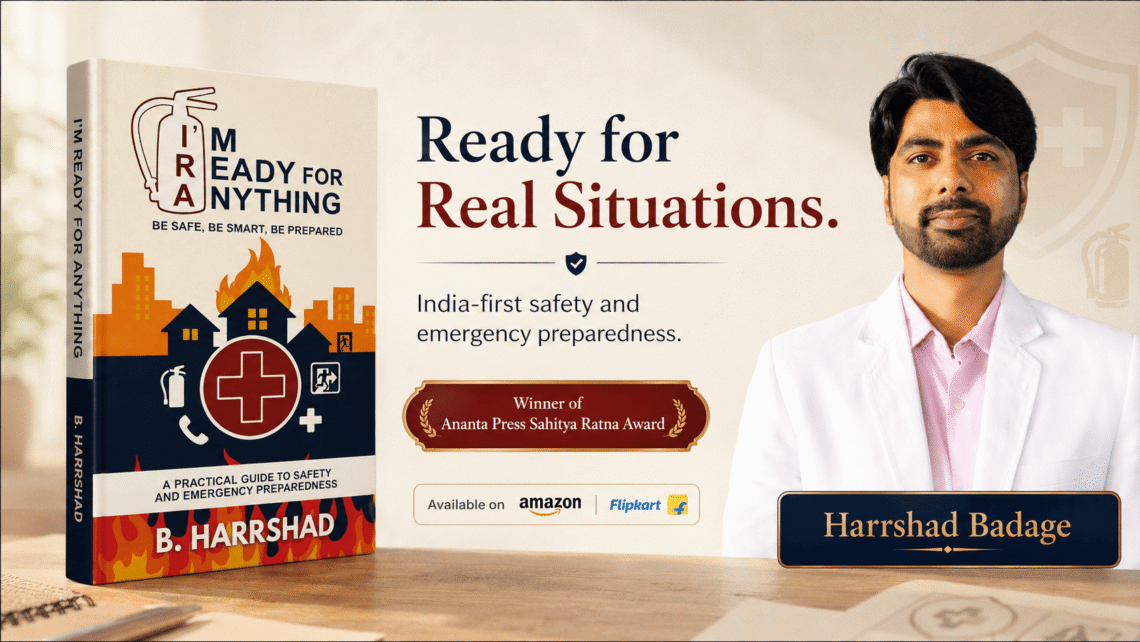
A reassuring guide to the psychology of emergencies and the power of simple plans
The most memorable idea in I’m Ready for Anything (IRA) is not a particular emergency technique but a change in mindset: preparedness is not fear; preparedness is confidence. That distinction gives Harrshad Badage’s book both its practical purpose and its emotional intelligence. Emergencies are frightening partly because they arrive with uncertainty. People may know that they should “stay calm,” yet calmness is difficult to summon when there is smoke in a corridor, water rising outside, a loved one injured after a road accident, a suspicious transaction on a phone, or darkness during a long power failure. The book responds to this problem by replacing vague reassurance with something more dependable – knowledge, planning, and simple actions that can be considered before the crisis begins.
This focus makes IRA especially useful for readers who find emergency preparedness intimidating. Safety education is sometimes presented in a way that overwhelms people with dangers, warnings, and technical procedures. Such an approach can accidentally create helplessness. Badage takes a more constructive route. The book is described as conversational and action-oriented, using relatable stories, Indian case studies, checklists, first-aid methods, and planning strategies. The intention is not to make readers memorize an entire emergency-management curriculum. It is to help them develop a small set of reliable responses that can reduce hesitation when something goes wrong.
The author’s professional observations appear to have shaped this philosophy. His profile notes that, while working in safety and emergency training, he repeatedly saw that panic was not always caused by the severity of an incident itself. Often, it grew from a lack of awareness and preparation. That insight is important. Human beings make poorer decisions when they are surprised, confused, or unsure about what is happening. Preparation cannot remove danger, but it can reduce the number of unknowns. If people have discussed where to meet, who will call whom, how to leave a building, how to shut off a hazard, or what first-aid steps are appropriate, the emergency begins with at least some structure.
IRA therefore treats planning as a form of psychological readiness. A checklist is not merely a list; it reduces the mental load of remembering everything at once. A practiced evacuation route is not merely a compliance exercise; it makes movement more familiar when visibility or attention is reduced. A saved emergency contact is not merely a phone entry; it prevents wasted time. A basic first-aid skill is not merely information; it can give a bystander a meaningful role. Seen this way, the book’s practical tools are also confidence tools. They help people move from “I have no idea what to do” toward “I know my next step.”
The range of emergencies included strengthens this theme. Fires, floods, earthquakes, road accidents, gas leaks, blackouts, workplace emergencies, cyber scams, and civil unrest are very different events, yet they share certain human challenges: recognizing risk, avoiding panic, communicating clearly, protecting vulnerable people, and making good early decisions. By bringing such scenarios together, the book suggests that preparedness is not only about memorizing separate instructions. It is also about developing habits of attention and planning that can transfer across situations.
This is where the book becomes more than a manual. It encourages readers to think about their relationship with uncertainty. Most people prefer to believe that serious incidents are rare enough to ignore. Yet everyday life contains many low-frequency, high-consequence events. The practical question is not whether a person can predict exactly what will happen, but whether simple preparation can reduce the harm if something does happen. IRA’s answer is clearly yes. That message is empowering because it focuses on what is within the reader’s control: awareness, basic skills, communication, household planning, and responsible behavior.
A compelling detail from Badage’s training career illustrates this idea. During a workshop in Pune, he taught participants how an improvised collar bandage could be made from ordinary newspaper and cloth. Nearly five years later, one participant reported using the remembered technique to stabilize a road-accident victim until professional medical assistance arrived. The story captures the value of practical safety education in a way statistics often cannot. The participant did not need to become a full-time rescuer. One retained technique, recalled at the right moment, created enough confidence to act. IRA appears to be written in that spirit: teach useful things clearly enough that they remain available in memory when needed.
The book’s India-first orientation also supports its reassuring quality. Advice is easier to trust when it reflects environments readers recognize. The author was motivated in part by the absence of a single practical resource dealing with common Indian scenarios such as LPG leaks, monsoon flooding, road accidents, cyber fraud, building fires, stampedes, and prolonged blackouts. International survival literature may be interesting, but a reader is more likely to engage seriously with a guide that speaks to the hazards of the home, street, workplace, and community around them. Familiarity makes the subject less abstract and helps preparedness feel achievable.
Another strength is the way the book can encourage shared confidence. Emergencies are rarely experienced in isolation. Parents worry about children; adult children worry about elderly family members; managers are responsible for teams; teachers care for students; neighbors may need to assist one another. A family plan or workplace procedure works best when multiple people understand it. The book’s practical format can support these conversations. Instead of one person carrying all the responsibility, preparedness becomes distributed. That can reduce panic even further because individuals know they are part of a coordinated response rather than alone.
The inclusion of cyber scams broadens the psychological message in an interesting way. Digital fraud often depends on panic, urgency, authority, or confusion – the same emotional pressures that impair judgment in physical emergencies. A message claims that an account will be blocked; a caller demands immediate action; a fraudulent link creates a sense of crisis. Preparedness in these moments also means slowing down enough to recognize the manipulation. By including modern digital risks, IRA demonstrates that calm decision-making is a safety skill across environments, not only during fires or disasters.
Readers who already have professional safety responsibilities may appreciate the book as a reinforcement tool, but its greatest value may be for people who have never taken a formal safety course. The conversational style lowers the barrier to entry. The use of stories and cases makes the subject human. The checklists and steps make the information actionable. Most importantly, the tone suggests that readers do not need to become fearless. They simply need to become better prepared.
I’m Ready for Anything is therefore a reassuring book about difficult subjects. It acknowledges danger without sensationalizing it. It respects the reality that panic can happen while showing that preparation can reduce its power. It encourages practical action without demanding perfection. And it reframes readiness as an expression of care: when people learn basic safety, they are not only protecting themselves but increasing their ability to help family, colleagues, and strangers.
The title ultimately becomes a statement of earned confidence rather than bravado. “I’m ready for anything” does not mean that nothing can go wrong or that every emergency can be controlled. It means that the reader has chosen not to be completely unprepared. That is a realistic and valuable promise, and it gives the book a distinctive place among general nonfiction guides on safety and resilience.
Amazon Purchase Link: https://amzn.in/d/01LeypC9