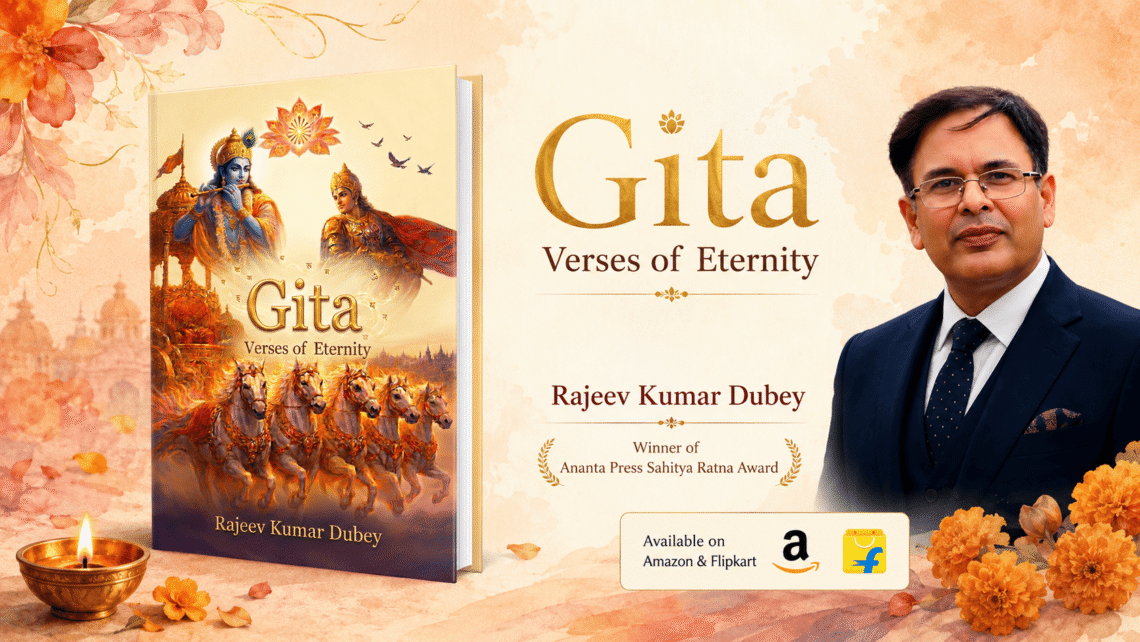
What makes Gita: Verses of Eternity by Rajeev Kumar Dubey especially relevant to the present day is its insistence that spiritual understanding belongs inside life, not outside it. The book draws inspiration from the Bhagavad Gita, a work born from a moment of extreme moral conflict, and seeks to make its insights accessible through poetry. This is significant because many modern readers do not approach philosophical texts merely out of historical curiosity. They are looking for language that can help them think through work, responsibility, uncertainty, ambition, relationships, and the difficult choices that accompany adult life. Dubey’s project speaks directly to that need.
The stated audience includes professionals facing ethical decisions, and this may be one of the most compelling ways to understand the book. Professional life often rewards speed, efficiency, competition, and measurable outcomes, yet the most consequential choices cannot always be reduced to performance metrics. A doctor may face competing obligations to patient welfare, institutional rules, available resources, and family expectations. A manager may have to choose between short-term advantage and fairness. A teacher may balance standards with compassion. A public servant may confront the tension between procedure and conscience. In such situations, the question is not simply “What can I do?” but “What should I do, and with what state of mind?” The Gita’s enduring relevance lies in precisely this territory, and Dubey’s poetry is designed to bring that territory closer.
The book’s core philosophical appeal is the relationship between action and understanding. It presents the Gita not as an argument for retreat, but as a guide to engagement. This is an important corrective to the idea that spiritual wisdom is mainly about renunciation of worldly responsibilities. For readers immersed in careers, families, institutions, and social obligations, a spirituality of responsible action can be far more meaningful. Gita: Verses of Eternity encourages a form of inward reflection that does not end in passivity. Instead, clarity is meant to improve the way one acts.
Poetry is a strong medium for this purpose because ethical life is rarely neat. Rules matter, but human situations are layered with emotion, identity, fear, loyalty, ego, and attachment. A poem can hold contradiction without rushing to resolve it. It can allow a reader to sit with uncertainty, which is often the beginning of mature judgment. Dubey’s decision to use poetic language therefore gives the book a reflective tempo that differs from self-help manuals or philosophical textbooks. It encourages thought rather than prescribing formulas.
This quality may make the book particularly useful for readers under pressure. In moments of stress, dense philosophical exposition can be difficult to absorb. Poetry offers shorter units of contemplation and can be returned to repeatedly. A reader may find that a verse understood one way during a calm period speaks differently during conflict or loss. Such re-readability is part of the lasting value of spiritual poetry. The book’s title, Verses of Eternity, suggests precisely this hope: that the words will not be exhausted by a single reading because the questions they address recur throughout life.
Rajeev Kumar Dubey’s professional background makes the ethical dimension of the book even more resonant. He serves as Professor of Anaesthesiology at the Institute of Medical Sciences, Banaras Hindu University, and his academic training spans anaesthesiology, critical care, and hospital administration. These are areas in which responsibility is not theoretical. Clinical work demands competence, calm decision-making, teamwork, and ethical awareness, often in high-stakes situations. Hospital administration adds questions of systems, resources, and institutional responsibility. Teaching requires the ability to transmit difficult knowledge clearly. It is therefore striking—and fitting—that an author with this background would be drawn to the Gita’s questions about action, judgment, steadiness, and duty.
At the same time, Dubey is not writing only as a physician or academic. He is also described as a sensitive poet with sustained interests in Indian culture, literature, history, spirituality, meditation, and yoga. His poetry has appeared in literary journals and has been presented on literary platforms and All India Radio. That artistic identity prevents the book from feeling like a professional ethics handbook disguised as spirituality. The medical background adds depth, but the literary impulse gives the work warmth, openness, and human resonance.
The book is also valuable because it refuses to limit its relevance to a single profession or age group. Young people searching for meaning may face a different kind of battlefield: decisions about career, identity, expectations, success, and belonging. They are often told to “follow their passion” or “work hard,” but such slogans do not answer deeper questions about purpose, responsibility, or the kind of person one wants to become. Gita: Verses of Eternity offers a vocabulary for these larger concerns. It suggests that clarity is not merely about choosing a goal; it is also about understanding the motives and attachments that shape one’s choices.
For spiritual seekers, the book offers another advantage: it presents spirituality as compatible with diversity of background. Its intended readership extends beyond those already immersed in Gita study. This openness matters because ethical questions are universal even when philosophical traditions differ. The reader can encounter ideas about disciplined action, self-awareness, and inner balance without needing to begin as a specialist. In this sense, the work is less a gatekeeping text than an invitation to reflection.
The author’s broader poetic concerns—truth, social harmony, universal brotherhood, and human values—give the book a civic dimension as well. Personal spirituality can become self-absorbed if it is concerned only with individual peace. The values associated with Dubey’s poetry suggest a wider horizon: inner clarity should influence the way people relate to others. A person who becomes calmer but less compassionate has not necessarily become wiser. A person who speaks about detachment but avoids responsibility may have misunderstood the point. By connecting spiritual reflection to human values, the book points toward an ethics that is both inward and social.
What distinguishes Gita: Verses of Eternity from many motivational books is that its foundation is not productivity, success, or positive thinking. Its deeper concern is orientation. It asks the reader to reconsider the relationship between action and attachment, purpose and ego, responsibility and fear. That gives it a seriousness that can appeal to readers tired of quick formulas. The poetic presentation may be gentle, but the questions underneath are demanding.
The book’s uniqueness also lies in the author’s ability to stand between worlds: science and spirituality, medicine and poetry, academic discipline and cultural tradition. Rather than treating these as opposites, the work suggests that a full human life may require several forms of intelligence. Scientific knowledge helps us understand processes; ethical and spiritual reflection helps us decide how knowledge should be used. Professional skill can make us effective; inner awareness can help us become responsible. Poetry can connect these dimensions by speaking to both thought and feeling.
Gita: Verses of Eternity is therefore more than a spiritual introduction. It is a reflective companion for people who must act in imperfect circumstances. Its message is relevant precisely because modern life gives us no shortage of decisions but not always enough wisdom about how to make them. By bringing Gita-inspired insights into accessible poetic language, Rajeev Kumar Dubey offers readers a chance to reconsider not only what they do, but the consciousness with which they do it. For anyone seeking a more thoughtful relationship with duty, purpose, and inner balance, this book has a clear and distinctive value.
Amazon purchase link: https://amzn.in/d/0e2udQ4o