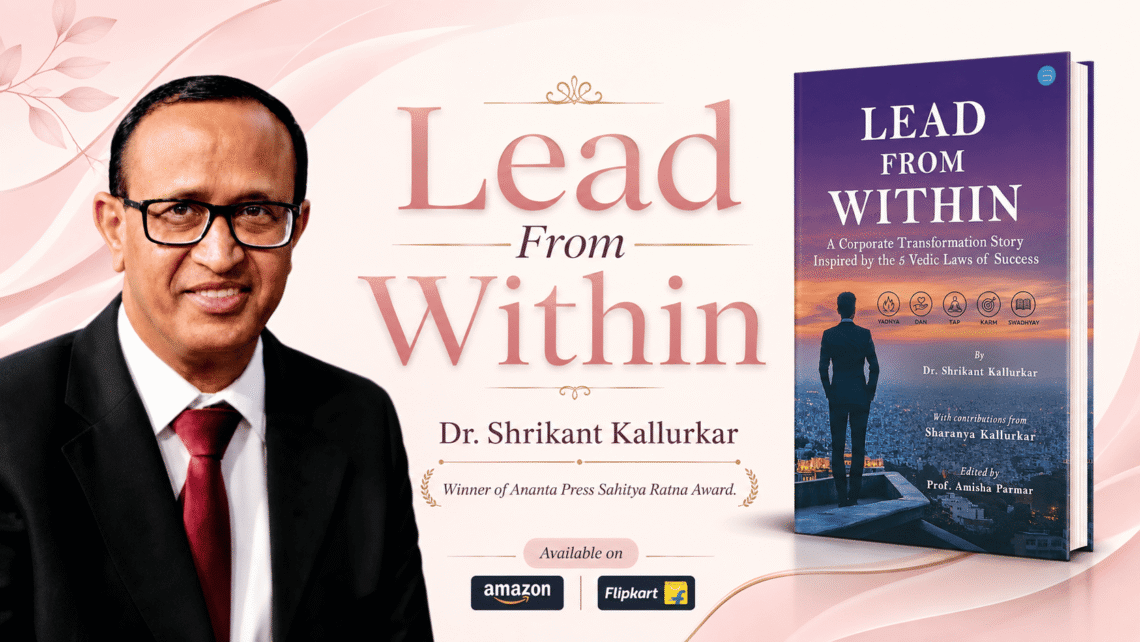
One of the most compelling features of Lead From Within: A Corporate Transformation Story by 5 Vedic Laws of Success is that it recognizes career stagnation as an inner experience before it becomes an external label. Dr. Shrikant Kallurkar does not begin with a failed professional, an incompetent employee, or a dramatic collapse. He begins with Michael Smith, a capable Cyber Security Engineer who is still functioning, still working, and still delivering technically strong results. Yet beneath that visible competence, something has changed. His energy is depleted. His health is neglected. He hesitates to speak. He feels overlooked. His confidence has faded, and the sense that his work has meaning has weakened. This is a recognizable condition for many readers because professional decline rarely begins with a single event. It often begins quietly, with a series of small retreats from one’s own capacity.
The phrase “You’re shrinking,” spoken to Smith by his boss, becomes a powerful diagnosis. It is not simply criticism about output. It names a loss of presence. Smith is becoming smaller in his own professional life. He is less visible, less assertive, less connected to his strengths, and less willing to occupy the space his competence has earned. The later incident in which a colleague presents Smith’s work and receives recognition becomes a breaking point because it makes that shrinking visible. Smith can no longer explain his situation only through workload or unfair circumstances. He must ask what has happened inside him that has made passivity, exhaustion, and silence seem normal.
This narrative setup is one reason the book works as self-development rather than conventional instruction. Readers are invited to identify with a person before being introduced to a system. Smith’s problem is not presented as a list of deficiencies. It is dramatized through the tension between what he is capable of and how he is actually living. This gives the book emotional credibility. Many professionals know the feeling of being productive but not progressing, responsible but not recognized, experienced but increasingly uncertain. The story suggests that the first step in transformation is not a new tactic but an honest recognition of the gap between the professional one has become and the professional one is capable of becoming.
The workshop led by Dr. Shrikant introduces the central proposition: inner system shapes outer performance. This idea changes the direction of the problem. Smith initially experiences his difficulty as a career issue. The book asks him – and the reader – to investigate the human system beneath the career. The Panchakosha becomes the diagnostic map for that investigation. Instead of treating the self as one undivided unit, the framework identifies five dimensions that influence professional functioning.
Annamaya Kosha, the physical dimension, is particularly important in Smith’s case because he has been working late and neglecting his health. Professional culture often praises sacrifice until the cost becomes impossible to ignore. Lead From Within challenges that pattern by treating physical care as part of excellence rather than a reward one earns after work is finished. Energy, sleep, nourishment, and recovery influence attention, mood, patience, and resilience. When the physical base is weak, even strong professional skills become harder to express consistently.
Pranamaya Kosha brings attention to breath and emotional energy. This dimension helps explain why two people with similar knowledge may respond very differently under pressure. A professional who cannot regulate internal arousal may become reactive, defensive, anxious, or withdrawn. Smith learns to pause, breathe, and act more consciously rather than allowing pressure to dictate his response. The importance of this practice lies in its simplicity. It gives self-leadership a physical entry point. Before changing a career, one may need to change the quality of a moment: the breath before speaking, the pause before replying, the few seconds in which an automatic reaction can become a deliberate response.
Manomaya Kosha addresses the mental narratives that shape behaviour. This is where the book becomes psychologically insightful without losing accessibility. Thoughts, fears, assumptions, and interpretations are not treated as harmless background noise. They influence what a person says, avoids, expects, and attempts. A professional can become trapped not only by organizational structures but also by an internal story about what is safe, possible, or deserved. Smith’s hesitation in meetings is therefore not merely a communication problem. It may reflect an entire pattern of interpretation about recognition, authority, risk, and self-worth.
Vijnanamaya Kosha introduces discernment and wisdom, expanding self-development beyond emotional confidence. The book implies that growth requires the ability to distinguish between impulse and right judgment, between busyness and meaningful action, and between external pressure and internal values. This is crucial because a person can become more confident without becoming wiser. Lead From Within is not interested in confidence as performance alone. It connects professional maturity with ethical clarity and thoughtful decision-making.
Anandamaya Kosha brings the reader to purpose and fulfilment. Smith’s stagnation is not only about promotion. The deeper question is whether he still experiences meaning in what he is doing and whether his professional life is connected to a larger sense of direction. By including joy and purpose in the framework, the book avoids reducing transformation to improved productivity. The destination is not simply a more efficient employee. It is a more integrated human being whose work expresses competence without destroying balance or meaning.
The Five Vedic Laws of Success then give Smith behavioural principles through which this inner rebuilding can become visible. Yadnya, or contribution, is particularly relevant to the emotional wound of being overlooked. It encourages quality of effort that is not completely dependent on immediate recognition. This does not mean accepting exploitation or remaining silent when credit is taken. Rather, it places contribution at the center of identity so that professional value is not defined only by applause.
Dana, or giving and kindness, adds a relational dimension to growth. A stagnant career can make a person inwardly preoccupied: Who is getting ahead? Who is receiving credit? Who is blocking me? Dana interrupts that narrowing of attention by encouraging appreciation, respect, patience, and support. The principle suggests that influence grows not only from competence but also from the quality of one’s presence with others.
Tapa, discipline and stability, is essential because transformation cannot depend on occasional inspiration. Smith’s problem developed over time, so it must also be rebuilt through repeated practice. Discipline here is not punishment. It is the capacity to sustain useful routines, regulate impulses, and remain steady when circumstances do not cooperate. This is a mature understanding of change. The book does not imply that one insight at a workshop will permanently transform a professional life. It emphasizes patterns.
Karma, right action, gives the book moral weight. Smith must learn not merely to feel better but to act with responsibility and courage. A professional can understand every principle intellectually and still avoid the difficult conversation, delay the important decision, or remain silent when integrity requires a response. Right action closes the gap between insight and behaviour. It asks the reader to become accountable for choices.
Swadhyaya, self-reflection, makes the process continuous. Every professional environment changes. New pressures arise, roles shift, and old habits return. Self-reflection creates a mechanism for ongoing learning. It allows readers to notice where they are shrinking again, where their energy is falling, where thought patterns are distorting reality, and where actions are moving away from values. In this sense, the book is not simply about one transformation. It offers a way of maintaining transformation.
The story-based structure makes all of these concepts more memorable. The reader is not required to memorize Sanskrit terms in isolation. Each idea is attached to a human problem. This gives Lead From Within a strong teaching quality. It can be read individually, but it also seems well suited to workshops, leadership discussions, classrooms, mentoring conversations, or professional development programmes where readers can connect a framework to their own experiences.
Another strength is that the book does not frame self-examination as withdrawal from ambition. Smith is not encouraged to become indifferent to his career. The goal is to rebuild the internal conditions that allow him to pursue excellence in a healthier and more conscious way. This balance is important. Some books celebrate relentless ambition; others react by suggesting detachment from achievement. Lead From Within proposes integration. Professional success matters, but it should emerge from health, regulation, clarity, wisdom, values, and purpose.
Dr. Kallurkar’s academic and mentoring background supports this educational approach. Having spent decades across engineering education, research, academic leadership, entrepreneurship, and institutional development, he brings a systems perspective to human growth. The language of “inner system” is especially appropriate for a writer with an engineering background because it treats performance as the output of interacting components rather than a mysterious quality called motivation.
Ultimately, the book’s uniqueness lies in the way it names an invisible problem. A professional may not be failing, yet may still be shrinking. A career may not be collapsing, yet may still be losing meaning. A person may continue to produce work while becoming disconnected from health, voice, values, and purpose. Lead From Within offers a framework for noticing that process before it becomes irreversible. It is a book about rebuilding presence from the inside outward, and that makes it a thoughtful contribution to contemporary conversations about work, wellbeing, leadership, and sustainable success.
Amazon link: https://www.amazon.in/Lead-Within-Corporate-Transformation-Inspired/dp/9378256465/ref=tmm_pap_swatch_0