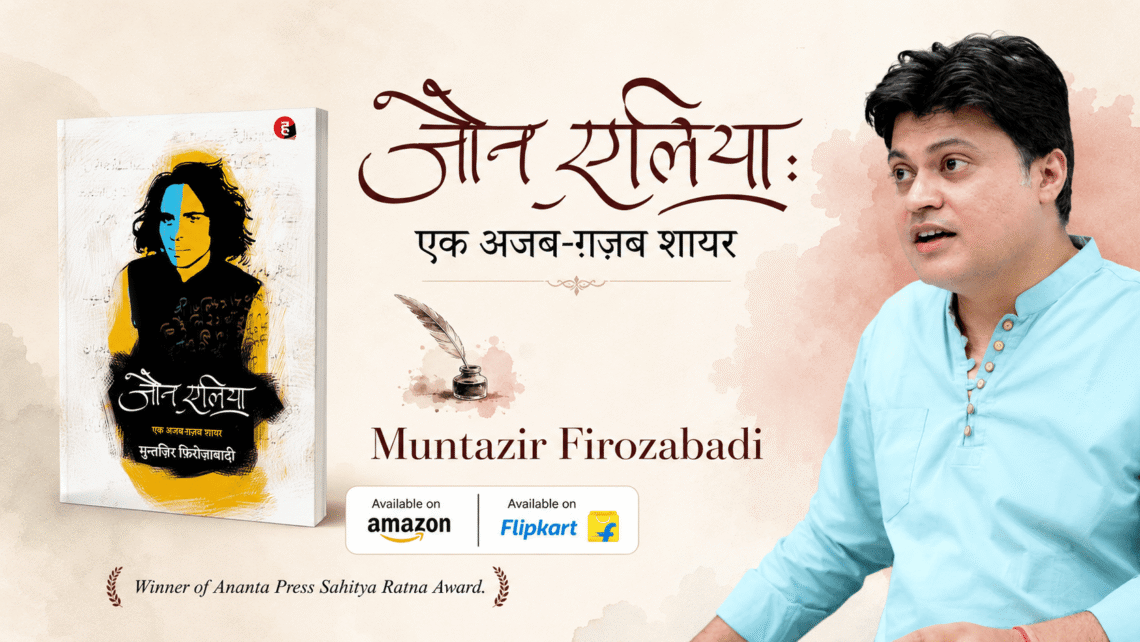
Book: Jaun Elia: Ek Ajab Ghazab Shayar | Author: Muntazir Firozabadi (Anant Bhardwaj) | Category: Poetry
There are writers whose biographies remain comfortably behind their books, and there are writers whose personalities become part of the reading experience. Jaun Elia is unmistakably one of the latter. To read him is often to hear an imagined voice: sharp, impatient, wounded, ironic, theatrical. Muntazir Firozabadi’s Jaun Elia: Ek Ajab Ghazab Shayar is especially interesting because it recognizes this unusual fusion of poetry and performance. The book’s exploration of ghazals, nazms, qata’at, and ‘Jauniyat’ gives readers a chance to understand not merely the words Jaun wrote but the dramatic temperament that continues to animate them.
The idea of drama in Jaun deserves serious attention. In ordinary usage, calling a poet dramatic might sound dismissive, but in Jaun’s case drama is an artistic resource. His poems often feel as though an argument is unfolding in real time. The speaker may accuse, withdraw, mock himself, challenge the beloved, reject convention, and suddenly arrive at a philosophical conclusion. Emotional states do not remain static; they become scenes. This gives Jaun’s poetry a performative force that translates exceptionally well to recitation and recorded media. It also explains part of his continuing popularity among younger audiences accustomed to hearing poetry as much as reading it.
Firozabadi’s portrayal of Jaun as blunt and rebellious adds a second dimension to that performance. Jaun did not cultivate the reassuring image of the dignified, balanced literary elder. His public memory is marked by discomfort with conformity. He could appear irritated by conventional moral language, impatient with social pieties, and unwilling to make himself agreeable. That abrasiveness gives his poetic voice unusual credibility when it speaks about alienation. The reader senses that the rebellion is not simply decorative; it belongs to a broader refusal to pretend that human beings are emotionally coherent.
Yet the book is not compelling merely because Jaun was rebellious. Rebellion without vulnerability quickly becomes posture. What makes Jaun enduring is that defiance repeatedly collides with need. The same voice that dismisses love may ache for it; the same intelligence that ridicules sentiment may be trapped by sentiment; the same persona that seems arrogant can expose a devastating fragility. A strong introduction to Jaun must preserve this tension, and the structure of Ek Ajab Ghazab Shayar appears designed to do so by placing poetry alongside aspects of personality.
The ‘Jauniyat’ component is therefore more than a decorative biographical section. It is a method of interpretation. Readers are invited to think about the relationship between the poet’s manner and his literary language. Why do certain lines sound different when we know something about the speaker’s temperament? Why do anecdotes about a poet alter the emotional color of a poem? At what point does a literary persona become part of cultural memory? These questions surround the reading experience even when the book is not presenting them in academic terms.
Jaun’s life story amplifies this sense of performance and rupture. Born in Amroha and later living in Karachi, he carried within his biography the movement and dislocation that shaped much of twentieth-century South Asian history. Yet he was never only a historical symbol. His literary persona feels fiercely individual. That combination—the historical and the idiosyncratic—is part of what makes him difficult to domesticate into a simple category. Firozabadi’s interest in personal stories and neglected facets gives the reader access to this complexity without demanding a scholarly background.
The book also benefits from the author’s own proximity to performance culture. Muntazir Firozabadi has participated in mushairas, literary festivals, radio, podcasts, YouTube conversations, and panel discussions. He understands that Hindi-Urdu poetry has always possessed an oral and performative life alongside print. His earlier ghazal collection and work with literary platforms indicate that he is not approaching recitation culture from outside. This matters because Jaun’s legacy cannot be fully explained by text alone; voice and presence are central to the phenomenon.
One of the pleasures of a volume combining multiple poetic forms is the chance to observe shifts in scale. A ghazal couplet can achieve extraordinary compression, allowing contradiction to flash within a few words. A nazm can develop an idea over a longer arc. Qata’at can deliver concentrated wit, commentary, or emotional force. When these modes are read together, the reader sees a poet moving through different expressive architectures. This is useful for audiences who know only the most quoted shers and may assume Jaun’s range begins and ends with short aphoristic brilliance.
The book’s language of addiction and thirst is also revealing. Jaun’s work often attracts readers through recognition: a line seems to articulate an irritation, loss, or self-contradiction they have felt but never phrased. Once that recognition occurs, the reader seeks more. Yet deeper reading usually complicates the initial identification. Jaun is not merely ‘relatable.’ He is intellectually demanding in the way he unsettles easy positions. The pleasure of reading him comes partly from discovering that a poet who seems immediately familiar can become stranger the longer one stays with him.
This strangeness is captured beautifully by the phrase ‘Ajab Ghazab.’ Jaun can be both intimate and alienating. He draws the reader close through emotional candor, then pushes the reader away through sarcasm or philosophical skepticism. He can make despair aesthetically exhilarating, which produces a morally and psychologically interesting tension. Firozabadi’s volume succeeds as a portrait because it does not need to resolve these contradictions. Its purpose is to let readers encounter them.
For contemporary readers, this is especially relevant. Digital culture favors simplified identities: the romantic poet, the rebel poet, the sad poet, the intellectual poet. Jaun refuses such neat branding even though he is frequently branded in precisely these ways. A book that combines his writings with glimpses of personality can challenge the flattening effect of internet fame. It can remind readers that the man behind the quote was complicated, historically situated, intellectually formed, emotionally volatile, and artistically deliberate.
There is also an important literary-critical benefit in seeing performance as part of poetics rather than as mere celebrity. Urdu poetry has a long history of public recitation, audience response, and sonic pleasure. Jaun’s delivery style belongs to that tradition while also modifying it. His pauses, tonal irritations, dramatic emphasis, and conversational stance helped create a distinct public voice. Firozabadi’s sustained interest in Jaun—including his work toward a film about the poet’s life—suggests sensitivity to these non-textual dimensions of literary memory.
The author’s wider projects on Sahir Ludhianvi, Parveen Shakir, and Shiv Kumar Batalvi reinforce the impression that he is engaged in building bridges between literary archives and popular audiences. Such work is crucial because canonical poets survive not only through academic syllabi but through acts of retelling. Each generation needs interpreters who can preserve complexity while renewing curiosity. Ek Ajab Ghazab Shayar performs that mediating function for Jaun.
Ultimately, this is a book for readers who want to understand why Jaun Elia feels larger than the page. It shows that his enduring appeal arises from the chemistry between thought, emotion, language, performance, and personality. His poetry has drama because his thinking moves dramatically; it has defiance because he distrusted easy settlement; it has vulnerability because beneath the rhetoric lies a deeply exposed self. Muntazir Firozabadi gathers these energies under the memorable idea of ‘Jauniyat’ and offers readers not a museum exhibit but a living encounter.
Amazon purchase link: https://amzn.in/d/09j2BZ3r