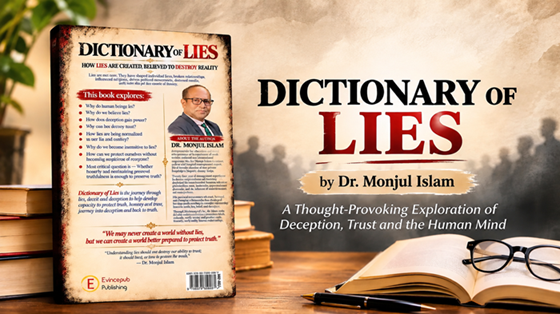
A misleading statement has always been able to travel from one person to another. What has changed is the speed, scale and appearance of that journey. Dictionary of Lies by Dr. Monjul Islam is particularly relevant when read against the pressures of contemporary information culture. Although the book moves through history, psychology and social life, its treatment of digital communication provides a compelling lens for the whole work. The central question becomes not simply why falsehoods exist, but why audiences are willing to accept and transmit them, sometimes without realizing that they are participating in deception.
Islam’s preface identifies the book as an investigation across history, religion, anthropology, psychology, philosophy, politics, media, healthcare, science and the digital world. This interdisciplinary ambition is important to its account of misinformation. False claims do not succeed because of technology alone. They often gain influence through existing relationships, fears, loyalties, aspirations and habits of belief. The book repeatedly returns to the human element behind the information channel. A platform may distribute a claim quickly, but the reader still has to decide what meaning and authority to assign to it.
The chapter devoted to social media describes a familiar modern problem: emotionally powerful content can be repeated until recognition is confused with reliability. Manipulated photographs, edited videos, fabricated quotations and synthetic material complicate the task of evaluation. Islam does not suggest that every dramatic image or controversial statement must be false. Instead, he asks readers to slow down the process of acceptance. Source checking, independent evidence and a distinction between reporting and commentary become basic tools of digital self-protection. This practical emphasis makes the discussion accessible beyond specialist audiences.
A valuable feature of the argument is its refusal to equate uncertainty with guilt. The author distinguishes deliberate falsehood from mistakes, misunderstandings, omissions and differences of interpretation. This is an essential safeguard in an environment where people may be publicly accused before the facts are known. Treating every inconsistency as proof of lying can be as damaging as accepting every claim uncritically. The book therefore frames verification as a constructive discipline. It allows readers to remain alert without turning alertness into reflexive distrust of everyone around them.
Islam’s account of the relationship between emotion and belief also deserves attention. A deceptive message may become persuasive because it promises something attractive or confirms an existing fear. The book’s examination of religious and philosophical traditions returns to this interaction among desire, belief, choice and consequence. In the context of contemporary media, the implication is clear: checking a claim requires more than inspecting the words on a screen. It may also require asking why a particular version of events feels so satisfying, alarming or immediately believable to us.
The chapters on institutions extend this concern beyond individual scrolling habits. A misleading business representation, an unreliable medical claim or an inaccurate educational narrative can alter decisions in ways that outlast the initial statement. In each setting, trust depends partly on the availability of reliable records and accountable procedures. The author’s recurring argument is that truth needs supporting practices. Good intentions alone are insufficient if a system rewards exaggeration, discourages correction or makes independent scrutiny difficult. The social cost of deception is therefore both emotional and structural.
The book also considers the industrialization of deception and the future role of artificial intelligence. These subjects fit naturally with its wider concern about the growing sophistication of misleading communication. Readers are encouraged to think about the difference between a convincing presentation and a verified account. The challenge is not only to recognize a fabricated item after it has circulated. It is to cultivate habits of inquiry before accepting or forwarding information. In this respect, the book connects technological change with a longstanding ethical question about responsibility for what one communicates.
Stylistically, Dictionary of Lies favours breadth, repeated reflection and explanatory examples over a narrow technical framework. That makes it approachable for readers interested in general ethical questions, although those seeking detailed empirical testing of every claim will need to consult additional specialized research. The author does not present the work as an exhaustive scientific verdict. He expressly welcomes criticism and identifies the project as a guide for self-transformation. This openness helps readers engage with the material as a starting point for examination rather than as an authority that ends discussion.
The most useful conclusion for a digital audience is that responsible information sharing begins with modest choices. One can wait before reposting a sensational claim, look for the original source, ask whether independent evidence exists and correct an error when necessary. None of these actions requires perfect knowledge. They require a willingness to acknowledge that first impressions can be wrong. Dictionary of Lies makes a case for that kind of intellectual humility, offering readers a way to resist manipulation without surrendering the possibility of trust.
Amazon Link: https://www.amazon.in/Dictionary-Lies-Dr-Monjul-Islam/dp/9373359266