A reflective review of empathy, courage, and character in early reading
A useful children’s story is not necessarily one that tells its reader what to think. Often it is a story that gives a child something worth thinking about. The details may be bright, playful, and fantastic, but beneath them there may be a question about being brave, welcoming a friend, helping a family member, or choosing kindness when selfishness would be easier. The description of Ojas Bansal’s Ojas Alphabet Tales places these values at the heart of its approach to alphabet learning. The 34-page illustrated book brings together stories, cheerful characters, vocabulary challenges, and interactive quizzes, while emphasizing curiosity, courage, kindness, friendship, and family. Its most interesting proposition is that emotional growth and language learning can happen in the same reading experience.
This proposition deserves attention because early literacy is never purely technical. A child can learn how to recognize a word without fully understanding what that word means in life. A term such as courage becomes richer when associated with a choice; friendship becomes more meaningful when attached to a relationship; kindness becomes easier to discuss when a character’s actions give it shape. Stories can create that bridge. They allow language to carry experiences rather than remain isolated information. The book’s theme-led description suggests that it seeks to make the alphabet a starting point for these wider conversations, rather than an endpoint in itself.
Curiosity is an especially appropriate value to place near the beginning of this journey. It is the impulse that makes a young reader turn a page, inspect an illustration, or ask why something has happened. In education, curiosity is sometimes treated as a pleasant extra, while correct recall receives most of the attention. Yet the wish to know more can make the effort of learning sustainable. An alphabet book that encourages imaginative questions has an opportunity to reward that impulse. The child may come for the colorful pictures and remain because a new word or situation feels interesting. In that moment, literacy is connected with the pleasure of wondering.
Courage, another theme named in the synopsis, is equally suited to children’s fiction. At five or six, bravery may concern quite ordinary experiences: speaking up, entering an unfamiliar classroom, admitting a mistake, trying a new activity, or asking for help. Fiction can frame fear in ways that feel manageable, whether the setting is familiar or magical. A brave character is not valuable because they never experience difficulty; they are valuable because they provide a language for discussing what it means to respond to difficulty. The available description does not identify a specific courageous scene from Ojas Alphabet Tales, so no such episode should be invented. The thematic emphasis is nevertheless promising, precisely because it creates opportunities for adults to talk with children about the many forms bravery can take.
Kindness and friendship bring the discussion closer to everyday relationships. Children learn social rules not only through instruction but also by watching what people do and by imagining how another person might feel. Stories are uniquely suited to this work because they let readers temporarily see an event through someone else’s eyes. Even very simple narratives can lead to questions about fairness, apology, cooperation, exclusion, and forgiveness. In a book that also introduces vocabulary, these conversations offer a chance to move beyond naming a feeling toward explaining it. A new word can become useful because the child has a reason to say it.
The inclusion of family as a stated theme gives the project an additional warmth. Family life is often where the earliest reading routines develop: a parent reading at bedtime, a grandparent asking about a picture, or siblings taking turns answering a question. When a story resonates with familiar bonds, it may invite children to connect the printed page with their own lives. A child might remember a time when someone offered help or when a disagreement ended in reconciliation. Such connections are valuable not because every fictional situation must become a lesson, but because they make stories feel relevant. The book’s emphasis on family therefore complements its potential use in shared reading.
One of the most encouraging elements in the summary is the decision to combine narrative with interactive material. An adult reading a story can ask whether a character made a good choice, but children also benefit from opportunities to explain their answers. Vocabulary activities and quizzes can support that process when they invite reflection instead of demanding a single rehearsed moral. For example, a parent might ask the child to describe a helpful action using a newly learned word, or to imagine another way two friends might solve a problem. These are suggestions for using the book, not claims about its exact quiz questions. They illustrate how its described design could allow ethical discussion and language practice to reinforce each other.
There is, however, an important difference between a story that embodies a value and one that merely announces it. The first allows readers to care about a situation; the second can feel like an instruction sheet. The premise of Ojas Alphabet Tales is appealing because it foregrounds imaginative stories and characters alongside positive messages. Whether any individual tale achieves a natural, emotionally convincing balance can be judged only from the complete text. That limitation is worth stating plainly. A review based on a synopsis should not pretend to have examined unseen dialogue, plot resolution, or character development. The credible point is that the book is intentionally positioned to join entertainment with reflection, a worthwhile aim in children’s publishing.
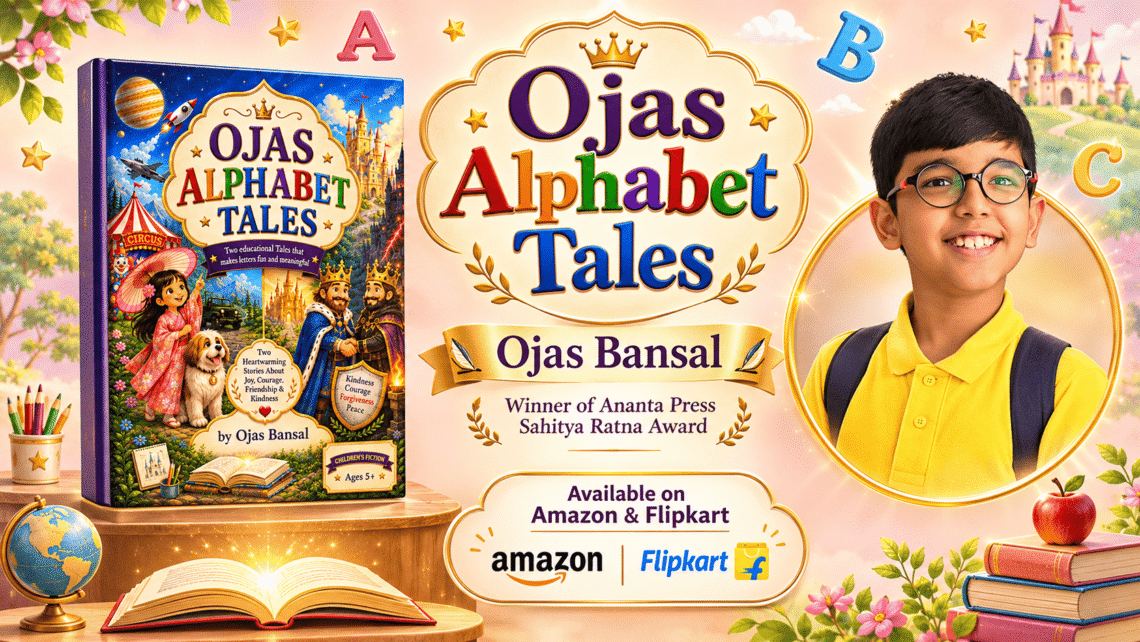
The images appear important to that aim as well. The supplied cover brings together a smiling child, a friendly dog, castles, royal figures, a circus, and the adventurous shapes of space travel. These elements make the book look openhearted and energetic. The scene with two kings shaking hands, alongside words associated with kindness and peace, is particularly revealing as visual messaging. It offers an accessible sign of reconciliation without requiring a complex explanation. Again, the cover should not be confused with the exact narrative content, but it demonstrates the emotional atmosphere the project wishes to create: excitement that leaves room for goodwill.
Ojas Bansal’s own story provides an intriguing parallel. The supplied biography describes him as an eight-year-old author with fifteen published books and an interest in languages, cultures, sketching, and coloring. A child who sees another child presented as a writer may begin to imagine creative possibilities of their own. That can be a positive form of encouragement, especially when it is framed around effort and expression rather than comparison. Not every child needs to publish a book. Every child, however, can be invited to tell a story, draw an imagined character, or share a thought in their own words. The author’s example can make that invitation feel real.
The book also has a potential role in helping adults resist an overly narrow definition of educational success. A correct answer to an alphabet question is satisfying, but so is an unexpected question from a child who has been genuinely engaged. A reader who connects a fictional act of kindness with an event at school has practiced interpretation. A child who invents a new ending has practiced imagination and expression. These outcomes are less easy to count than memorized letters, yet they contribute to the deeper experience of reading. The book’s proposed mixture of narrative, vocabulary, and activity is well suited to supporting that broader understanding.
What makes Ojas Alphabet Tales worthy of consideration, then, is the way its ambitions overlap. It seeks to entertain without abandoning learning, teach without relying entirely on drills, and discuss values without losing the color of fantasy. Its brief illustrated form makes it potentially approachable for early readers, while its themes give adults openings for richer conversations. Parents and teachers should still examine the complete pages to assess the fit for a particular child, especially the complexity of the words and the nature of the questions. But the guiding idea is compelling: a child can learn letters and learn to think about others within one imaginative space.
A story that ends with a child more attentive to language is already useful. A story that also leaves the child wondering how to be a good friend, what courage looks like, or why someone needs kindness has accomplished something more delicate. On the evidence supplied, that is the kind of experience Ojas Alphabet Tales aims to offer. Its greatest potential is not simply to make the alphabet colorful, but to connect those colors with emotions and choices that young readers are beginning to understand. The lessons worth keeping are often the ones that first arrive disguised as a wonderful story.
Buy the book on Amazon: https://www.amazon.in/Ojas-Alphabet-Tales-Bansal/dp/B0HLXNHBXV/