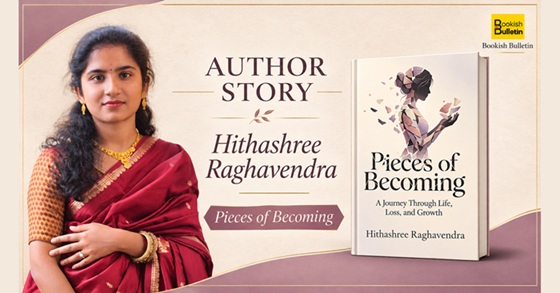
Hithashree Raghavendra and Pieces of Becoming
Hithashree Raghavendra begins Pieces of Becoming by asking readers not to expect all the answers. That choice gives her debut a clear identity. The book is a place for questions about growing up, relationships and the gap between an imagined life and the one taking shape. For Bookish Bulletin, the most revealing way to approach this young writer and poet is through the attention her work gives to things people often leave unexplained.
Raghavendra draws inspiration from everyday experiences, emotions and quiet thoughts. She enjoys putting feelings into words and noticing what is easily overlooked. Pieces of Becoming carries those interests into short reflective chapters. It does not build its appeal around an extraordinary personal history. Instead, it looks at the small encounters and recurring worries through which people understand themselves. A friendship becomes distant. A hoped-for result does not arrive. A feeling proves difficult to name.
This attention to ordinary life shapes the author’s relationship with the reader. Rather than addressing an audience from a position of complete certainty, the narrative voice regularly pauses to ask what a situation might mean. Questions about purpose appear alongside questions about identity and social expectations. What remains when a person is no longer defined by achievements or a role? How much of a chosen life belongs to the person living it? The opening chapter leaves room for answers to change with experience.
Her use of the language of becoming is important here. Growth is not presented as a single achievement that settles everything else. The chapter We Grew Up places increasing responsibility beside a continuing desire for the comfort of childhood. Its movement between vulnerability and independence gives the book an emotional starting point. The reader does not have to choose between being capable and still needing reassurance. Both can belong to the same person at the same moment.
Raghavendra’s interest in connections gives that developing self a wider setting. Chemistry of Connections compares friendships with different kinds of chemical bonds and considers people who change a life without staying in it. The comparisons are literary devices, but they introduce a useful question about permanence. Does a relationship lose its meaning when it changes? Across the book, the answer is more complicated than a simple division between people who remain and people who leave.
The chapters on misunderstanding and unspoken feelings explore the difficulty of making that meaning visible to another person. Two friends can interpret the same silence differently. A thank-you can be delayed until its moment has passed. Someone who appears detached may be struggling to explain what they feel. These situations show where her attention rests: on the distance between inner experience and outward behaviour. By examining what each person assumes, the writing gives familiar acts of withdrawal more than one possible explanation.
That distance also informs the chapter on judgment. Quick conclusions about another person’s clothes, choices or quietness become a reason to ask what an observer does not know. Raghavendra links understanding with patience, while preserving space for a person to make choices rather than live entirely by outside opinions. The book’s concern with kindness is therefore connected to self-definition. It asks readers to reconsider assumptions about others and the assumptions they have accepted about themselves.
The voice that emerges is conversational. Short paragraphs and direct questions allow the reader to stop without losing the thread. Images of pages, seasons and changing paths make the writing approachable, while the chemistry comparisons provide a more individual touch. The style is less concerned with establishing an elaborate theory than with keeping a difficult feeling within reach. Readers can recognise a situation, consider the interpretation offered and decide whether it fits their own experience.
The later movement towards acceptance and hope does not remove the earlier uncertainty. Acceptance can be interrupted by returning memories; moving on requires repeated choices rather than one declaration. Hope is separated from a guarantee that life will follow a plan. This makes the book’s optimism most useful when it remains modest. It offers a way of continuing without pretending that disappointment has become simple or that an earlier version of the future must be restored.
The closing reflection questions leave the next part to the reader. They turn attention towards beliefs, expectations and relationships rather than claiming to complete the conversation. Raghavendra’s debut introduces an author interested in that exchange between a page and the person reading it. Pieces of Becoming is her first book, but its central invitation is not about arriving at a finished identity. It is about observing the experiences through which identity continues to change, and finding language for some of them along the way.