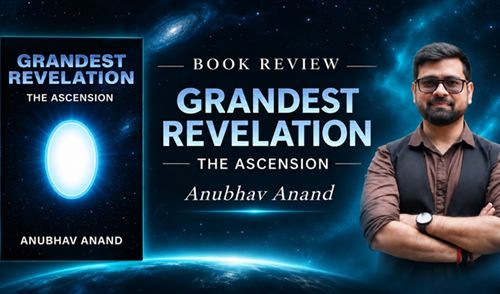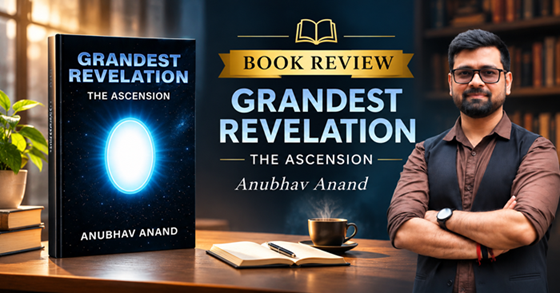
Book review | Grandest Revelation: The Ascension by Anubhav Anand
Grandest Revelation: The Ascension makes its promise through scale. Anubhav Anand writes of characters whose parentage connects them to stars, a war whose consequences extend beyond Earth, and journeys that can turn an ordinary sense of distance upside down. Yet the novel’s central tension is not simply between small heroes and a vast enemy. It is between what its characters believe they know and the histories, motives and possibilities that keep escaping those beliefs.
As a continuation of Grandest Revelation: The Exordium, the novel inherits an already troubled world. Arthur Kane Davis, the mentor associated with the Demistars’ resistance, has died. Ras Alhague and the Entagnast remain a formidable threat. A recap and character guide help reconstruct the essential situation, including celestial ancestry and specialised abilities. They are sensible additions to a dense sequel, although they cannot entirely reproduce the experience of the earlier book. This is a narrative that rewards existing familiarity rather than pretending every reader begins on equal terms.
The opening places that history under emotional pressure. Mark Jones tries to sustain the group while its members question his leadership and compare him with Davis. Grisha’s response to loss pulls her towards vengeance. Their disagreements prevent the resistance from becoming merely a collection of compatible powers. Anand understands that the aftermath of a defeat can produce argument and restlessness as readily as unity. The characters’ difficulty is not a shortage of reasons to fight, but a shortage of confidence about the next right action.
When the Maize scatters them, separation becomes a means of expanding both geography and perspective. Ethan encounters Melissa and a community whose rules he does not initially understand. Grisha’s route exposes her to danger that cannot always be recognised from appearances. Other strands draw old obligations into the current war. The changing viewpoints allow the reader to hold pieces of information that the characters themselves cannot yet assemble. This produces anticipation around eventual reunions, when separate experiences may change a shared understanding.
The book’s world-building is strongest when a new detail alters a practical possibility. Different powers must be matched against particular opponents; a portal is useful for more than travel; a weapon’s relationship with its bearer matters. Such rules prevent every confrontation from depending only on greater force. They also connect learning with survival. A remembered lesson from Davis can become valuable under new conditions, making his influence persist without simply restoring his physical presence to the group.
Elsewhere, Anand pursues wonder more directly. The marketplace of Hanway and the exploration of the universe’s beginnings suggest a world that continues beyond the immediate demands of the central battle. The narrative enjoys describing different kinds of beings, the places they inhabit and the mechanisms through which they move. Its cosmology combines scientific language with magical and mythic assumptions. Readers expecting rigorous hard science will find that distinction important; the novel’s astronomical vocabulary is the material of fantasy invention rather than a guarantee of scientific plausibility.
Knowledge itself is unstable within this universe. Accounts of the past can be incomplete, and apparent betrayals invite reconsideration. The later narrative complicates first impressions rather than allowing every allegiance to remain obvious. That is a productive use of the sequel form: expansion means revising the significance of earlier events, not simply introducing a larger creature or a stronger opponent. The uncertainty surrounding ancestry also connects cosmic mystery to the personal question of who these characters actually are.
The writing does not always give its inventions enough space to make their own impression. Explanations can become extended, and the narration often comments on the importance of an event after its action has already conveyed the point. Emphatic language and repeated descriptions of emotional states sometimes diminish contrast between ordinary exchanges and major reversals. A more selective approach would make the strongest images stand out. The novel’s considerable energy is evident, but energy and narrative precision are not always the same thing.
Its darkness should also be acknowledged. Detailed violence and frequent strong language accompany sexual content and storylines involving sexual abuse and distress. These are not incidental tonal exceptions, and younger characters do not make the novel automatically suitable for younger readers. Readers seeking a reassuring moral adventure may be unsettled by the distance between a character’s courage and the choices that character makes. For others, that unevenness may be exactly what makes the ensemble worth following.
The ending preserves the saga’s forward motion through unresolved threats and new questions. It is an expansion rather than a final reckoning, so the reading experience depends partly on an appetite for continuation. The Ascension is generous with invention and less disciplined with explanation, but its strongest passages bring spectacle into contact with uncertainty, loyalty and loss. Anand’s achievement is not a perfectly streamlined adventure. It is a distinctive, crowded fictional universe whose survivors must keep revising their understanding before they can hope to change their fate.
Amazon Link:https://www.amazon.in/GRANDEST-REVELATION-ASCENSION-ANUBHAV-ANAND/dp/9373351095