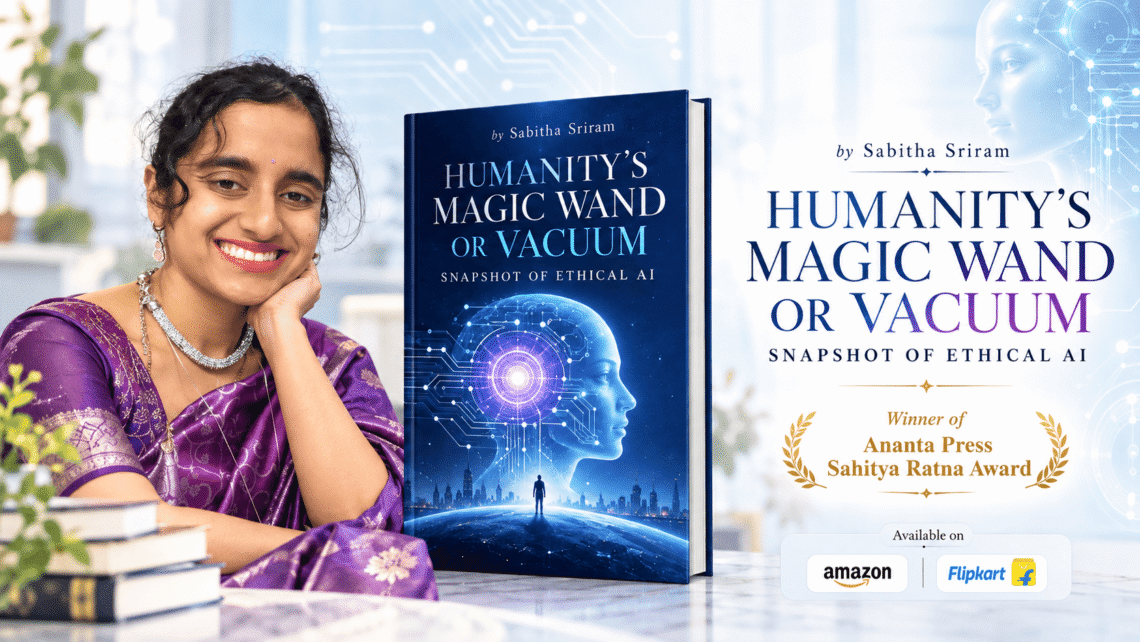
BOOK Humanity’s Magic Wand or Vacuum: Snapshot of Ethical AI AUTHOR Dr. Sabitha Sriram
Discussions of artificial intelligence frequently begin with the most powerful tools and the wealthiest organizations. New products are announced, investment figures are celebrated, and the future is described through the language of competition. Yet technology’s importance cannot be understood only by looking at the institutions that create it. We must also consider the communities that experience its consequences. Dr. Sabitha Sriram’s Humanity’s Magic Wand or Vacuum: Snapshot of Ethical AI approaches AI with an explicit commitment to humanitarian purpose, inclusive development, and equitable growth. This focus gives the subject a social dimension that can disappear when innovation is treated chiefly as an economic race.
The book’s title can be interpreted as a question about distribution. A magic wand is valuable only if its benefits reach the people who need them. A vacuum is troubling because it pulls things inward, potentially concentrating resources and influence. The metaphor is especially appropriate in a field where a small number of organizations may control important infrastructure and where the benefits of adoption are not necessarily shared evenly. The book’s description places humanity ahead of the dominance of large technology companies. That is not an argument against private innovation. It is a reminder that commercial success and social progress are different measures, and responsible societies should examine both.
Humanitarian AI is an appealing phrase, but its meaning requires care. It should not imply that a machine possesses goodwill. Instead, it describes human decisions to deploy technical capabilities toward identifiable forms of public benefit. A system might support the accessibility of information, help an organization recognize patterns in complex data, or improve the responsiveness of an essential service. Whether such uses actually help is an empirical and ethical question. Beneficiaries need to be involved, local conditions need to be understood, and apparent efficiency gains should be tested against possible harms. The humane character of an application depends on the arrangement around it, not on the label attached to it.
This makes the book’s concern about biased outputs especially important. A tool may perform well for people who are heavily represented in its development data while working less reliably for others. If institutions accept that imbalance without asking questions, AI could reproduce existing inequalities at greater speed and scale. Fairness is not achieved simply by giving everyone access to the same interface. It also concerns language, disability, geography, literacy, affordability, and the consequences of being misunderstood. When an AI system speaks fluently in one setting but poorly in another, equal availability may conceal unequal usefulness. This is precisely why equity must shape design rather than appear in promotional language afterward.
The public-good perspective also complicates the idea of choice. Consumers sometimes have the freedom to leave a service that does not meet their expectations. People interacting with schools, employers, hospitals, or public agencies may have far less power to avoid automated processes. If an essential institution relies on AI, the responsibility to offer explanation and meaningful human review becomes stronger. An individual should not have to master technical terminology to question a result that affects their life. Compassion in this setting looks like intelligible communication, accessible support, and procedures that acknowledge how stressful institutional mistakes can be.
Dr. Sriram’s professional grounding in cybersecurity adds another useful consideration: disadvantaged communities can be particularly vulnerable when digital protection is treated as optional. Data gathered for a beneficial purpose may still cause harm if it is mishandled, retained unnecessarily, or exposed. Communities asked to trust a new service should not have to trade dignity and security for access to assistance. Ethical progress therefore requires attention to what information is collected, who may view it, how long it is kept, and what recourse exists when protections fail. Public benefit should not be purchased with invisible costs imposed on the least powerful participants.
There is a temptation to measure social impact through the number of applications deployed. That metric can reward visibility rather than value. A genuinely inclusive project might begin more slowly because it consults people, translates materials, tests accessibility, or establishes a feedback channel. Those steps can look inefficient when compared with a rapid rollout, yet they may determine whether the technology is useful in the long term. The book’s underlying argument for managed risks and ethical use supports a broader understanding of progress: the quality of an intervention should matter at least as much as the scale of its announcement.
Questions of local context are equally significant. An AI tool developed around the habits, resources, and assumptions of one environment may not translate neatly into another. A community with intermittent connectivity, limited institutional capacity, or different languages may need different forms of support. Successful humanitarian use cannot be reduced to distributing a sophisticated product and assuming adoption will follow. It requires listening to the people who know the problem, considering whether technology is even the right response, and allowing space for nontechnical alternatives. Sometimes the most ethical decision may be to simplify a service rather than automate it.
The book’s inclusive vision is also useful for thinking about power. If the dominant companies determine the terms of deployment, the people affected may become passive recipients of decisions made far away. More equitable governance would create opportunities for public-interest researchers, civil society groups, local institutions, and affected communities to participate in shaping rules. This does not mean every technical choice can be made by consensus. It means that decisions with broad social consequences should be transparent enough to invite legitimate scrutiny. Democracy and participation are relevant not because every AI system is a public institution, but because AI can influence access to public opportunities.
The promise of compassionate technology should nevertheless be examined critically. Benevolent intentions do not guarantee good results, and a humanitarian slogan can be used to shield a project from scrutiny. The proper questions remain concrete. Did the system solve a problem people identified as important? Were risks communicated? Could a person decline participation without losing essential support? Is there evidence that the benefit reaches groups who have historically been underserved? Are mistakes corrected openly? These are not necessarily formal evaluation criteria listed in Sriram’s book, but they are natural questions arising from the ethical values articulated in its description.
For students of technology and society, this orientation has educational value. It widens the frame of AI literacy beyond how a model works or which software is currently popular. Readers are encouraged to think about the relationship between tools, institutions, markets, and social outcomes. In the academic category, a work organized around such questions can support discussion across disciplines, including ethics, public policy, information systems, business, and social development. Its emphasis on governance is particularly timely because good intentions alone do not create fair institutions. Institutions need rules and responsibilities that protect the communities they claim to serve.
Humanity’s Magic Wand or Vacuum is most distinctive, then, for treating people as the point of technological progress rather than an audience watching progress unfold. AI deserves attention not only when it produces something remarkable, but when it makes an ordinary life safer, more capable, or more dignified. Dr. Sabitha Sriram’s proposed balance of compassion, regulation, and risk management offers a constructive way to judge the claims made about powerful systems. The book’s central challenge is simple and demanding: if intelligence is expanding, who is sharing in its benefits? A future worthy of celebration would answer that question with evidence of broader human flourishing, not only evidence of greater computational power.AMAZON PURCHASE LINK https://www.amazon.in/dp/9362880296