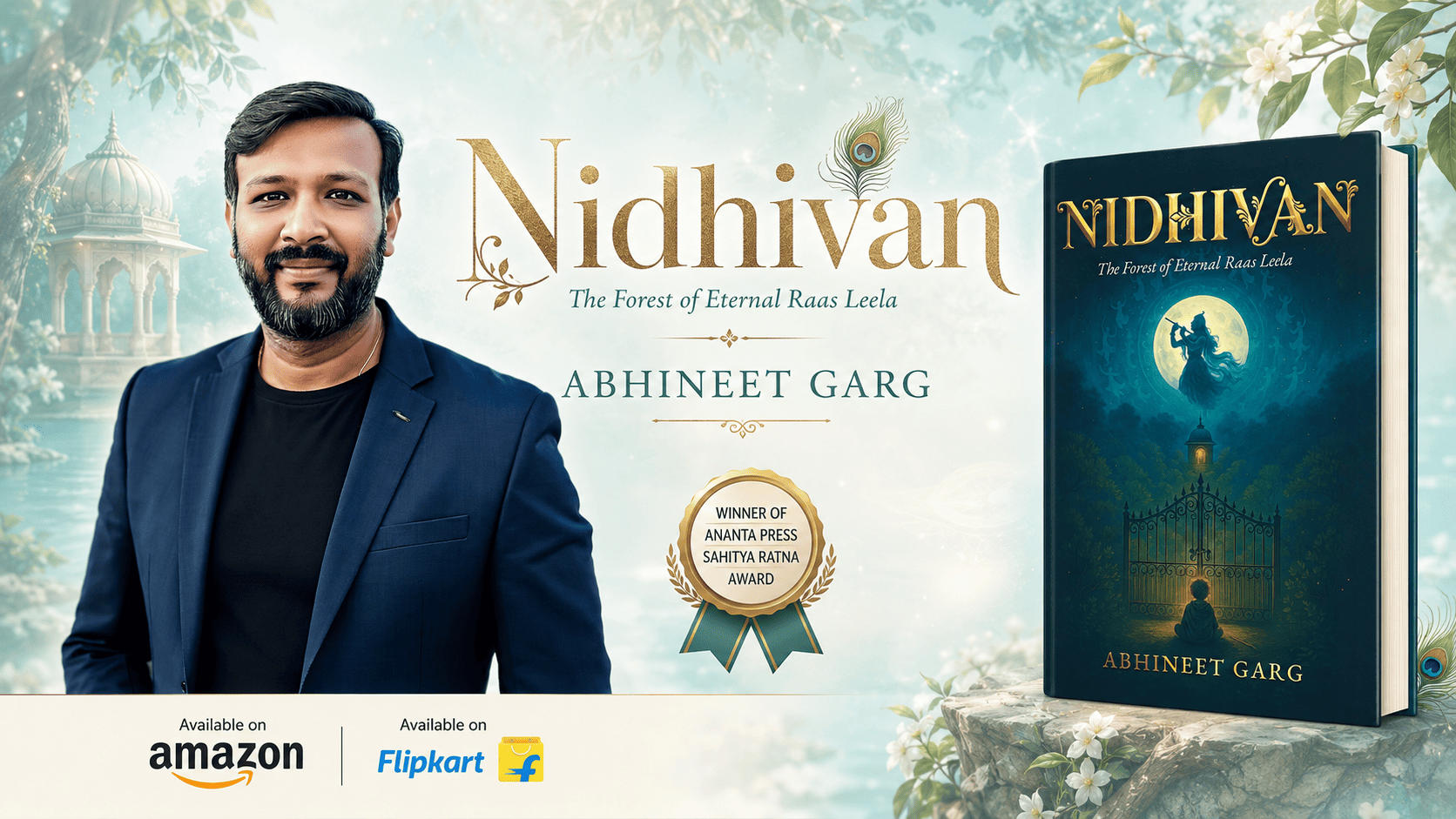
There is a particular kind of courage required to write spiritual fiction as a genuine mystery. The author must resist two easy answers. The first is to dismiss faith as superstition and reduce every sacred claim to deception or psychology. The second is to use divine intervention as a shortcut that resolves every uncertainty. In Nidhivan: The Forest of Eternal Raas Leela, Abhineet Garg avoids both extremes. His novel is compelling because it treats faith as an experience, proof as a human demand, and mystery as a space where neither can completely defeat the other.
The story is rooted in the sacred grove of Nidhivan in Vrindavan, a place associated with the enduring belief that Radha and Krishna perform the eternal Raas Leela after sunset. The grove is therefore more than a location. It represents a boundary between the visible and invisible, between public ritual and private revelation, and between what human beings are permitted to approach and what they insist on possessing. The warning not to remain inside after nightfall establishes a physical rule, but the novel gradually reveals that the deeper prohibition concerns intention. Why does a person want to see? What would proof change? Is witnessing the divine an act of devotion, or can it become an act of intrusion?
These questions are explored through three seekers. Anirudh Narayan, the journalist who begins his investigation in 1985, embodies the modern confidence that reality becomes legitimate only when it can be recorded, explained, and published. His profession rewards skepticism, and skepticism can be valuable. It protects against fraud, exaggeration, manipulation, and fear. Yet Garg shows how skepticism becomes dangerous when it stops being a method and becomes an identity. Anirudh does not merely question the legends of Nidhivan. He assumes in advance that they must be reducible to something smaller than themselves.
His investigation of Rang Mahal, the seven locks, the offerings, and the accounts of nightly Raas Leela begins as an attempt to produce a story. Slowly, the story begins to produce him. He loses the detached position of the reporter and becomes emotionally captured by the mystery. This transformation is one of the book’s most important psychological insights. Obsession is often the shadow of disbelief. The skeptic who says, “I will not believe until I see,” may become more dependent on revelation than the believer who is willing to remain without it.
Radha’s journey, beginning in 1988, complicates the debate. She enters through devotion and feeling rather than professional suspicion. It would be easy to present her as the spiritual opposite of Anirudh and therefore as the safer or wiser seeker. The novel refuses that simplification. Radha’s longing has beauty, but longing can also become a demand. She does not only believe in the sacred presence associated with Nidhivan; she wants to encounter it personally. The desire is understandable, especially when faith is connected to grief, hope, identity, or emotional need. Yet the book asks whether even sincere devotion must learn restraint.
Through Radha, Nidhivan becomes a story about the ethics of spiritual desire. In many traditions, the highest devotion is described not as possession but as surrender. The devotee does not command the divine to appear. The devotee accepts the divine freedom to remain hidden. Radha’s movement toward the forest therefore carries a poignant tension. She is not simply risking physical danger. She is risking the transformation of love into insistence.
Meera, the historian who arrives in 1990, offers a third way of knowing. She respects evidence, context, oral tradition, sacred geography, and the accumulated memory of communities. Her investigation includes the ritual and symbolic world of Vrindavan: Rang Mahal, Lalita Kund, Gopeshwar Bhagwan, Swami Haridas’s legacy, Radha temples, and the Ashta Sakhi tradition. Her scholarship expands the reader’s understanding while avoiding the tone of a textbook. These elements matter because they reveal that the legend of Nidhivan does not exist in isolation. It is part of an interconnected devotional landscape.
Meera’s strength is humility. She understands that historical research can clarify origins, variations, practices, and meanings, but it cannot always determine the final nature of sacred experience. This distinction is essential. A ritual can be historically traced and still carry spiritual significance. A legend can evolve through oral transmission and still express a truth that is not merely factual. A place can be shaped by centuries of belief while also shaping the experiences of those who enter it.
The novel’s three-part movement can be read as a philosophy of knowledge. Anirudh begins with certainty and is forced into uncertainty. Radha begins with faith and is forced to examine desire. Meera begins with disciplined inquiry and reaches the limits of documentation. Together, they suggest that truth is not only a matter of information. It is also a matter of readiness, character, intention, and consequence.
The narrator who inherits their fragments decades later adds a fourth perspective: memory. As a five-year-old child, he receives an experience he cannot fully interpret. At forty, he becomes the person who attempts to assemble records, testimonies, and spiritual residues. His position is deeply human. Most people inherit beliefs before they understand them. Family stories, warnings, rituals, and unresolved experiences enter childhood as fragments. Adulthood often becomes an attempt to organize those fragments into meaning.
This intergenerational frame gives the novel emotional depth because the mystery is not sealed within the past. It continues to act. The narrator’s life has been shaped by something he did not choose, and his reconstruction of the three seekers’ stories is also a reconstruction of himself. His return to the forbidden question shows that the desire for proof can survive for decades, changing form but not disappearing.
The book’s treatment of the supernatural is especially effective because it does not rely on theatrical horror. Its fear comes from the possibility that the sacred is not symbolic but active. The idea that Radha and Krishna might continue their Raas Leela after sunset is not presented as a decorative fantasy. It is treated as a claim with emotional, spiritual, and existential consequences. If the divine is present, then human beings are not the centre of reality. They are not entitled to see everything, explain everything, or convert every experience into evidence.
This reversal is the source of the novel’s deepest unease. Modern investigation assumes that the observer has authority. The camera points, the journalist records, the historian classifies, the reader interprets. Nidhivan resists that hierarchy. The seekers may believe they are approaching an object of study, but the grove behaves more like a subject that chooses what to reveal. It does not need to satisfy human standards of proof.
The novel is also distinctive in the way it links fear with reverence. Conventional horror often invites the reader to defeat, escape, or expose the unknown. Garg’s story asks the reader to respect it. The unknown is not automatically evil. It may be sacred, and sacredness can be terrifying because it confronts human smallness. The forest becomes frightening not because it threatens to destroy belief but because it may confirm belief in a form too immense for ordinary understanding.
Readers interested in philosophy will appreciate the book’s central dilemma. What counts as knowledge? Is eyewitness testimony sufficient? Can collective tradition preserve something that official history cannot verify? Does the absence of proof imply falsehood, or does it sometimes reveal the inadequacy of available methods? The novel does not answer these questions through abstract argument. It dramatizes them through character, setting, and consequence.
At the same time, Nidhivan remains accessible as a thriller. The timelines create forward movement. The rituals and forbidden spaces build suspense. The incomplete records generate curiosity. The narrator’s eventual return promises confrontation. Garg balances intellectual themes with an atmosphere of danger, ensuring that the novel never becomes a philosophical lecture.
The book’s uniqueness lies in this balance. It is mythological fiction without being a conventional retelling. It is supernatural suspense without generic ghosts. It is spiritual fiction without easy preaching. It is an investigation in which the most important evidence may be the transformation of the investigators themselves.
Nidhivan: The Forest of Eternal Raas Leela ultimately suggests that humility is not the opposite of knowledge; it may be its highest form. To admit that a mystery cannot be possessed is not intellectual defeat. It can be ethical wisdom. Abhineet Garg has written a novel that leaves the reader with the unsettling and beautiful possibility that some truths remain hidden not because they are unreal, but because concealment is part of their sacred nature.
PURCHASE THE BOOK