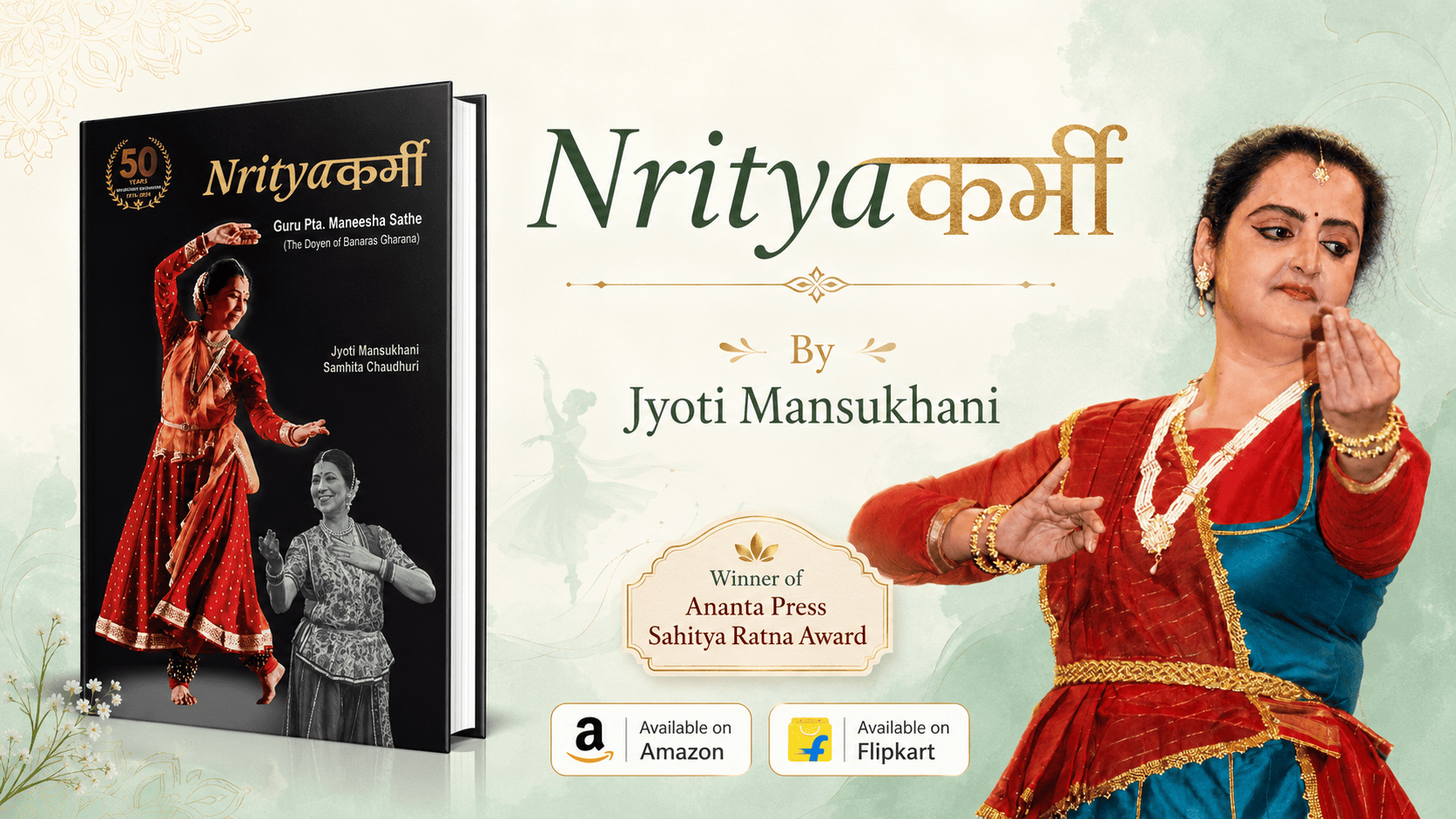
To describe Nrityaकर्मी only as a biography would be accurate but incomplete. The book is better understood as a cultural archive built around the life and artistic legacy of Guru Pta. Maneesha Sathe ji. Through narrative, photographs, recollections and performance videos, Jyoti Mansukhani and co-author Samhita Chaudhury have attempted something especially valuable for the performing arts: they have brought together forms of evidence that are often scattered across personal collections, fading memories and isolated recordings.
The need for such documentation is urgent. Dance exists powerfully in the moment of performance, yet that very immediacy makes it vulnerable. A performance ends; an audience disperses; costumes are stored; conversations are forgotten. Reviews may record the event, but they rarely capture rehearsal processes, teaching relationships, artistic decisions and the personal qualities that shaped the work. Nrityaकर्मी responds to this problem by constructing a layered record. It recognises that the history of a dancer cannot be preserved through dates and honours alone.
The book’s first section follows Maneesha ji’s journey across more than sixty years. This long span enables the reader to see artistic growth rather than only the final, celebrated image. Childhood and early training are essential because they reveal foundations: the cultural environment, the influence of parents, the authority of Gurus and the habits formed before public recognition. Later stages – performer, teacher, Guru and legend – show how artistic identity expands over time. Each stage involves different responsibilities, and the biography’s structure gives these transitions importance.
The visual material makes this section especially valuable. Photographs from childhood to the present create a timeline that words alone cannot provide. Images of parents and Gurus locate Maneesha ji within personal and pedagogical lineages. Solo performance photographs document costume, posture, expression and stage presence. Pictures with students demonstrate the growth of an institution and a community. Family photographs balance the public archive with the private life of the person behind it.
Such photographs are not decorative extras. In cultural documentation, an image can answer questions that prose does not anticipate. Future students may study changes in presentation or costume. Researchers may identify collaborators and performance contexts. Readers may observe how a young learner gradually assumes the composure of an established artiste. Even casual viewers gain a sense of duration – the visible accumulation of decades devoted to one art form.
The performance videos are perhaps the most innovative feature. Classical dance cannot be fully understood through still images, because movement unfolds through time. Rhythm is experienced as progression; expression changes from one moment to the next; the relationship between gesture and music is dynamic. Video preserves at least part of this temporal quality. When placed beside written accounts, it creates a productive conversation. A contributor may describe Maneesha ji’s intensity, command or sensitivity, and a reader can then watch a performance with those observations in mind.
This integration of media makes Nrityaकर्मी accessible to different kinds of readers. Scholars may use the written material and testimonies. Students may study performance excerpts. General readers may be drawn first to photographs and then into the narrative. Families and cultural institutions may recognise the importance of organising their own archives. In this way, the book does more than preserve one legacy; it models a method for documenting performing artists.
The second section expands the archive through thirty-two write-ups from people closely connected with Maneesha ji. Oral history and personal testimony are indispensable because archives are not made only of objects. They are also made of interpretation. A photograph can show who was present, but a recollection can explain why the moment mattered. A video can preserve a performance, but a musician can describe the dancer’s responsiveness during collaboration. A programme brochure may list names, but an anecdote can reveal the trust, discipline or humour behind the event.
The range of contributors – senior Gurus, senior artistes, musicians, technicians and others – ensures that the archive is not dominated by a single professional viewpoint. The presence of Taalyogi Pt. Suresh Talwalkar ji, Pt. Rajendra Gangani ji, Pt. Jai Kishan Maharaj ji, Shama Bhate ji, Dr. Sucheta Chapekar ji, Pt. Nandkishore Kapote ji and many more situates Maneesha ji within a broad network of Indian classical arts. Their testimonies help document not only her personality but also a wider era of artistic interaction.
The editorial choice to give each write-up a distinctive tagline is more significant than it may initially appear. Archives can become overwhelming when material is presented without interpretation. A tagline offers orientation. It identifies the essence of the memory while allowing the full contribution to remain personal. This suggests that the compilers have not merely collected statements; they have shaped them into a readable narrative sequence.
The third section, devoted to senior students from different decades, is essential to the archive because pedagogy is one of the least visible parts of performance history. Public audiences see the finished dancer. They rarely see years of correction, repetition, explanation and encouragement. Student reflections help recover this hidden labour. They may reveal how a Guru teaches rhythm, communicates expression, responds to mistakes, prepares students for the stage and supports them through periods of doubt.
Representing every decade also creates a longitudinal record of the institution. It allows readers to observe continuity and change across generations. A student trained many years ago may remember a different cultural environment from one trained recently, yet both may recognise the same core values. This makes the section useful not only emotionally but historically. It can show how a Guru adapts while remaining rooted.
The description of these accounts as honest and heartfelt is important because an archive should preserve complexity, not only praise. Genuine gratitude often includes memories of strictness, fear, challenge and transformation. A demanding teacher may be remembered with affection precisely because the discipline produced growth. When student voices retain such complexity, the resulting portrait becomes more credible and useful.
The book’s archival value is strengthened by the person who initiated it. Jyoti Mansukhani has a demonstrated commitment to cultural preservation. In 2009, she launched My Journey with Kathak Maestros, a DVD compilation on distinguished Kathak Gurus in Maharashtra, created with guidance from Maneesha ji. That earlier project reveals that Nrityaकर्मी is not an isolated effort. It continues a long concern with recording lives, knowledge and contributions that might otherwise remain fragmented.
Jyoti’s work through Prerana Foundation also gives her access to the living network of dancers, Gurus and institutions. For more than twenty years, she has organised competitions in Indian classical and folk forms, instituted awards honouring major figures and created Ekal Nritya Utsav as a platform for thematic solo performance. These activities require not only administrative skill but an understanding of how cultural communities function. The same ability to connect people is visible in a book that gathers numerous contributors around one subject.
Her vision for Nrityachakra is another example of cultural documentation through collective action. In 2024, 1,188 Kathak dancers from twenty cities across Maharashtra performed together for twenty minutes and twenty-five seconds on three compositions, creating records recognised by the Limca Book of Records and World Records Book of India. The event demonstrated that heritage can be preserved not only in museums and books, but through large-scale participation. Nrityaकर्मी complements that achievement by preserving a more intimate history through text and memory.
The book is also likely to encourage readers to think about the ethics of documentation. A respectful biography does not appropriate a life; it listens to the subject and the community around her. It distinguishes between public achievement and personal memory. It gives credit to collaborators. It understands that lineage matters. From its stated structure, Nrityaकर्मी appears attentive to these responsibilities.
One of its greatest contributions is the preservation of feeling. Cultural archives sometimes become cold repositories of dates, certificates and photographs. This book promises something warmer. The reflections are intended to capture motivations, bonds, gratitude and the emotional atmosphere around Maneesha ji. Such material is not less historical because it is emotional. On the contrary, emotion explains why people committed themselves to an institution, why students remained connected and why an artiste’s influence endured.
For libraries, dance schools, arts researchers and students, Nrityaकर्मी should be a valuable reference. It offers biographical chronology, visual documentation, performance access and first-person accounts in one place. For general readers, it provides an engaging entry into Kathak through the life of a remarkable practitioner. For the artistic community, it demonstrates the importance of documenting senior Gurus while memories and materials are still available.
The book stands out because it understands that a performing artist leaves more than performances. She leaves methods, standards, relationships, stories, gestures, institutional cultures and generations of trained bodies. Nrityaकर्मी gathers these traces with affection and purpose. It is not simply a record of the past; it is a resource for the future, ensuring that the work and spirit of Guru Pta. Maneesha Sathe ji can continue to educate, inspire and move readers well beyond the immediate circle of those who witnessed her journey firsthand.