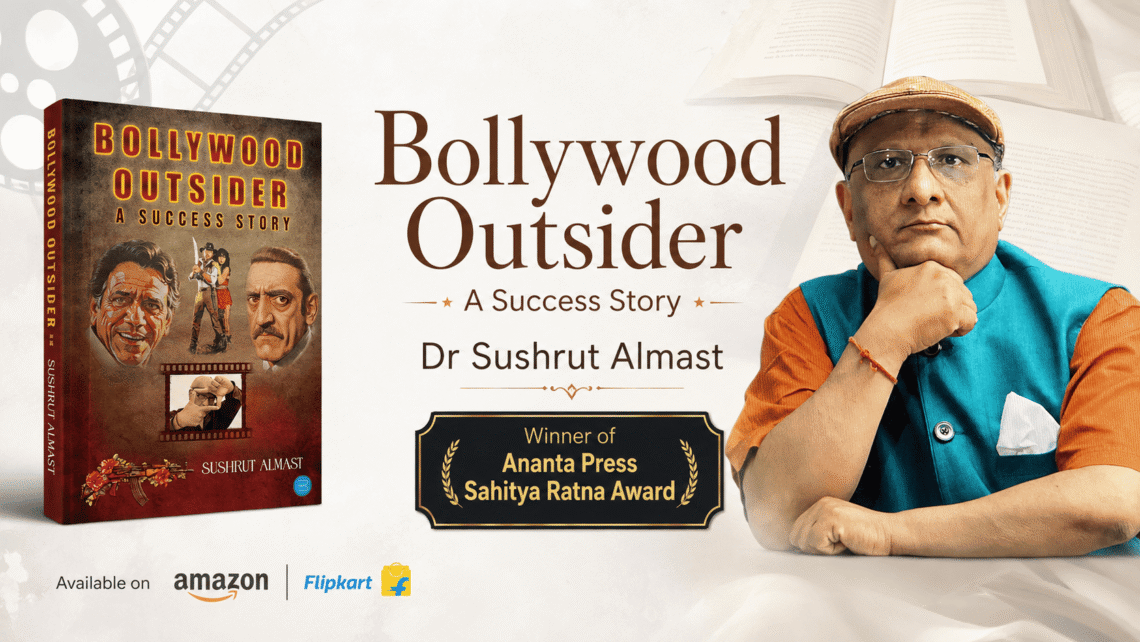
The central emotional truth of Bollywood Outsider – A Success Story is that delay tests belief more severely than rejection. A rejection is painful but definite; a delayed project remains suspended between possibility and failure. Dr Sushrut Almast’s film journey began with Vyakul in 1991, continued through its rebranding as Nirnayak – The Decider in 1993, and reached theatrical release only in 1997–98. Those years transform the book from a simple account of ambition into a study of sustained motivation. The reader encounters a dream that had to survive long before it could be celebrated.
This makes the book particularly relevant to people living through an “in-between” period. Many motivational titles focus on starting or winning, but comparatively few examine the difficult middle: the months or years when a person has already invested too much to feel detached yet has received too little confirmation to feel secure. The story of Nirnayak occupies that middle. The film was once shelved, and the possibility of permanent incompletion must have been real. By presenting a project that eventually moved beyond that suspended state, the book gives language and meaning to a stage of achievement that is usually invisible.
The title Nirnayak – The Decider becomes symbolically important in this context. The decisive person is not necessarily the one who controls every outcome. More often, it is the one who chooses a direction despite incomplete information. Dr Almast could not command the entire film industry, guarantee distribution, or predict the future popularity of the film. What he could do was continue making choices that protected the project’s chance of survival. This distinction is one of the book’s strongest self-help lessons. Personal power is rarely absolute, but it is rarely zero. Between total control and helplessness lies the ability to take the next responsible action.
The author’s outsider status intensifies this lesson. He entered Bollywood as a medical doctor without established industry connections. That fact matters because uncertainty feels different when one lacks a familiar network. An insider may have mentors, inherited knowledge, or the confidence that comes from belonging. An outsider must learn procedures, relationships, and unwritten expectations while simultaneously proving that the project deserves attention. The book therefore treats courage not as fearlessness but as movement without social reassurance.
Readers who are considering a major change of direction may find Dr Almast’s multidisciplinary life especially encouraging. His profile includes medicine, radiodiagnosis, cinema, finance, Vedic astrology, leadership writing, media arts, and service-oriented organisations. Modern professional culture often pressures individuals to present a single, easily explained identity. This book resists that limitation. It suggests that a serious medical career and a serious cinematic ambition can exist within the same life. Curiosity does not have to be reduced to a hobby merely because it lies outside one’s formal qualification.
At the same time, the story does not romanticise change as effortless liberation. Crossing into another field requires the humility to become inexperienced again. A respected professional may discover that previous achievement does not automatically translate into authority in a new industry. The outsider must ask questions, endure misjudgement, and develop credibility from the beginning. That process can be uncomfortable, yet it is also transformative. Bollywood Outsider – A Success Story shows that reinvention is not the rejection of one’s earlier self; it is the expansion of what that self is willing to attempt.
The film’s eventual success gives the narrative hope, but the later digital response makes the motivational message even more profound. The supplied description states that Nirnayak – The Decider went on to receive more than sixteen million YouTube views and a 7/10 IMDb rating. These figures suggest that the work continued to attract attention long after its original theatrical moment. For readers, the lesson is not merely “keep trying until you win.” It is “do not assume that the first period of recognition is the only period that matters.” Creative work, professional contributions, and personal efforts can gain new relevance when the environment changes.
This perspective can be deeply reassuring for writers, artists, researchers, and entrepreneurs whose work has not yet received the response they expected. Timing is an unpredictable partner. A good idea may arrive before the right platform exists. A film may find its widest audience decades after production. A book may become meaningful to readers during circumstances the author could not foresee. The story encourages creators to distinguish between the quality of their effort and the speed of external validation. While quality must still be examined honestly, delayed attention should not automatically be interpreted as proof of worthlessness.
The book’s self-help value also comes from the way it reframes failure. A shelved film appears, from one angle, to be a failure. Yet in this story it becomes a temporary condition within a longer process. This does not mean every setback will reverse itself. It means that labels such as failed, finished, or impossible can sometimes be premature. Human beings often make permanent emotional conclusions from temporary circumstances. Dr Almast’s journey challenges that habit. The project’s status changed because continued effort allowed new possibilities to emerge.
Another valuable theme is the relationship between persistence and flexibility. The film did not simply remain untouched while the author waited. It was renamed and repositioned. This suggests that resilience is not stubborn repetition. Effective persistence includes adaptation. A person may need to revise the title, alter the presentation, change the timeline, seek different collaborators, or discover a new platform. The dream can remain constant while the route evolves. This is a more mature motivational message than the instruction to continue doing the same thing indefinitely.
The involvement of Om Puri and Amrish Puri gives the book a memorable cinematic dimension. The account describes their pairing as a “Clash of Titans,” an expression that communicates the scale of performance associated with the film. For the outsider producer, bringing such powerful actors into the same project represents more than casting. It symbolises the moment when an individual once distant from the industry participates in creating work with recognised artistic figures. That achievement will resonate with readers who dream not only of entering a field but of contributing at a serious level within it.
The author’s wider philosophy also influences the tone of the book. His declared belief that India can guide the global family toward peace, prosperity, and happiness reflects an optimistic and service-oriented outlook. His involvement with organisations focused on holistic health, Vedic wisdom, and the empowerment of doctors suggests that he views achievement as connected to social purpose. Consequently, the book’s inspiration is not limited to fame or profit. It belongs to a broader belief in knowledge, constructive action, and the possibility of improving life through committed work.
For readers who prefer motivational books built on personal experience, Bollywood Outsider – A Success Story has clear appeal. It does not depend on an abstract system of numbered rules. Instead, it offers an extended example from which readers can draw their own principles: begin before certainty arrives; expect the middle of the journey to be longer than imagined; remain flexible without abandoning the goal; recognise that belonging may have to be earned; and allow time to reveal forms of success that were not visible at the beginning.
The book is ultimately about preserving possibility. Dr Almast’s greatest achievement may not be that he encountered no barriers, but that the barriers did not become the final authors of his story. The film’s journey from an early title to a delayed release and then to digital popularity demonstrates that outcomes can remain open when effort, adaptation, and belief continue to interact. Readers facing their own prolonged uncertainty may close this book with renewed patience. Not passive patience, but decisive patience—the kind that continues to work, learn, revise, and prepare until a closed chapter discovers another ending.