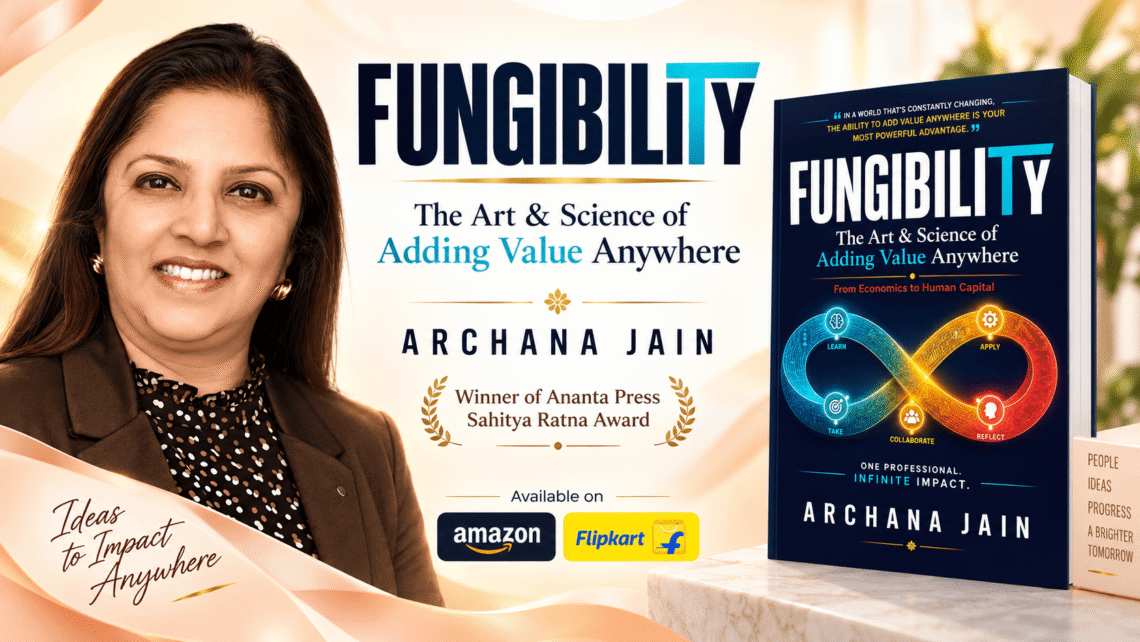
The conversation about artificial intelligence often begins with a comparison: what can machines do better than people, and what will be left for humans? Fungibility: The Art & Science of Adding Value Anywhere takes a more productive route. Rather than asking readers to compete with technology on the terms technology defines, Archana Jain focuses on the human capacity to adapt, connect, learn, interpret, and create value across changing environments. The result is a book that sits at the intersection of self-help, leadership, career development, and future-of-work thinking. Its core insight is both practical and reassuring: relevance is not a fixed possession. It is a capability that can be renewed.
The book arrives at a moment when many professionals are experiencing a strange mixture of opportunity and anxiety. New tools make individuals more productive, but they also expose how quickly certain tasks can be automated. New industries emerge while familiar ones restructure. Skills that once differentiated a person may become common features in software. This can lead to a defensive mindset: protect the role, protect the expertise, protect the territory. Fungibility argues for the opposite response. Instead of protecting yesterday’s tasks, build tomorrow’s value. That orientation is one of the book’s most significant strengths because it converts fear into a development agenda.
Jain’s use of the term “fungibility” is provocative in the best way. Traditionally, something fungible can be exchanged for something equivalent. In this book, the idea is adapted to professional capability. The aim is not to make people interchangeable, but to make their skills and strengths transferable. That distinction is essential. Human beings create value through combinations of knowledge, judgment, empathy, experience, curiosity, and context. No two people combine those elements in exactly the same way. Yet a person can still learn to carry their strengths across roles and industries. The book therefore redefines versatility as a serious professional advantage rather than as a lack of specialization.
This human-centered interpretation is consistent with the author’s broader philosophy. Jain’s writing and professional work emphasize that technology may transform how work is done, while humanity continues to shape how people lead, trust, collaborate, and make meaning. Her first book, The Human Premium, explored the importance of clarity, empathy, and human-centered leadership in an AI-driven world. Fungibility extends that conversation from the question of human distinctiveness to the question of human portability. If empathy, judgment, resilience, communication, and learning remain valuable, how do professionals carry those qualities into new contexts? That is the territory this book explores.
The idea of portability is particularly important because modern work is increasingly organized around problems rather than permanent boundaries. A difficult business challenge may require knowledge from technology, customer experience, operations, communication, finance, and people leadership at the same time. Professionals who can only operate inside the exact conditions in which they were trained may struggle even when they possess deep knowledge. By contrast, people who can translate what they know, collaborate across disciplines, and learn enough about adjacent areas to contribute meaningfully become unusually valuable. Fungibility names and organizes this capability.
The author’s professional journey strengthens the book’s argument. Her experience has crossed advertising, public relations, customer service, coaching, team management, business operations, and the technology industry. That range matters not because variety is automatically valuable, but because it demonstrates repeated adaptation. It suggests that capabilities can accumulate even when job contexts change. Communication learned in one field can improve leadership in another. Customer understanding can influence operations. Coaching can strengthen management. Business exposure can sharpen strategic thinking. A nonlinear career, viewed this way, is not a series of restarts. It is a compounding system.
One of the book’s most appealing ideas is the move from expertise as possession to learning as capability. In stable environments, being the person who knows the answer can create status. In unstable environments, being the person who can find, learn, test, and apply the next answer may be more valuable. This does not diminish expertise. It puts expertise into motion. It asks whether knowledge can be updated, connected, challenged, and redeployed. For experienced professionals, that can be a demanding but liberating shift because it replaces the pressure to know everything with the discipline to remain learnable.
The human dimension becomes even clearer when considering collaboration. Transferable capability is rarely exercised alone. Moving across functions and industries requires the ability to listen, ask questions without ego, understand unfamiliar terminology, build trust with people who think differently, and contribute without pretending to know what one does not know. These are deeply human skills. They are also often underestimated because they do not always appear as hard credentials. Fungibility elevates them by showing how they enable movement and impact.
Another notable quality is that the book appears to combine conceptual thinking with practical orientation. The description references global research, leadership insights, business case studies, and usable frameworks. That mixture is important in a self-help book focused on work. Readers do not merely need encouragement to be adaptable; they need language and structure for examining their own capabilities. What can I transfer? What needs to be learned? Which problems do I repeatedly solve well? Where does my experience have value outside its original context? How can I become known for contribution rather than designation? These are the kinds of questions the fungibility framework naturally generates.
The book is also valuable for organizations seeking to build future-ready teams. Leaders often discuss reskilling as if it were a sequence of training programs. Training matters, but a truly adaptable workforce requires more: psychological safety to admit gaps, mobility across functions, opportunities to practice new skills, managers who recognize adjacent strengths, and cultures that reward learning rather than only prior expertise. A fungibility mindset can therefore influence talent development, internal mobility, succession planning, and leadership development. It encourages organizations to see employees as evolving capability portfolios rather than fixed occupants of roles.
There is a social and emotional benefit to this framework as well. Career disruption can damage confidence because it challenges the story people tell about themselves. Redundancy, restructuring, returning after a break, switching industries, or being overtaken by a new technology can feel like proof that previous experience has lost value. Fungibility offers a way to recover continuity. The task is to translate, not discard. A person’s past may still contain strengths that matter; they simply need to be articulated in the language of a new context. That perspective can make transitions less frightening and more strategic.
What makes this book stand out is that it avoids the false choice between technology and humanity. It does not suggest that people can remain relevant simply by leaning on uniquely human qualities while ignoring technical change. Nor does it imply that survival depends on endlessly chasing every new tool. Instead, the book’s framework suggests a synthesis: learn enough to move with change, develop capabilities that travel, and use human judgment to create value where context matters. The strongest professional is not the one who resists technology or worships it. It is the one who can integrate new tools into a wider capacity for contribution.
For students and early-career readers, the book can serve as an antidote to the pressure to choose a perfect path. Careers will likely evolve in ways no course catalog can fully anticipate. Building transferable capabilities provides optionality. For mid-career professionals, the book offers a language for reinvention. For leaders, it provides a lens for recognizing potential in people whose backgrounds do not match conventional templates. For entrepreneurs, it validates the need to move fluidly across domains. The framework scales because the underlying problem is universal: how do you remain valuable when the environment changes?
Fungibility is ultimately optimistic without being naive. Change can be difficult. Skills do expire. Roles do disappear. AI will continue to alter how work is structured. But the book refuses the conclusion that professionals must simply wait to be disrupted. It places responsibility where it can be useful: learn, adapt, reflect, collaborate, and make your value portable. That is a demanding message, but it is also empowering. It tells readers that the future of work is not only something happening to them. It is also something they can prepare themselves to enter with greater versatility and confidence.
In a crowded field of books about productivity, career success, and AI, Fungibility offers a distinctive contribution because it names the quality that connects many of the skills people are being told to develop. Adaptability, learning agility, resilience, collaboration, and transferable skill are not isolated virtues. Together, they create the capacity to add value anywhere. That is the book’s promise, and it is a promise well matched to the uncertainty of modern professional life.Amazon link: https://www.amazon.in/Fungibility-Science-Adding-Value-Anywhere-ebook/dp/B0HCL37QY5/ref=sr_1_1?crid=P0MZP65RWR8P&dib=eyJ2IjoiMSJ9.VV1teaHHjTpxtBX2RBvlLl74tqW9136U99KQyxpg4RDGjHj071QN20LucGBJIEps.OavO35Ak7j3XXH2IbLtnlXKLJlM8jVhvqECGUfVrE_g&dib_tag=se&keywords=fungibility&qid=1787137886&s=digital-text&sprefix=fungibilit%2Cdigital-text%2C313&sr=1-1