This interpretation immediately gives the text emotional relevance. Most readers will never command an army or participate in a historic confrontation, but nearly everyone understands paralysis. We know what it is like to delay a difficult decision, to fear disappointing someone, to question our own judgement, or to remain in a familiar situation because uncertainty feels more threatening than dissatisfaction. The “warrior” in Ahamasmi Yodha speaks to this very human condition. The enemy is not another person. The enemy is often confusion, fear, attachment, ego, or the habit of avoiding what we already know must be faced.
The book’s use of Krsna is important because Krsna represents guidance in the moment before action. The motivational value of this image lies not in supernatural intervention but in the idea that clarity can transform paralysis. Fear may not disappear, but its authority over the individual can weaken. When purpose becomes clearer, action becomes possible. This is a psychologically sound metaphor even for readers who approach the material primarily as philosophy or literature. Human beings often suffer not because they have no choices, but because the meaning of those choices is obscured by emotion. The book’s warrior ideal is therefore a discipline of seeing.
One of the book’s most distinctive qualities is that it does not equate self-mastery with emotional suppression. The phrase “fight without hatred” implies that emotion is recognised but not allowed to govern the ethical direction of action. This is a subtle difference. To become a warrior in this framework is not to become numb. It is to become less controlled by reactive emotion. Anger, grief, fear, and attachment may all be present, but they need not dictate the final decision. This makes the book especially relevant to readers interested in personal growth, because so much of growth involves learning the difference between feeling an emotion and obeying it.
The same is true of attachment. The book’s philosophy of protecting without attachment is not coldness; it is a challenge to examine the motives beneath care. Sometimes we protect people because we genuinely serve their wellbeing. At other times, protection becomes control because we are afraid of loss, change, or disapproval. In a similar way, we may remain silent in the name of peace when the deeper motive is fear. Ahamasmi Yodha’s conceptual framework encourages readers to look beneath the labels they give their own behaviour. That introspective quality is one reason the book belongs comfortably within the self-help and motivational space despite its mythological and spiritual foundation.
The declaration “Ahamasmi Yodha — I am the Warrior” also works psychologically as an identity statement. Self-help literature often uses affirmations, but an affirmation is only meaningful when it points toward a practice. Here, “I am the Warrior” implies a commitment to behave differently when conflict arises. It suggests a willingness to develop clarity, courage, restraint, and a sense of purpose. The phrase does not promise that life will become easier. In fact, the book’s premise recognises the opposite: some choices remain difficult even when they are right. The warrior identity is therefore less about feeling powerful and more about accepting the discomfort that comes with responsible action.
Another notable strength is the way the book complicates the popular contrast between peace and conflict. Many people imagine peace as inherently virtuous and confrontation as inherently negative. Ahamasmi Yodha does not dismiss peace; rather, it asks what happens when peace is pursued beyond the point at which it protects injustice, avoidance, or dishonesty. Psychologically, this is a profound question. Individuals often preserve superficial harmony at the cost of inner truth. They agree when they want to refuse, remain silent when a boundary is crossed, or postpone action because they fear the emotional consequences. The book’s warrior philosophy suggests that a deeper peace may sometimes require a difficult confrontation first.
This does not mean the text encourages impulsive confrontation. On the contrary, its emphasis on diplomacy, silence, courage, and decisive action implies sequence and discernment. Not every disagreement is a battlefield, and not every irritation requires heroic resistance. The challenge is learning to recognise the moments that do. That is why Dharma is essential to the book’s argument. Without Dharma, the warrior metaphor could be used to justify ego, anger, or aggression. With Dharma, the metaphor becomes ethical and introspective. The reader must ask not merely whether they feel strongly, but whether the action they contemplate is aligned with truth, responsibility, and a larger good.
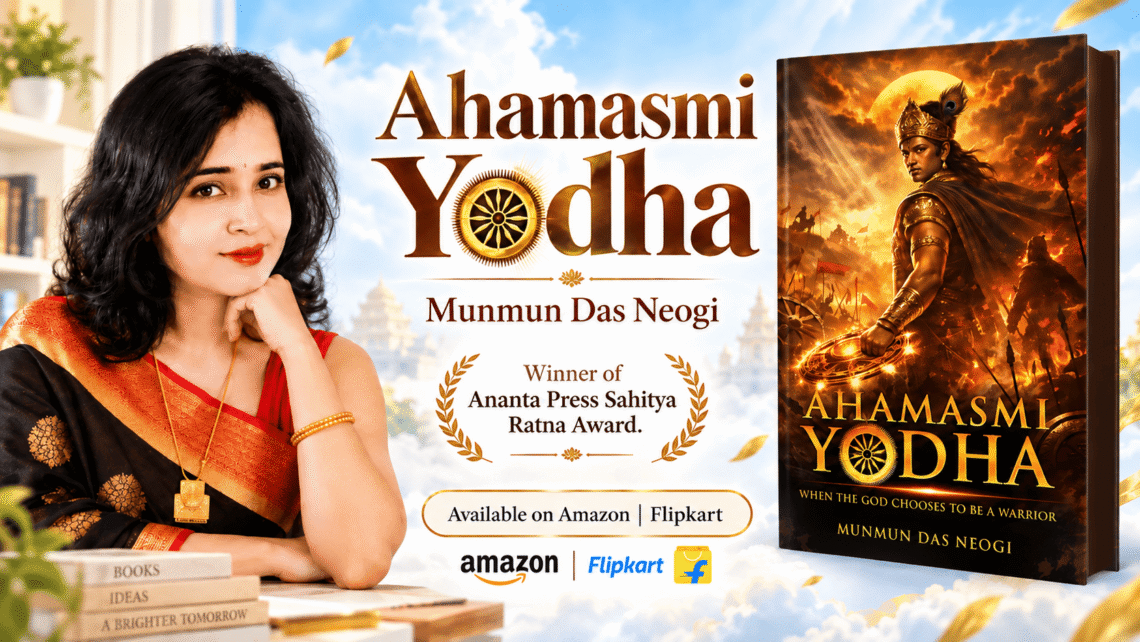
Munmun Das Neogi’s broader interests help give this psychological reading a distinctive texture. Her author background describes a lifelong fascination with stories that carry deeper meaning, especially Indian epics, mythology, spiritual literature, cosmology, Vedic philosophy, history, and the emotional questions that shape human life. She also comes from a long technology career, a field associated with logic and structured problem-solving. Ahamasmi Yodha reflects both impulses: it is spiritually imaginative, yet conceptually organised around a clear problem—how does a person act rightly under conditions of inner conflict?
For a modern reader facing anxiety about career, relationships, responsibility, boundaries, or personal change, the book’s message can be translated into a practical sequence. First, recognise the battlefield rather than pretending it does not exist. Second, identify the forces operating within: fear, attachment, ego, duty, compassion, truth. Third, seek clarity before action. Fourth, act without making hatred or self-glorification the fuel. Finally, accept that courage is not validated only by external victory; it is also present in the quality of consciousness from which the decision is made. The book may not present these ideas as a formal therapeutic model, but its central philosophy naturally supports such reflection.
What makes Ahamasmi Yodha memorable is that it gives readers a culturally resonant symbol for self-mastery. Many motivational books describe “fighting your battles,” but this work gives that phrase philosophical depth. The battle is connected to Dharma. The guide is Krsna. The warrior is defined by restraint as much as by action. The goal is not conquest but clarity. These distinctions matter because they keep the book from becoming another generic call to be strong.
Ultimately, Ahamasmi Yodha is an invitation to stop imagining courage as a quality possessed only by exceptional heroes. It places courage inside ordinary human choices. Every time a person chooses truth over fear, responsibility over comfort, or principled action over passive avoidance, a small Kurukshetra is crossed. In that sense, the book’s title is not simply about Krsna becoming a warrior. It is about the reader recognising that the capacity for disciplined courage already exists within. The question is whether it will be awakened when the moment demands it.
Amazon purchase link: https://www.amazon.in/dp/9376310659