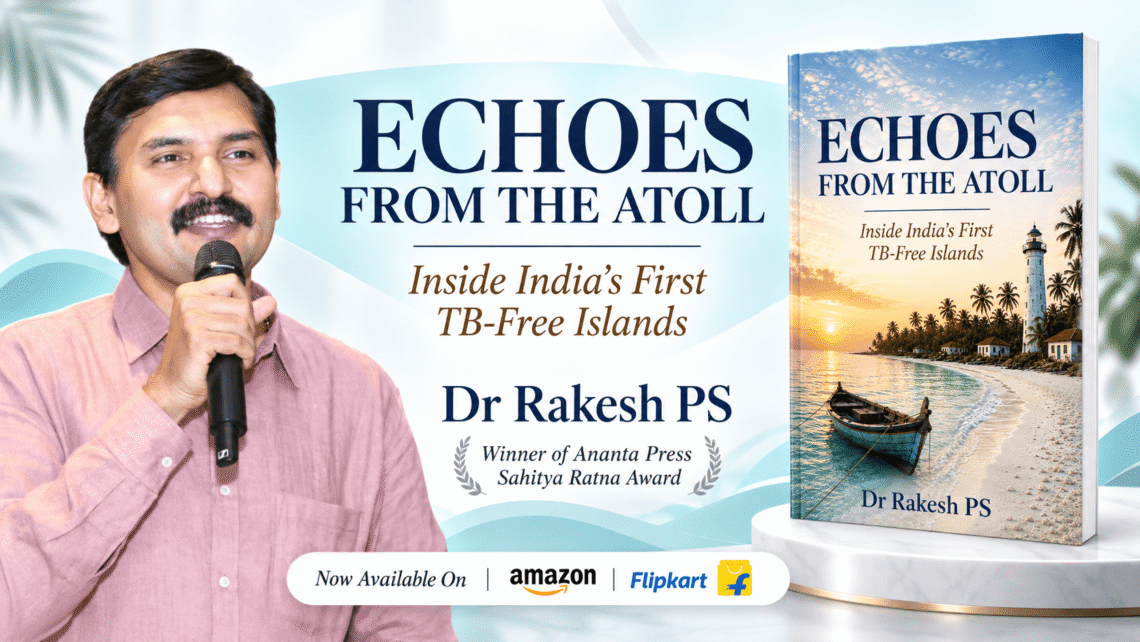
Although Echoes from the Atoll: Inside India’s First TB-Free Islands is built around an extraordinary public health achievement, its deepest questions are not medical. They are human. What makes a place home? How does a community hold on to its identity while changing? What do outsiders learn when they stay long enough to move beyond observation? And how do professional responsibilities become personal memories? These questions give Dr Rakesh PS’s literary memoir an emotional reach far beyond the subject of tuberculosis.
At first glance, the title and subtitle may lead readers to expect a book primarily about disease elimination. That expectation is understandable, especially given the author’s distinguished background in public health and his involvement in Lakshadweep’s journey towards TB-free certification. Yet the book’s description makes clear that TB is deliberately positioned as a backdrop rather than the sole subject. This choice opens the narrative to a much wider readership.
The most affecting element is the author’s transformation from a professional working in the islands to a storyteller who has been changed by the place. That journey gives the memoir a natural emotional arc. Professional assignments are often described in terms of goals achieved, programmes completed and outcomes measured. A memoir asks different questions. What stayed with the person after the work was over? Which encounters altered the way he understood service, community or himself? What could never fit into an official report?
Echoes from the Atoll appears to emerge from that gap between what can be documented administratively and what can only be remembered personally. Reports can record that a geography achieved a TB-free milestone. They can list activities, indicators and outcomes. What they cannot easily preserve is the texture of travelling by sea, the emotional meaning of distance, the trust required to enter homes, the everyday commitment of community health workers, or the way a place slowly becomes familiar. A literary memoir is uniquely suited to preserving those dimensions.
The question of belonging is particularly powerful in an island context. Islands have clear physical boundaries, yet human belonging is much less definite. A person can be born in one place, live in another and feel transformed by a third. Dr Rakesh’s years in Lakshadweep seem to have created precisely this kind of layered attachment. He arrived with professional responsibilities, but the islands gradually became associated with relationships, experiences and reflections that outlasted the assignment.
There is something universal in this process. Many readers have experienced the strange moment when a temporary place becomes emotionally permanent. A city visited for study, a village entered through service, a workplace far from one’s original home or a community encountered during a difficult period can become part of personal identity. The memoir’s strength is that it connects this universal experience with a setting most readers will never know intimately.
At the same time, the book does not appear to treat belonging as a private matter alone. It asks what belonging means for the island communities themselves at a time of social transformation. Lakshadweep is changing, and the narrative pays attention to the tension between continuity and modernity. This is one of the most valuable layers of the book because change is rarely emotionally neutral. New aspirations can create opportunity, but they can also generate anxiety about what will disappear.
The memoir’s treatment of tradition meeting modernity therefore gives the reader a richer understanding of public health as well. Health is not delivered into an empty social space. Communities have histories, values, expectations and ways of organising relationships. Any successful health initiative must move within that reality. The TB-free journey is meaningful not simply because medical interventions were implemented, but because the effort seems to have become connected with the community’s own sense of what kind of future it wanted.
That connection is most visible in the role of ASHAs, health workers, families and community leaders. Their importance in the narrative challenges the common idea that major health achievements belong mainly to institutions or experts. Experts may design strategies, but implementation depends on thousands of acts of communication, trust and persistence. The memoir honours those acts by bringing them into the foreground.
This is also where the author’s professional philosophy becomes visible. Across his career, Dr Rakesh has worked at the intersection of scientific evidence and community action. His experience includes health systems strengthening, disease prevention, tuberculosis elimination and outbreak response. He has published extensively in scientific settings, but he has also written health education materials for general audiences and children. Echoes from the Atoll seems like a natural progression in that journey: a book in which expertise remains present but the language of evidence gives way to the language of memory and people.
That shift is important because scientific training can sometimes encourage professionals to suppress subjectivity. In research, detachment can be useful. In memoir, however, emotional honesty is part of the truth being explored. By allowing his own attachment to Lakshadweep to enter the narrative, Dr Rakesh does not weaken the public health story. He makes it more complete. The reader understands that health work is performed by people who are themselves affected by the communities they serve.
The book also seems to understand that successful public service often involves learning to see familiar concepts differently. “Access,” for example, is not an abstract policy term when movement depends on boats and weather. “Community participation” is not a line in a project document when it depends on real relationships with families and local leaders. “Elimination” is not merely a threshold when people begin to imagine that a disease need no longer be part of their islands’ future. The memoir translates institutional language back into human experience.
That translation is one of its most distinctive achievements. Readers unfamiliar with tuberculosis programmes can still understand the emotional stakes. A community wants its children and families to live without a disease that has long affected societies around the world. Health workers carry that aspiration from house to house. Professionals adapt systems to the realities of geography. Leaders help sustain collective confidence. The public health story becomes legible because it is told through hope, persistence and shared responsibility.
The book’s release on a global platform in the presence of health leaders further highlights an interesting contrast. The achievement has international relevance, but the memoir insists on local specificity. Global health often speaks in the language of scale: millions of people, national targets, regional trends. Echoes from the Atoll brings the reader back to individual communities and particular islands. It suggests that scale is built from intimacy. Large goals succeed when someone knows the road, the boat, the family, the village and the local reality.
For general readers, the literary dimension may be the strongest reason to pick up the book. The themes of memory, home, transition and attachment are accessible even without interest in medicine. The island setting gives the narrative a distinctive atmosphere, while the author’s reflective position gives it emotional depth. The reader is invited to observe not only what happened in Lakshadweep, but also what the experience meant.
For professionals, meanwhile, the book offers a reminder that the most meaningful achievements are rarely produced by technical excellence alone. They depend on trust. They depend on listening. They depend on people believing that a programme reflects their needs and belongs to them. In this sense, the memoir may be more educational than a conventional manual because it illustrates the culture of successful public health rather than merely describing its components.
Another strength is the refusal to make the TB-free milestone the final word. Certification matters, but communities continue changing after milestones are achieved. The deeper questions remain. How does Lakshadweep carry its traditions into a rapidly changing future? Which forms of identity will remain stable, and which will evolve? What happens to relationships when mobility, aspiration and technology change? The memoir’s interest in these questions prevents the story from becoming a simple celebration.
Instead, Echoes from the Atoll feels like an act of preservation. It records a particular period in the life of the islands and in the author’s own life. It preserves the memory of a collective health achievement while also capturing the atmosphere of a society in transition. This gives the book value as both personal testimony and social chronicle.
The author’s central belief – that behind every statistic is a human being – is not merely a slogan here. It is the organising principle of the narrative. Statistics may establish the scale of success, but stories explain why success matters. The book appears to ask readers to look beyond official achievement and see the relationships that made it possible.
What makes Echoes from the Atoll unique is therefore the combination of intimacy and scale. It begins in a geographically small and remote setting, yet it engages with global health goals. It tells the story of a disease-elimination effort, yet it ultimately asks philosophical questions about identity and home. It comes from a scientist, yet it is written as literary nonfiction. It documents professional work, yet its strongest effect is personal.
By the end, the reader is left with a sense that Lakshadweep is not simply where the author worked; it is a place that continued to live within him. That lingering presence is the real “echo” of the title. It is the memory of people, journeys, conversations and changes that continue to resonate after one has moved on.
For readers drawn to reflective nonfiction, social change, public service, island communities or stories in which place shapes character, Echoes from the Atoll offers something unusual. It is both grounded and contemplative, specific and universal. The TB-free achievement gives the book its historical frame, but the exploration of belonging gives it emotional permanence.Amazon Link: https://www.amazon.in/Echoes-Atoll-Inside-TB-Free-Islands/dp/9375002454