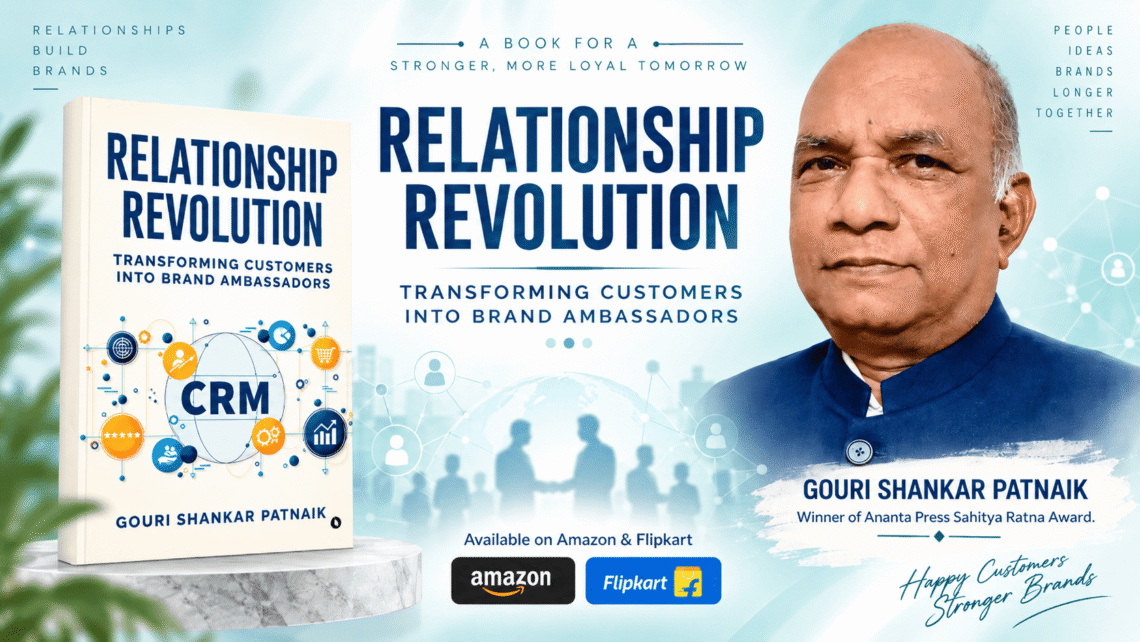
The most interesting idea in Gouri Shankar Patnaik’s Relationship Revolution: Transforming Customers into Brand Ambassadors is not that companies should maintain better customer records. It is that customers themselves can become a strategic source of brand value. That shift in perspective changes the conversation around Customer Relationship Management. Instead of asking only how to acquire, retain, or service customers more efficiently, the book asks how an organization can create relationships strong enough to generate confidence, loyalty, recommendation, and advocacy. This makes the book relevant not only to CRM specialists but to anyone concerned with brand reputation, business growth, organizational strategy, and long-term stakeholder value.
Customer advocacy is a powerful concept because it cannot be manufactured in the same way as advertising. A company can purchase media visibility, optimize campaigns, and automate communication, but it cannot simply command genuine recommendation. Advocacy must be earned. It is the outcome of accumulated experiences in which the customer finds the organization useful, reliable, responsive, and trustworthy. By placing brand ambassadors at the end of the relationship journey, Patnaik offers readers a practical measure of whether customer-centric claims are translating into real value.
The book’s comprehensive treatment of CRM helps explain the conditions required for that outcome. It introduces concepts, benefits, technologies, and implementation strategies and connects them with marketing, sales, and service goals throughout the customer lifecycle. This breadth matters because customer relationships are inherently cross-functional. A brand may attract attention through marketing, establish expectations through sales, deliver value through operations, and protect trust through service. If these functions are disconnected, the customer feels the inconsistency even when internal departments do not.
One of the reasons the book works for both academic and professional audiences is that it does not reduce CRM to a narrow technical subject. Technology is certainly part of modern relationship management, but the emphasis remains on managerial application. This is essential. Organizations frequently have more customer data than they know how to use. They can record contacts, transactions, complaints, campaign responses, and digital behavior, yet still fail to understand what customers actually value. Patnaik’s approach encourages readers to focus on the purpose of information: better decisions, stronger experiences, and more sustainable relationships.
The book’s flexible structure is another practical advantage. Readers can begin with the chapter most relevant to their immediate interest. This makes the text accessible to students building foundational knowledge as well as to professionals looking for a specific perspective. A reader does not need to approach it as a linear textbook. It can function as a learning resource, a managerial reference, or a starting point for organizational discussion. That adaptability is especially useful in a field as broad as CRM, where the questions faced by a marketing student, a sales manager, a service leader, and a chief executive are very different.
Patnaik’s own career gives the book an unusual depth. With over four decades of experience in the pulp and paper and manufacturing sector and senior leadership roles at JK Paper Ltd. and ITC Limited, he writes from the perspective of someone familiar with complex organizations and long-term business systems. His expertise in quality governance, ESG and sustainability oversight, enterprise risk management, regulatory compliance, and quality systems suggests a habit of thinking beyond isolated initiatives. CRM benefits from exactly this kind of systems perspective because a relationship strategy succeeds only when the underlying organization can deliver consistently.
Quality management and customer relationship management are more closely connected than they may first appear. Quality focuses on meeting requirements, controlling variation, learning from feedback, preventing failure, and improving processes. CRM focuses on understanding customers, coordinating interactions, strengthening satisfaction, and increasing relationship value. Both disciplines depend on disciplined information, accountability, measurement, and continuous improvement. Patnaik’s background therefore allows the book to approach CRM with a practical appreciation for what happens between strategy and execution.
This perspective is especially valuable when discussing customer expectations. A brand is not built simply through what it says about itself. It is built through the customer’s interpretation of repeated encounters. The speed of a response, the accuracy of information, the consistency of service, the quality of a product, the ease of doing business, and the manner in which problems are resolved all become part of the brand. CRM, when used well, helps the organization see these interactions as connected rather than separate. That is a major reason the subject is strategically important.
The book also invites readers to think about the economics of relationships. Acquiring customers is often expensive. Retaining a satisfied customer can create repeat revenue and reduce the need to replace lost business constantly. But the value of advocacy can extend further because an advocate influences other potential customers. A recommendation from a trusted person may carry more credibility than a conventional advertisement. Although the book is framed broadly rather than as a narrow financial model, its central thesis naturally leads readers to recognize that relationship quality can have measurable business consequences.
At the same time, the book’s impartial approach prevents the advocacy concept from becoming simplistic. Not every customer will become an ambassador, nor should every relationship be managed identically. Effective CRM requires judgment about needs, value, context, and expectations. The real strength of a CRM strategy lies in helping the organization become more deliberate about where and how it creates value. Technology can support segmentation, communication, tracking, and analytics, but managerial reasoning is still required to determine what actions are appropriate.
For students, this is a valuable lesson because the modern business environment can encourage overly technological explanations. There is a temptation to assume that a sophisticated CRM platform automatically produces better customer relationships. Patnaik’s framing helps correct that assumption. Software can increase visibility and coordination, but it cannot substitute for clear strategy, process ownership, employee capability, and organizational commitment. A poorly designed process becomes a faster poorly designed process when automated. A strong process, by contrast, can be amplified by the right technology.
For professionals, the book can serve as a diagnostic lens. Readers can compare its integrated perspective with their own organizations and ask difficult questions. Do marketing, sales, and service teams share customer information effectively? Are objectives aligned across the customer lifecycle? Are employees using CRM data to improve interactions or merely to satisfy reporting requirements? Are customer complaints treated as isolated problems or as signals for broader improvement? Does the organization measure relationship health, or only short-term transactions? These questions make the book useful beyond passive reading.
The author’s work in ESG and sustainability also adds an interesting dimension to the discussion of relationships. Modern brands are increasingly judged not only by the immediate product or service experience but also by how they conduct themselves as organizations. Stakeholders may care about environmental responsibility, governance practices, transparency, ethics, and long-term impact. Patnaik has advised senior leadership and board-level stakeholders on integrating ESG principles with business strategy, including Business Responsibility and Sustainability Reporting frameworks and environmental stewardship. This wider understanding of trust strengthens the credibility of a book centered on relationships and brand advocacy.
Trust is, after all, the connecting idea. Customers advocate for brands they trust. Trust develops when promises and performance align. Governance protects trust by reducing irresponsible behavior. Quality protects trust by increasing reliability. Service protects trust when problems occur. Transparent communication protects trust when expectations must be managed. CRM can help connect these activities by keeping the organization attentive to the customer’s history, needs, feedback, and experience.
Patnaik’s association with standards and professional bodies such as the Bureau of Indian Standards, TAPPI, IPPTA, and the Quality Council of India further reinforces the disciplined character of his approach. His recognition as a Most Influential Quality Leader in 2025 and 2026 and as a Topmost Quality Leader by the International Quality Congress 2025 reflects a professional reputation shaped by quality and organizational excellence. Readers therefore encounter CRM through the perspective of a leader who understands that sustainable outcomes are created by systems, not slogans.
The book is also notable for its relevance across career stages. A student can use it to understand why CRM occupies an important place in modern management. A young professional can use it to see how individual customer interactions contribute to wider business outcomes. A manager can use it to improve coordination across functions. A senior leader can use it to evaluate whether the organization’s customer strategy is truly embedded in processes and governance. This breadth gives the book lasting usefulness.
Relationship Revolution ultimately argues for a more mature view of business relationships. Customers are not entries in a database, targets in a campaign, or endpoints in a sales funnel. They are participants in an ongoing exchange of value. When organizations listen well, respond intelligently, deliver consistently, and learn systematically, customers can become more than buyers. They can become supporters whose advocacy strengthens the brand in ways that paid communication alone cannot achieve.
That is what makes the book distinctive. It connects the operational discipline of CRM with the strategic ambition of brand building. It respects technology without worshipping it, emphasizes implementation rather than theory alone, and presents customer advocacy as an earned outcome. For readers who want to understand how relationship management can become a source of long-term growth and reputation, Gouri Shankar Patnaik offers a thoughtful, structured, and practically relevant guide.Amazon Purchase Link: https://amzn.in/d/04pCNjFr