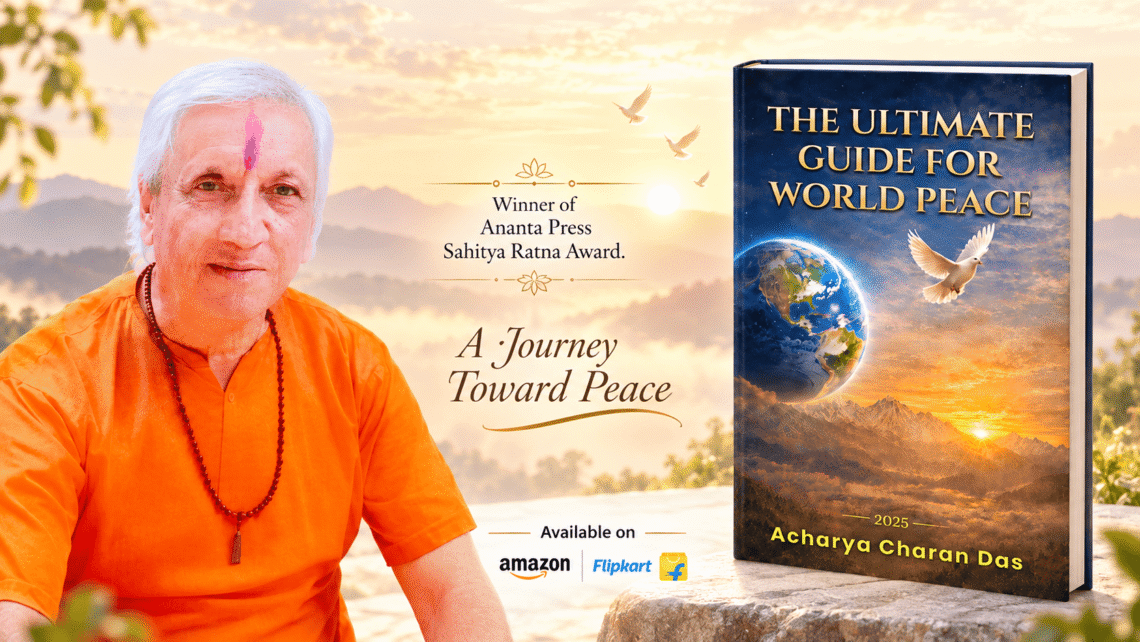
The Ultimate Guide for World Peace is perhaps most accurately described as a spiritual polemic with a universal ambition. Acharya Charandas takes on one of the largest possible subjects – the causes of human conflict – and approaches it through a sustained comparison between what he regards as eternal Vedic principles and the teachings, institutions, and historical records of other religious traditions. The result is not a neutral introduction to comparative religion. It is an argument, often forceful and sometimes confrontational, that world peace requires a standard of truth capable of transcending sectarian loyalty.
That distinction is essential for understanding both the strengths and the difficulties of the book. A reader expecting balanced summaries of multiple faiths will not find that here. Charandas writes from a declared Vedic perspective. The table of contents makes the direction clear: after an opening chapter on “A Missing Clue for the Right Solution,” the book moves into chapters on the Koran, the Bible and Vedic concepts; Christianity; world population; past Vedic influence; duties and renunciation; a chapter titled The Bible in the Balance; the Macaulay episode; “The Missing Pieces of the Puzzle”; “Solution – The Solutions”; and several concluding sections. This architecture makes comparison, critique, and correction central to the project.
The author’s governing question is surprisingly practical: how can humanity know whether a teaching leads toward peace or away from it? His answer is to examine teachings by consistency, conduct, and consequences. He repeatedly contrasts belief with what he calls eternal truth. Heat belongs to fire regardless of opinion; the sun gives light regardless of nationality; actions produce consequences regardless of labels. These analogies are used to argue that spiritual truth should function in a similarly universal way. If a moral principle is genuinely universal, it should not depend on birthplace, inherited membership, or institutional power.
This emphasis on universality is one of the book’s strongest intellectual features. Charandas is deeply suspicious of inherited certainty when it becomes an excuse for refusing comparison. He wants readers to inspect what they have been taught, to ask whether a doctrine encourages compassion or violence, humility or domination, self-control or indulgence, and to compare claims against what he understands as natural law. In that sense, the book is an extended invitation to intellectual disobedience. It tells the reader not to accept ideas merely because parents, clergy, governments, or communities repeat them.
The method is provocative because the author’s own conclusions are far from neutral. The Vedas, Bhagavad Gita, and related traditions are presented as the most coherent source of spiritual knowledge, while other traditions are frequently criticized in severe terms. There are passages that make sweeping claims about religious communities and historical events. A careful reader should distinguish between Charandas’s interpretive framework and independently established history. Some assertions are controversial, some are not conventionally accepted by historians, and some statistical or scientific claims may be dated or require verification. The book is strongest when read as a record of the author’s worldview and reasoning rather than as an uncontested reference work.
Once that reading position is established, the book becomes much more interesting. Its uncompromising tone serves a purpose: Charandas wants to break the social habit of treating religion as exempt from moral examination. He argues that no scripture, leader, or institution should be protected from questions if its teachings affect the treatment of human beings, animals, the environment, or other communities. This insistence on accountability gives the book a seriousness that is often missing from superficial interfaith discussions. Peace, in his view, cannot be built merely by asking everyone to be polite about contradictions. It requires the courage to investigate them.
At the same time, the book is not simply negative or oppositional. Its positive center is the idea of self-realization. Charandas argues that the human being is more than the body and that the soul’s identity is deeper than temporary religious or national categories. That spiritual anthropology allows him to imagine a universal community. His desired world is one in which people recognize a shared spiritual origin, practice compassion toward sentient beings, perform duties without excessive attachment, and cultivate a consciousness free from pride, arrogance, anger, and ignorance. The comparative religious sections are therefore meant to clear ground for a constructive vision rather than exist only as criticism.
The author’s repeated use of examples is another notable feature. He is less interested in elegant abstraction than in everyday tests: a parent whose behavior contradicts advice, a manufacturer whose machine requires the correct manual, a person who must taste food rather than accept a seller’s advertisement, a mind that can become either friend or enemy depending on its training. These analogies are memorable because they translate a dense theological argument into ordinary experience. One may disagree with the conclusion and still understand the route by which the author reaches it.
The text’s scale also contributes to its uniqueness. It is a large, layered work containing scriptural quotations, historical narratives, visual plates, newspaper-style material, philosophical reflections, environmental arguments, moral exhortation, and autobiographical context. The preface explains that an earlier version of the project was connected with the Turner Tomorrow Award in 1990 and that the manuscript was developed around the question of the survival and prosperity of life on the planet. This gives the book the feeling of a life project rather than a topical publication produced for a passing debate.
For readers of comparative religion, the value of The Ultimate Guide for World Peace lies partly in the fact that it does not hide its standpoint. Its perspective is unmistakable. That openness allows the reader to engage critically. One can ask: Which comparisons are persuasive? Which historical claims need checking? Which moral principles appear genuinely universal? Where does the author’s rhetoric illuminate a contradiction, and where might it oversimplify a complex tradition? A book that generates these questions can be intellectually useful even when the reader does not share its conclusions.
Ultimately, this is a book for readers willing to encounter a strong voice. It does not aim for diplomatic balance; it aims for conviction, challenge, and transformation. Its most important claim is that peace requires a truth larger than sectarian identity and a moral standard applied consistently to everyone, including one’s own community. That claim gives coherence to a vast and controversial work. The Ultimate Guide for World Peace is unique because it combines comparative religious criticism with a larger spiritual thesis about consciousness, compassion, duty, and universal kinship. It asks the reader not merely, “What do you believe?” but, more demanding still, “What does your belief produce in the world?”
Amazon Link: https://www.amazon.in/ULTIMATE-GUIDE-WORLD-PEACE-ebook/dp/B0H27JGP8W/