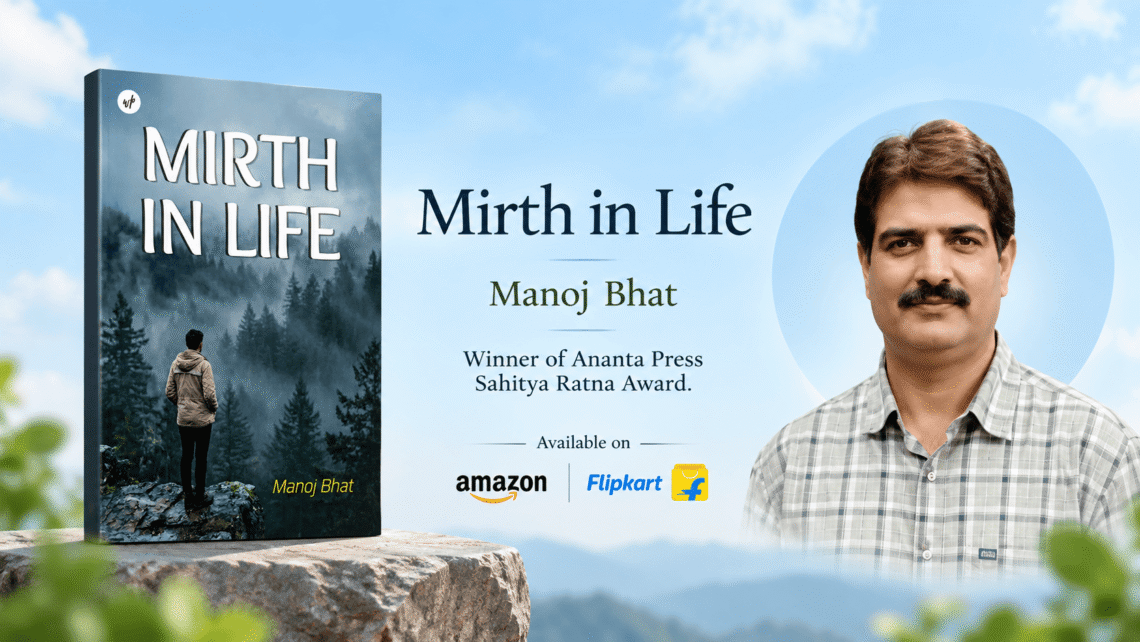
Mirth in Life by Manoj Bhat begins with a contradiction that gives the novel its strongest narrative energy. Rohan is intelligent, ambitious, observant, and determined to live differently, yet the very qualities that help him progress do not guarantee the emotional fulfillment he expects. His life becomes an inquiry into the difference between success and contentment. In a time when achievement is often treated as a universal solution, this is a timely and worthwhile subject for fiction.
The novel’s premise is built around Rohan and his close friends Gurdeep, Akriti, Irfan, and Tapas, a group described as stoic and purposeful. They enter adult life with structure and defined objectives. Their instinct is to plan, work, resist negativity, and escape the vicious cycles they observe around them. There is something admirable in this mindset. It reflects the hope that discipline can create a better future. Yet Manoj Bhat does not allow the story to remain at the level of motivational optimism. Instead, he exposes the limits of planning when confronted by time, uncertainty, emotional pain, and destiny.
That movement gives Mirth in Life a more serious identity than its title might initially suggest. “Mirth” can sound light, but the book reaches for it through difficult terrain. Regret, melancholy, skepticism, woes, and miseries all form part of the characters’ experience. The narrative question is not whether they can simply become cheerful. It is whether they can discover a form of happiness strong enough to survive disappointment.
The distinction between intelligence and wisdom is central. Rohan has intellectual ability in abundance. He can comprehend patterns and visualize the consequences of decisions. But human beings are not mathematical systems. Emotional life rarely responds to analysis in a predictable way. The novel gradually makes space for a different kind of intelligence—one involving self-knowledge, humility, values, and perspective. Rohan’s journey becomes compelling because he must learn that the mind capable of solving problems can still be confused about purpose.
This is where the literary reference to Robert Frost becomes particularly meaningful. “The Road Not Taken” is invoked as an image of choices and divergent paths. In Mirth in Life, the metaphor is not decorative; it captures the structure of Rohan’s dilemma. He wants to choose a path others may not have chosen, but unconventionality itself does not guarantee fulfillment. Every road carries uncertainty. The difficult question is not merely which path is unique, but which path is meaningful and whether meaning can be recognized before the journey is complete.
The novel’s treatment of financial freedom sharpens this idea. Rohan attains it at an early stage, which would normally signal success in a conventional narrative. But Bhat deliberately refuses to end the story there. Financial freedom solves a category of problems while leaving another category untouched. The result is a subtle critique of the idea that material independence automatically produces inner independence. The protagonist’s disappointment becomes philosophically productive because it forces him to reconsider the assumptions that guided his earlier choices.
Another strong feature is the role of unpredictability. The prologue observes that the unplanned period becomes the most interesting. This is an excellent narrative principle because it reflects real life. Plans reveal intention, but interruptions reveal character. Rohan and his friends discover themselves not only through what they decide to pursue but through how they respond when destiny moves in an unexpected direction. The “clock of time” and the changing “wind” become reminders that life is dynamic, and no individual possesses complete control.
The group dynamic also prevents the novel from becoming overly abstract. Gurdeep, Akriti, Irfan, and Tapas give Rohan a network of relationships through which ideas can be tested. The search for happiness becomes communal. Friendship matters because it creates emotional continuity when plans fail. It also introduces the possibility that meaning is found not only in individual accomplishment but in loyalty, shared struggle, mutual support, and the ability to remain present in another person’s difficult season.
Bhat’s use of scriptures and meaningful messages adds a spiritual dimension without changing the book’s basic human focus. The characters are searching for an interpretive framework that can make suffering intelligible. Financial calculations and rational plans have their place, but they do not explain grief, regret, destiny, or the desire for peace. The turn toward wisdom traditions suggests that the search for mirth may require a broader understanding of life than modern measures of success usually provide.
The novel is also notable for its interest in ideology. The prologue suggests that changes in one’s ideology toward life are essential. This is a deeper proposition than simply thinking positively. An ideology is a system of beliefs about what matters, what counts as success, and how one should respond to experience. If Rohan’s old system equates intelligence, effort, and financial achievement with happiness, then disappointment becomes evidence that the system itself needs revision. The story’s true transformation therefore occurs at the level of worldview.
For readers who enjoy reflective fiction, this creates considerable value. Mirth in Life invites readers to pause and examine their own assumptions. How much of one’s life is organized around goals inherited from society? When does ambition become a substitute for self-understanding? Is contentment something achieved through external arrangement, or cultivated through inner clarity? Such questions give the book relevance beyond the immediate storyline.
The author’s biography strengthens the thematic connection. Manoj Bhat studied English Literature, worked in a multinational pharmaceutical company, earned recognition as a Star Performer, and then devoted twenty-eight years to government service. His professional path combines ambition, performance, transition, and long-term responsibility. A writer with that background is well positioned to reflect on what achievement feels like from inside a life rather than from a distance. The book’s questions therefore carry the texture of experience even when expressed through fiction.
One can also appreciate the novel’s refusal to portray hardship as meaningless noise. Difficulty becomes part of the characters’ education. Rohan’s doubts and the group’s struggles are not merely obstacles placed in the way of a happy ending; they are the conditions that force deeper inquiry. Without disappointment, Rohan might never question the adequacy of his earlier definition of success. In that sense, adversity functions as a teacher.
The phrase “final assault” on negativity, emotional planning, regret, woes, and miseries gives the story a dramatic edge. Yet it also highlights a subtle paradox: some forms of suffering cannot simply be conquered by force. They may require acceptance, understanding, forgiveness, or a change in perspective. Whether Rohan and his friends realize this becomes one of the most interesting implications of their journey.
Mirth in Life stands out because it uses an accessible story to engage with enduring philosophical concerns. It is interested in destiny without surrendering human agency, in spirituality without abandoning everyday reality, and in success without worshipping it. The novel suggests that a person may reach a destination and still discover that the real journey has only begun.
For readers navigating careers, relationships, responsibilities, and the pressure to appear successful, Manoj Bhat’s book offers a resonant premise. It reminds us that happiness is not a mathematical outcome produced by intelligence plus effort plus money. It is a more complex state shaped by meaning, choices, relationships, values, and the capacity to interpret experience with wisdom. That is what gives Mirth in Life its identity: it turns the familiar pursuit of success into a deeper investigation of what makes success worth having in the first place.
Amazon Purchase Link: https://amzn.in/d/0aKhgiLE