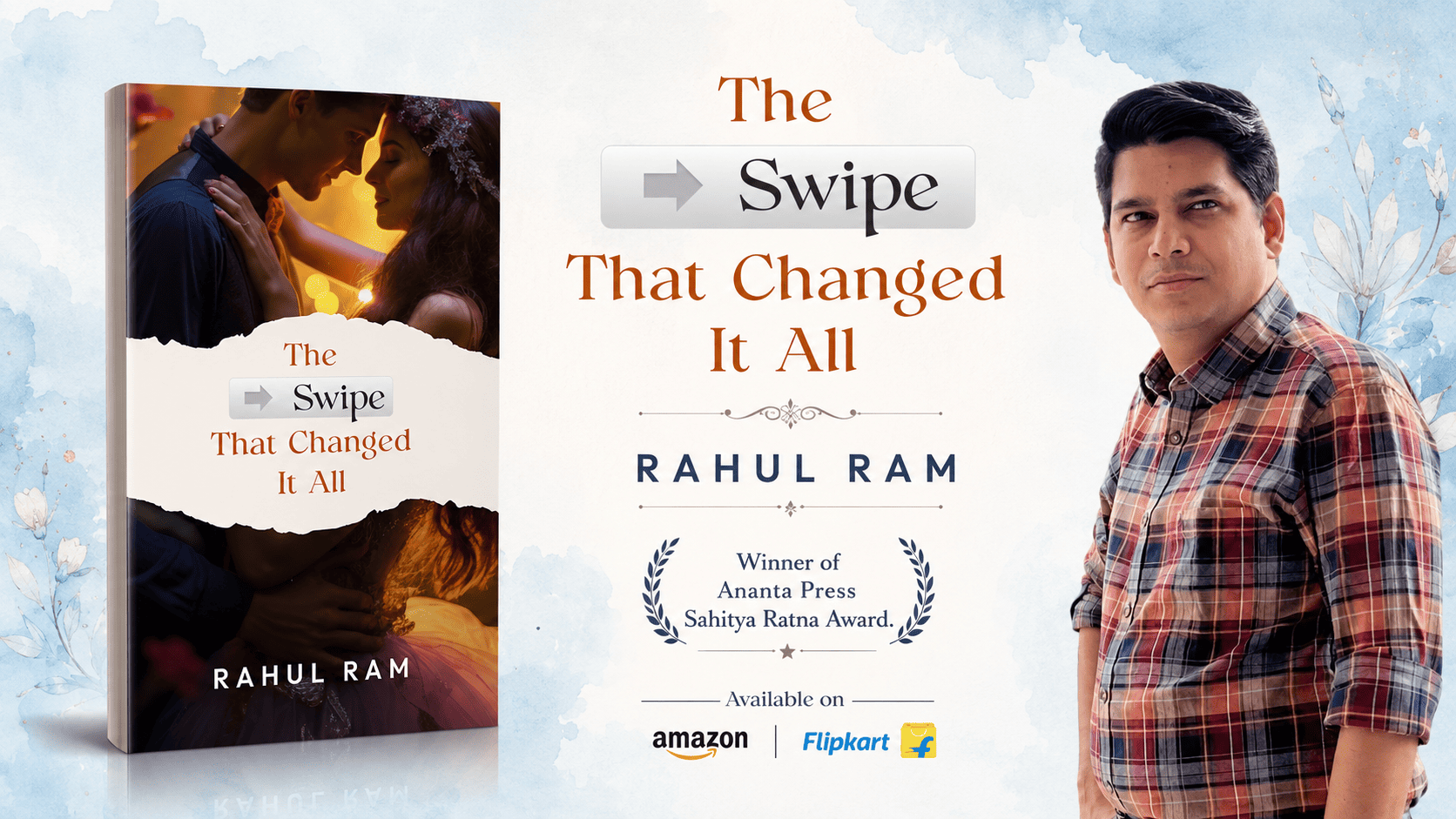
The Swipe That Changed It All by Rahul Ram
At its heart, The Swipe That Changed It All is a relationship story. Its technological premise is original and important, but the deepest emotional question concerns Vivaan and Aanya. They are connected by passionate love, separated by pain, and placed before the possibility of healing. Rahul Ram uses their relationship to explore what happens when grief enters love and changes the way a person gives, receives, and protects affection.
Vivaan is introduced as an inventive genius, but the quality that defines him most strongly is not intelligence. It is woundedness. He carries the memories of losing loved ones, and those memories have become so painful that he wants to remove the sensation of pain itself. His invention begins as an act of survival. He is not simply chasing fame or proving his brilliance. He is trying to escape an inner world that has become unbearable.
This motivation makes Vivaan emotionally complex. Readers can understand why he wants relief even when they question his method. His decision comes from a recognisable human wish: the wish to stop being haunted. Grief often creates the feeling that life has divided into a before and an after. The person may continue working, speaking, and functioning, but the memories remain present. Vivaan’s machine turns that invisible burden into the engine of the plot.
Aanya stands on the other side of this conflict. She represents passionate love, emotional connection, and the life Vivaan risks losing while he tries to escape the past. Her importance is greater than that of a conventional romantic interest. She becomes proof that pain and love cannot always be separated. Vivaan’s fear of suffering affects his ability to remain fully present with her. In trying to protect himself, he damages the person and relationship that could help him return to life.
This dynamic is one of the book’s most meaningful qualities. It recognises that unresolved grief does not remain private. Even when a person tries to hide it, grief can shape communication, trust, attention, and intimacy. A partner may feel shut out, neglected, or unable to reach the person they love. The Swipe That Changed It All presents this emotional distance through a dramatic technological obsession, but the underlying relationship pattern will feel familiar to many readers.
The novel’s idea of second chances is therefore especially important. A second chance between Vivaan and Aanya cannot simply mean resuming the relationship from the point where it broke. Too much has happened. Vivaan has allowed his pain and invention to take priority over love. Aanya has experienced the consequences of being pushed aside. Healing must include recognition, accountability, and change.
This makes their possible reconciliation emotionally richer than a simple reunion. The reader is invited to consider whether love can survive damage without denying it. Forgiveness is not the same as pretending that nothing happened. Trust cannot be restored by romantic words alone. A meaningful second chance requires a new way of relating. Vivaan must learn that love is not a reward waiting for him after he solves his personal suffering. It is a living bond that needs honesty and participation.
The title contributes to the relationship theme. A swipe is quick, but relationships are not. Modern digital life can create the impression that connection is immediate and replaceable. A person can accept, reject, or move on with a small gesture. Yet emotional attachment develops through time, memory, sacrifice, and repeated choice. The Swipe That Changed It All uses the language of digital speed to tell a story about feelings that cannot be rushed.
The contrast between Vivaan’s machine and Aanya’s love is particularly effective. The machine offers control. Love requires surrender. The machine promises to reduce sensation. Love intensifies sensation. The machine is built through technical knowledge. Love is sustained through empathy, patience, and vulnerability. Vivaan is comfortable with the logic of invention because it gives him clear problems to solve, but Aanya asks him to enter a space where certainty is impossible.
This tension gives the novel strong emotional and symbolic value. Vivaan’s choice is not only between a machine and a woman. It is between two ways of living. One path seeks safety through numbness. The other accepts that a meaningful life includes joy and sorrow, attachment and fear, memory and uncertainty. Aanya embodies the second path because love asks Vivaan to remain open even after loss has taught him how much openness can hurt.
Rahul Ram’s background adds another interesting dimension to the romance. He has spent more than a decade in digital marketing after studying software engineering, giving him practical experience with technology and human behaviour. He understands that digital systems are not separate from emotion. They are designed around attention, desire, decision, and connection. This understanding appears in the novel’s core concept, where a technological invention becomes inseparable from a personal relationship.
The author’s long interest in books and movies is also visible in the cinematic nature of the premise. An inventive genius, a machine capable of altering pain, a damaged love story, and the possibility of redemption create a strong narrative frame. Yet the emotional themes remain grounded enough for readers to recognise themselves. Most people will never build a machine like Vivaan’s, but many have tried to avoid pain by becoming distant, busy, controlled, or unavailable.
The relationship between Vivaan and Aanya may especially appeal to readers who enjoy stories about flawed people rather than perfect heroes. Vivaan’s brilliance does not protect him from making harmful decisions. Aanya’s love does not automatically give her the power to save him. Both ideas are important. Love can support healing, but one person cannot do another person’s emotional work. Vivaan must choose to confront his grief, and Aanya must decide what love can reasonably ask her to endure.
This creates space for an important discussion about boundaries. Passionate love is powerful, but healthy love also requires self-respect. Aanya’s significance lies partly in the fact that she cannot simply disappear into Vivaan’s pain. Her presence reminds the story that the suffering person is not the only person affected. The partner’s experience matters too. A story of healing becomes more honest when it acknowledges the harm caused by withdrawal and obsession.
The novel’s message is therefore compassionate without being simplistic. It understands why Vivaan wants to escape pain, but it does not assume that his suffering excuses every choice. It values Aanya’s love, but it does not suggest that love alone can repair everything. It believes in second chances, but it connects those chances to growth. This balance gives the book emotional maturity.
Readers may also appreciate the way the story treats memory. Memories of loss hurt Vivaan, yet memories of love are also part of what makes Aanya precious. If he weakens his capacity to feel pain, he may also weaken the emotional meaning of what he wants to preserve. The novel suggests that human memory cannot be divided into clean categories. Joy and grief often occupy the same place. A person misses someone because they were loved. A relationship matters because it can be lost.
For contemporary romance readers, The Swipe That Changed It All offers more than the usual question of whether two people will remain together. It asks what kind of emotional transformation is necessary for love to survive. For readers interested in speculative ideas, the machine creates tension and originality. For readers who have experienced grief, regret, or emotional distance, Vivaan’s struggle may feel personally relevant.
Rahul Ram’s debut stands out because it gives romance a modern ethical challenge. Vivaan does not face an external villain in the traditional sense. His greatest conflict is the belief that he can eliminate pain without losing part of himself. Aanya’s role is not merely to wait for him. She represents the human connection that exposes the weakness in his solution.
The Swipe That Changed It All is ultimately a story about the courage to return. Vivaan must return to feeling, to responsibility, and possibly to love. Aanya must decide whether the person returning is capable of protecting a second chance. Their journey reminds readers that healing is not the absence of pain. It is the ability to remember, love, and move forward without allowing the past to destroy the present.
This makes the novel a meaningful choice for readers who value emotionally driven fiction. Its romance is shaped by loss, its hope is earned through the idea of change, and its technological premise strengthens rather than replaces the human story. Vivaan and Aanya’s relationship shows that love may be damaged by fear, but it can remain powerful when both truth and transformation are allowed to enter.
Buy the Book on Amazon: https://www.amazon.in/Swipe-That-Changed-All/dp/B0DWXFBFZJ/