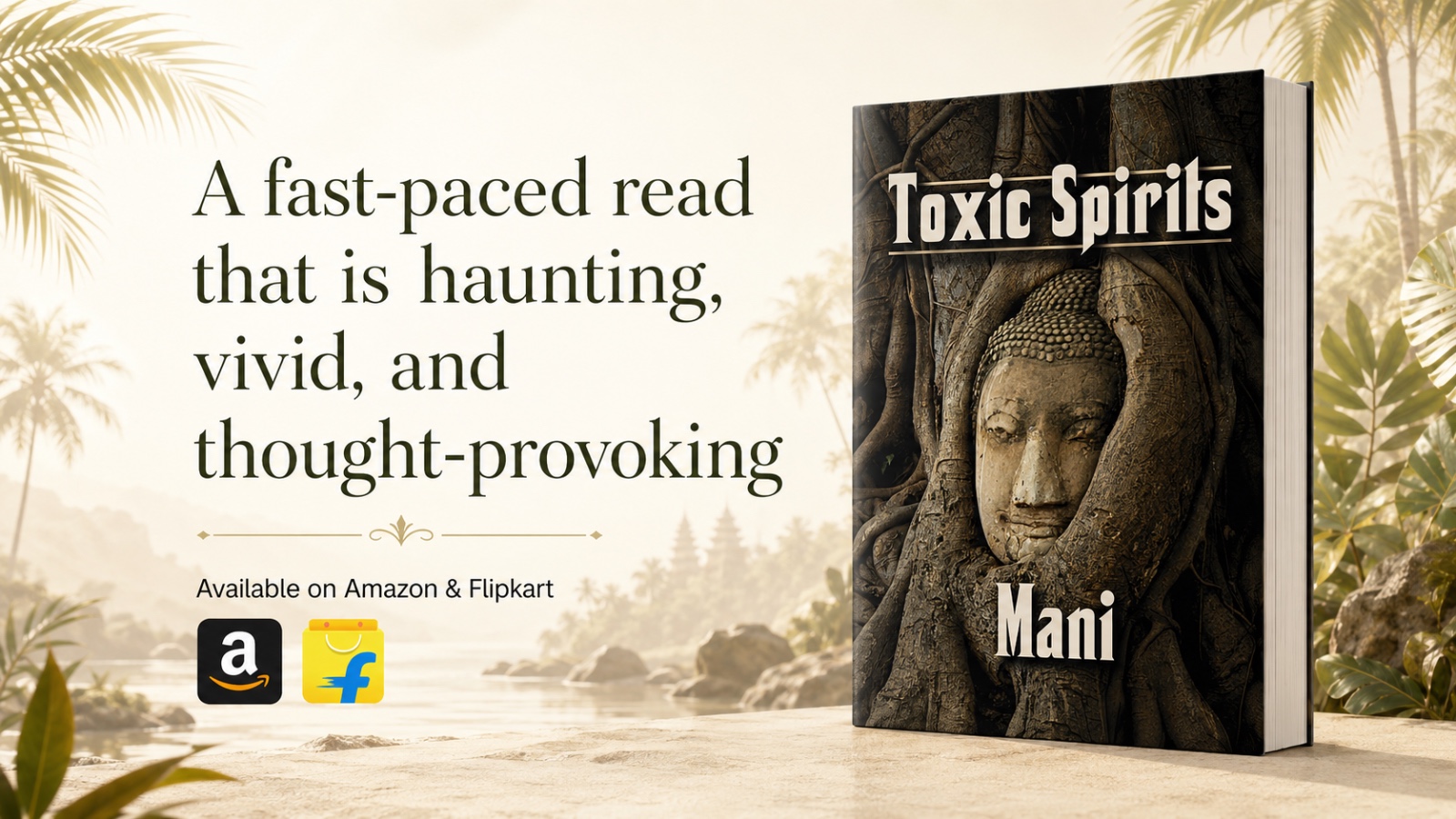
Through Benton, Siri, Mimi, and Pierre, Mani explores identity as something shaped by ancestry, migration, power, memory, and the dangerous desire to redesign life.
Toxic Spirits begins with a fascinating and complex character trying to leave his life behind. Benton has lost his wife, retired from intelligence work in Washington, and moved to Thailand. Like many expatriates, he imagines geographical relocation can spawn a fresh identity. A new country may offer new routines, new relationships, and distance from old wounds. Mani’s novel quickly dismantles that hope. Benton discovers that identity travels with the body, and in this thriller the body itself can be altered.
Benton as a complicated outsider
Benton is described as an African-American man with Native American and East Asian ancestry. That background is not an ornamental detail. It makes him the natural centre of a novel interested in genetics and multiculturalism. He understands that race is socially imposed and historically violent, yet his own ancestry also resists simple categories. His life has been shaped by American institutions, including military intelligence, while his appearance and experience have likely kept him aware that those institutions do not treat everyone equally.
In Thailand, Benton occupies another complicated position. He is a foreign retiree with resources and mobility, but he is not identical to the white Western expatriates around him. He can enter their bars and conversations while remaining alert to assumptions that they may not notice. This double perspective allows Mani to examine the expat world from inside and outside at once. Benton is privileged in relation to poor local communities, vulnerable in relation to Pierre’s scientific power, and emotionally exposed because of grief.
The expat world as performance
The fictional seaside town of Prajawan is filled with colourful expatriates, local residents, workers, singers, intellectuals, and people escaping unfinished histories. Bars become stages where everyone tells a version of himself. Retirement, travel, and reinvention create the illusion that identity is flexible, but the novel repeatedly asks the reader to reflect on who has the freedom to reinvent themselves and who remain caught in the stories others tell about them.
For wealthy foreigners, Thailand may appear to be a playground. For Siri’s hill-tribe community, the same country contains unequal institutions and dangerous medical experiments. The contrast exposes the limits of the tourist gaze. A beautiful landscape can be enjoyed without being understood. A tribal singer can be admired as exotic while her political warning is ignored. Toxic Spirits forces the outsider to move beyond consumption and confront the lives hidden behind the scenery.
Siri and the struggle to be heard
Siri’s disappearance begins the mystery, but her role is also symbolic. She has been speaking out about the side effects of drug trials carried out on her hill-tribe. She refuses the identity assigned to marginalized subjects: silent, grateful, available, and easily represented by others. Her voice turns a medical programme into a public accusation. That makes her dangerous to the people who benefit from secrecy.
The fact that Benton first encounters Siri as a captivating singer is important. He is drawn to her beauty and performance before he understands her political courage. The novel quietly challenges him, and the reader, to see her as more than an object of fascination. Her disappearance transforms attraction into a mission to uncover what is hidden behind the beautiful face of Thailand.
Mimi and a different mixed identity
Mimi, a gifted young Thai-Australian muay thai boxer, enters the story after Benton has already been pulled into danger. She represents another form of multicultural identity. Unlike Benton, whose ancestry is tied to the long racial history of the United States, Mimi’s identity is a cross-product of Thailand and Australia. Her physical skill, youth, and confidence contrast with Benton’s weariness, yet both characters live between cultural categories.
Their relationship gives the novel emotional warmth, but it is deliberately uncomfortable. Their love develops while Benton is undergoing terrifying changes caused by the genetic drugs. The question is not only whether two people from different generations and backgrounds can connect. It is whether intimacy can survive when the body no longer feels stable. Mimi’s presence asks Benton to remain human at the moment when scientific manipulation makes him fear that humanity is slipping away.
Pierre and the fantasy of redesign
Pierre, the Indo-Cambodian doctor running the trials, is also a multicultural figure. His mixed background could have made him sensitive to complexity. Instead, he turns complexity into a project of control. He is a brilliant scientist with a criminal mind, and his genetic work reflects a dangerous fantasy: that life can be improved by someone intelligent enough to decide what improvement means.
This is one of the novel’s sharpest ironies. The most culturally mixed characters do not automatically become ethical or open-minded. Multiculturalism is not presented as a moral badge. It can produce empathy, but it can also produce insecurity, ambition, or the desire to master one’s own fragmented identity through science. Pierre’s background helps make him more than a foreign villain imposed on Thailand. He is a product of several worlds and accountable to none.
Genes, ancestry, and the myth of purity
The genetic theme allows Mani to challenge simplistic ideas of race. Benton’s joking declaration that beneath the skin human beings are “a bunch of crazy mutts” expresses the novel’s resistance to purity. Human history is migration, mixing, adaptation, violence, desire, and survival. The attempt to define a person through a clean biological category is therefore both scientifically and morally suspect.
Yet Toxic Spirits does not suggest that biology is meaningless. The drugs affect bodies in real and horrifying ways. Ancestry matters, proteins matter, and DNA matters. The novel’s point is subtler: biological information is part of identity, but it cannot contain identity. A gene cannot explain grief, loyalty, memory, love, or responsibility. When Pierre treats genetics as destiny and material, he confuses knowledge of the body with ownership of the person.
A geography of belonging
The novel’s movement from Thailand to Washington, DC, and Auroville near Pondicherry expands its meditation on belonging. Washington represents Benton’s former institutional life, with its intelligence systems and racial tensions. Thailand represents escape, desire, and eventual danger. Auroville, imagined as a utopian international community, introduces another attempt to build identity beyond nationality, while concealing private lives of brutality and neglect. Each place promises a different answer to the question of how people from many backgrounds can live together.
None of these spaces is simple. Institutions can speak of universal values while reproducing hierarchy. Expat communities can celebrate freedom while remaining detached from local suffering. Utopian projects can offer hope while carrying their own contradictions. Mani’s locations are therefore not postcards; they are experiments in belonging, as unstable as Pierre’s genetic trials.
Language and the sound of cultural contact
The novel’s attention to local speech and its inclusion of a glossary reinforce its multicultural design. Language is one of the first places where outsiders confront difference. A phrase can signal intimacy, confusion, humour, or power. Mani’s ear for regional patois keeps the Thai setting from becoming linguistically flat. Characters do not all speak in the same neutral voice merely for the reader’s convenience.
This linguistic texture also creates productive discomfort. Readers may occasionally need to slow down, infer meaning, or consult the glossary. That small act mirrors the larger ethical demand of the novel: entering another culture should require effort. Understanding cannot be achieved through immediate consumption.
Identity under pressure
As the thriller intensifies, every major character is forced to reveal what he or she values. Benton must choose between withdrawal and responsibility. Siri risks herself by speaking. Pierre is trying to become a saviour who cures cancer by any means. Mimi, young and pretty, chooses how to respond to an older man whose body and circumstances are changing. Identity in Toxic Spirits is therefore under constant pressure.
The forces of tribal healing, high-tech medicine, and love finally compete over who will survive. Each offers a different idea of what a person is. High-tech power treats the person as a system to manipulate. Tribal healing sees the body within a community and ecology. Love recognizes an individual who cannot be reduced to either data or category. The novel gains emotional force from allowing these ideas to collide rather than resolving them into a simple slogan.
Final verdict
Toxic Spirits is an unusual thriller because its question of identity is not added after the suspense. It generates the suspense. Benton’s investigation becomes frightening precisely because he discovers that the powerful can alter the boundary between self and body. The thriller asks whether identity can survive forced transformation, and whether multicultural belonging can become a source of solidarity rather than another form of consumption.
Readers interested in migration, race, genetic science, Southeast Asia, and morally complicated characters will find the novel rewarding. It is atmospheric and fast, but also reflective. Its people are never merely representatives of one culture. They are mixtures, contradictions, and unfinished stories. In a world increasingly tempted by biological shortcuts and clean categories, Toxic Spirits argues for a messier truth: human beings are shaped by many inheritances, but they become themselves through the choices they make.
Buy the book: Toxic Spirits on Amazon India