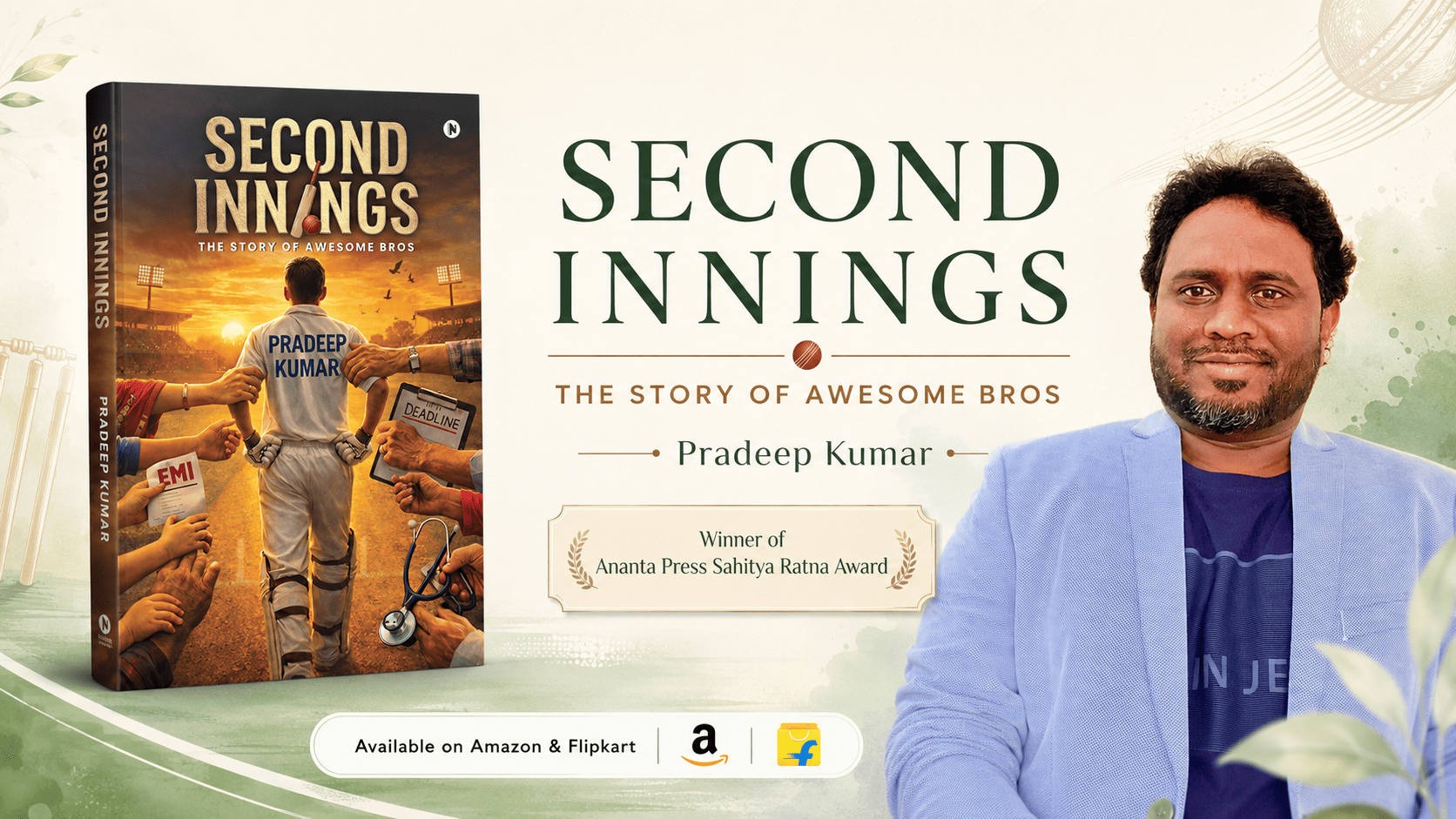
For many people in India, cricket begins long before it becomes organised. It begins in narrow lanes, school grounds, apartment courtyards, terraces, and any open space where a boundary can be imagined. The equipment may be improvised, the rules negotiated, and the arguments endless, but the attachment is real. Then adulthood arrives. Careers become demanding, families need attention, and free time becomes a carefully managed resource. Second Innings: The Story of Awesome Bros enters at this point. It asks what happens when adults, surrounded by responsibilities, decide that cricket still deserves a place in their lives.
Pradeep Kumar’s book is appealing because it treats weekend cricket with seriousness without taking away its fun. These are not professional athletes seeking national selection. They are working people carrying office deadlines, business schedules, EMIs, health concerns, and domestic responsibilities. Yet when Saturday comes, they step onto the field and enter a different rhythm. The match matters. The early morning matters. The team matters. For a few hours, life is measured in overs, partnerships, catches, appeals, and the familiar hope that the next ball can change everything.
This return to play gives the book its emotional power. Adults are often encouraged to treat recreation as optional, something to be fitted in only after every productive duty has been completed. But duties are never fully completed. There is always another email, payment, meeting, errand, or household task. Awesome Bros represents a decision to protect a space for joy. The team is created not because the participants have abundant free time, but because they choose to make time. That distinction turns their cricket into an act of commitment.
The details highlighted in the book’s description are vivid: close matches, missed catches, early morning sunrises, heated debates, shared breakfasts, and unforgettable moments away from the field. Together, these elements create the texture of amateur sport. A match is never only its final score. It includes the messages sent the previous evening, the uncertainty about who will arrive, the rush to prepare, the teasing after an error, the dispute over a decision, the analysis that continues long after play, and the meal that becomes more memorable than the result. The book understands that sporting memory is social memory.
Missed catches are particularly meaningful in this context. Professional highlights tend to preserve brilliance, but personal memories often preserve imperfection. The easy catch dropped at the worst moment may become a story repeated for years. The player who failed may later laugh the loudest. Humour turns embarrassment into belonging. By including these imperfect moments, Pradeep Kumar avoids creating a polished mythology. He celebrates the team as it actually existed: competitive, emotional, flawed, and deeply alive.
The book’s cricketing environment also allows adults to rediscover parts of themselves that routine may have hidden. A person known in the office for caution may play fearlessly. A reserved resident may become the loudest encourager. Someone exhausted by professional pressure may feel unexpectedly light while fielding under the morning sun. Sport permits a temporary reordering of identity. It does not erase responsibility, but it reminds people that they are more than their responsibilities.
The word “Second” in the title captures this renewal. A second innings is not a return to childhood in the literal sense. The players cannot become children again, and the book does not pretend that they can. Instead, it shows how adult life can recover playfulness without abandoning maturity. These men bring their experiences, disappointments, habits, and responsibilities to the game. Their cricket is enriched by everything they have lived through. It becomes a second innings because it offers another chance to participate passionately in something that may once have seemed left behind.
The story is also strongly rooted in place. A gated community becomes more than a collection of apartments when residents begin creating shared traditions. Weekend cricket gives the community a narrative. People remember seasons, matches, turning points, rivalries, and celebrations. Newcomers enter an existing culture, while long-time players become custodians of memory. The field becomes a landmark not because of its physical features but because of what has happened there.
Cricket readers will appreciate the book’s understanding that teamwork is emotional as well as tactical. A partnership depends on communication. Fielding depends on trust. A captain must read people as well as conditions. Players must accept that individual ambition cannot always control the game. These truths are familiar to anyone who has played seriously at any level. What makes the book distinctive is that it connects them to the wider realities of friendship, leadership, and community.
Readers who are not cricket enthusiasts can still enter the story easily because the game functions as a universal metaphor. Every life contains close matches and missed opportunities. Everyone knows what it means to lose despite effort, to be supported after failure, or to return after disappointment. The book’s sporting language carries emotional experiences that extend far beyond the boundary. Cricket is the setting, but perseverance is the subject.
Pradeep Kumar’s voice is well suited to this material because he writes from lived experience. This is his debut work, and he was not previously a habitual reader or writer. That background gives the book the quality of a story that needed to be told. The author is not approaching Awesome Bros as an outsider documenting a social phenomenon. He helped build the team, experienced its tensions and joys, and recognised that its meaning exceeded sport. The writing becomes a form of preservation, ensuring that the lessons and memories do not disappear into casual conversation.
There is also something generous about creating a book from a collective experience. Although the author’s name appears on the cover, the subject is a group. The project honours the players, supporters, families, and circumstances that allowed the team to exist. This collective focus distinguishes Second Innings from memoirs centred on individual achievement. Its pride is shared. Its victories belong to many people, and even its losses become common property.
Ultimately, Second Innings: The Story of Awesome Bros celebrates the cricket that exists beyond stadiums and statistics. It celebrates the match played before the workday begins, the friendship formed between neighbours, the joke born from a mistake, and the breakfast that keeps everyone together a little longer. It reminds readers that passion does not have an expiry date. Life may become crowded, but the field remains capable of offering surprise, connection, and renewal. For anyone who once loved a game and wondered whether there was still time to return, this book offers an encouraging answer: the next innings may already be waiting.
| PURCHASE THE BOOK ON AMAZON https://amzn.in/d/0bT5H2eK |