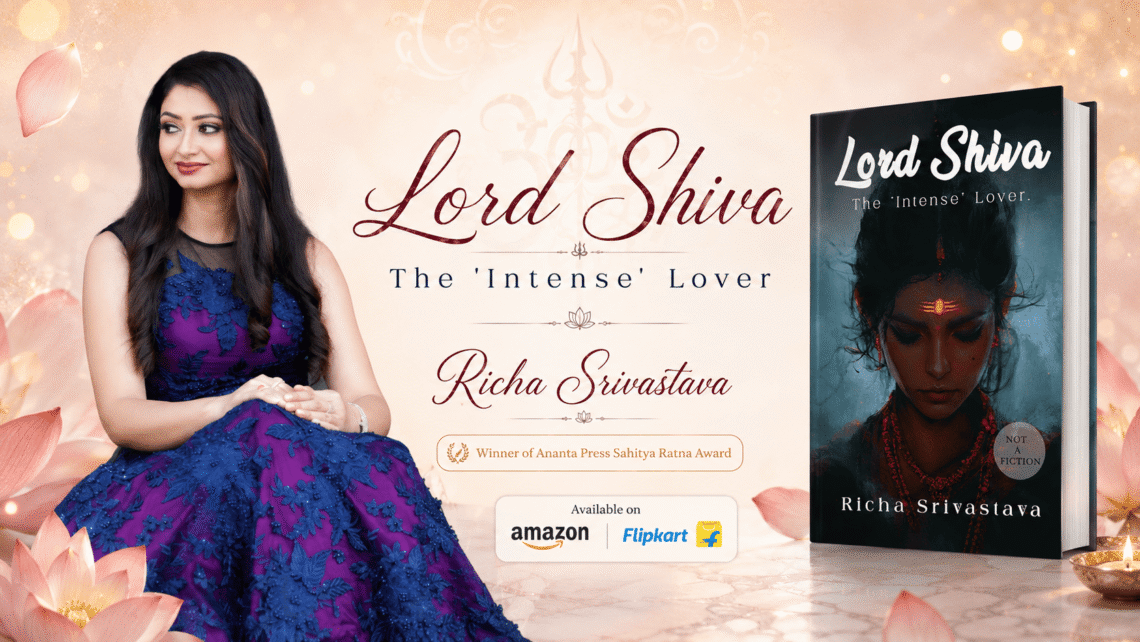
The most compelling spiritual books are often those that do not pretend faith is effortless. Lord Shiva – The “Intense” Lover by Richa Srivastava appears to understand this deeply. Framed as the author’s autobiography and based on real incidents and supernatural experiences, the book presents devotion as a relationship filled with trust, hurt, longing, and transformation. It does not approach Lord Shiva only through mythology or religious explanation. Instead, it brings the divine into the complicated emotional reality of an individual life.
The title is bold, intimate, and deliberately unconventional. Calling Lord Shiva an “intense lover” shifts the reader’s attention from religion as institution to spirituality as relationship. A lover is close, emotionally significant, and capable of awakening powerful feelings. The word “intense” suggests that this closeness is not always gentle. It may involve silence, testing, destruction of illusions, or events that the devotee cannot immediately understand. This framing allows the book to explore a form of devotion that is deeply personal rather than merely ceremonial.
The cover’s emotional statement reinforces this idea. It conveys that the author does not doubt divine intention, yet still admits to being hurt. That is an unusually honest spiritual position. Many devotional texts emphasise surrender but avoid discussing the emotional resistance that can accompany it. Srivastava’s premise allows both trust and pain to exist together. This is important because real faith is often shaped in precisely that tension. People may believe in a higher purpose while still struggling with what they have endured.
As an autobiography, the book derives its strength from personal risk. Fiction allows a writer to hide behind characters, but memoir places the author directly before the reader. When the material includes supernatural experiences, that exposure becomes even greater. The author must reveal events that some readers may accept immediately and others may question. The courage to share such experiences is itself part of the book’s meaning. It demonstrates that the author considers these incidents too important to conceal or fictionalise.
The supernatural dimension adds mystery, but the emotional dimension gives it substance. Unexplained experiences can be fascinating, yet they become memorable only when they are connected to human need. A dream, sign, presence, coincidence, or intuitive certainty carries weight when it arrives during grief, confusion, hope, or personal crisis. The book’s value therefore rests not simply on unusual events but on how those events reshape the author’s understanding of herself and Lord Shiva.
This focus on transformation is particularly appropriate to the figure of Shiva. In Indian spiritual thought, Shiva is associated with dissolution and renewal. Destruction is not presented merely as an ending; it is the removal of what no longer serves truth. An autobiographical work centred on Shiva can therefore become a record of inner dismantling. Old assumptions, attachments, fears, and identities may be challenged so that a stronger self can emerge. The “intensity” of divine love may lie in its refusal to leave the devotee unchanged.
Richa Srivastava’s professional and public journey adds credibility to the book’s theme of multidimensional identity. She is known as an entrepreneur, counsellor, motivational speaker, and author, with a background in intellectual property and content. She has also received several honours related to business, leadership, writing, and motivational communication. These achievements show discipline, ambition, and resilience. Yet the book reveals that accomplishments do not eliminate the need for spiritual meaning. A person may be successful and still ask profound questions about suffering, destiny, protection, and divine connection.
This makes the memoir relevant to readers living modern, demanding lives. Spirituality is sometimes portrayed as separate from professional aspiration, but Srivastava’s profile suggests the opposite. Her journey demonstrates that the sacred can be sought alongside entrepreneurship, public work, creativity, and self-development. The book may therefore appeal to readers who do not fit the traditional image of a spiritual seeker but who nevertheless experience moments of intuition, devotion, or unexplained guidance.
Another quality of the book is its potential to encourage emotional self-examination. Even readers who do not interpret supernatural events in the same way may recognise the underlying process. When people experience something they cannot fully explain, they are forced to examine what they believe. They may become more attentive to patterns, more aware of their fears, or more willing to accept that life contains dimensions beyond immediate control. The memoir can thus be read as an invitation to look inward.
The book also raises an important question about the language of divine love. Human beings often use the language of relationships to understand God: parent, friend, guide, protector, beloved. Each metaphor reveals something different. By choosing the language of an intense lover, Srivastava emphasises emotional closeness, longing, and personal involvement. This metaphor may feel surprising, but it has deep roots in devotional traditions where the soul’s relationship with the divine is described through love. The author’s modern phrasing makes that ancient idea feel immediate.
One of the work’s most appealing features is that it does not appear to be a conventional retelling of Shiva’s stories. Readers familiar with popular mythology have encountered many accounts of Kailash, Parvati, the Ganga, the third eye, the cosmic dance, and the destruction of evil. This book distinguishes itself by asking a different question: what does a relationship with Shiva look like in the life of a contemporary woman? The answer is not offered through legend alone but through autobiographical events.
That contemporary female perspective is significant. Women’s spiritual experiences have often been recorded through traditional devotional roles, but modern memoir allows a woman to speak simultaneously as a professional, entrepreneur, public figure, counsellor, and devotee. The author does not need to reduce herself to one identity. Her relationship with Shiva exists alongside her worldly achievements, emotional wounds, and intellectual life. This complexity gives the narrative relevance.
The book’s classification as general non-fiction is appropriate because it can reach beyond strictly religious audiences. It may interest readers of memoir, inspiration, spirituality, self-reflection, and unexplained phenomena. Its appeal lies in the convergence of these areas. A reader may begin with curiosity about supernatural experiences and remain for the emotional honesty. Another may approach it through devotion to Shiva and discover a broader story about identity and resilience.
The greatest achievement of Lord Shiva – The “Intense” Lover is its effort to make private spiritual experience communicable. Such experiences are difficult to translate into words because they are often felt more strongly than they are understood. By writing them down, the author creates a bridge between the inward and outward worlds. The reader may not live the same incidents, but can still recognise the desire to be seen, guided, protected, and transformed.
Ultimately, this is a book about the cost and power of closeness to the sacred. It suggests that divine love may not always arrive as comfort. Sometimes it appears as disruption, truth, loss, or a mystery that demands growth. That is what makes the book more than a simple account of supernatural events. It becomes a meditation on how faith survives hurt and how hurt itself may become part of spiritual awakening.
Lord Shiva – The “Intense” Lover stands out for its originality of perspective, autobiographical courage, and emotional complexity. It offers readers an intimate interpretation of Shiva’s presence and encourages them to consider the ways in which mystery enters ordinary life. Whether read as testimony, memoir, inspiration, or symbolic spiritual narrative, it leaves the reader with an important idea: the deepest forms of love are often those that transform us most completely.
Amazon Link: https://amzn.in/d/0dpvsP2g