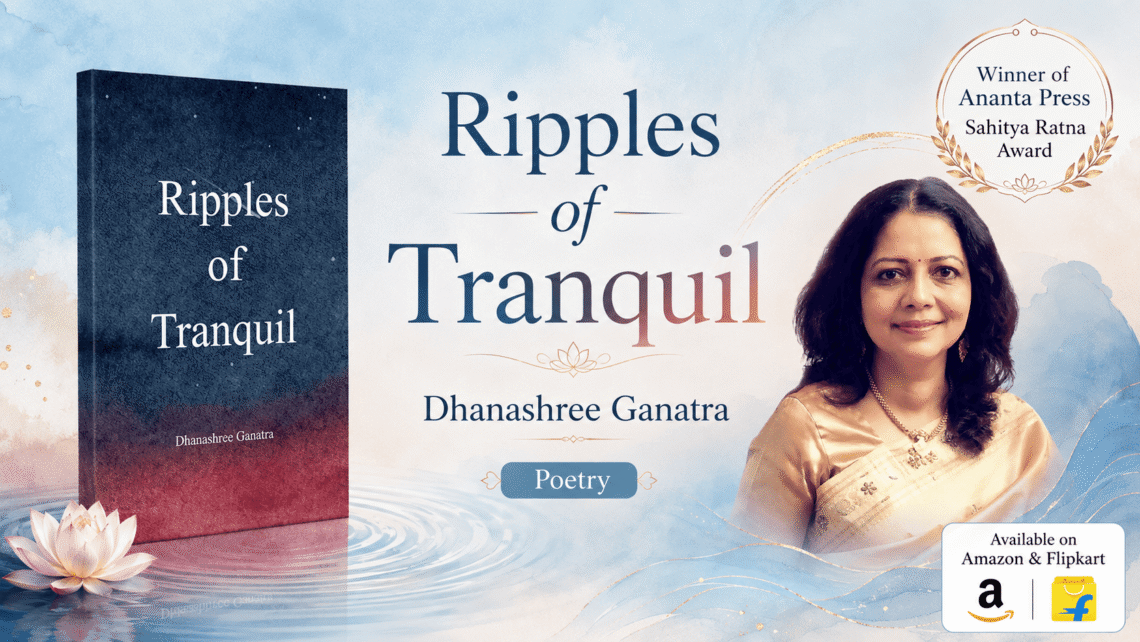
To read Ripples of Tranquil with knowledge of Dhanashree Ganatra’s wider artistic life is to recognise that this is a poetry collection created by someone who does not experience words as silent objects alone. Ganatra is also a singer, songwriter, music composer, and filmmaker, and that multidisciplinary background offers a valuable lens through which to consider the collection. Poetry has always had a close relationship with music: before it was printed, it was recited, sung, remembered, and carried by rhythm. Ripples of Tranquil feels connected to that older understanding of poetry as an art of breath and resonance, even while its themes are distinctly contemporary.
The collection’s title immediately has a sonic quality. “Ripples” suggests repeated movement, one small wave following another, while “Tranquil” introduces spaciousness and calm. This combination resembles music in which sound matters because of the silence around it. A melody without rests can become exhausting; a poem without space can become merely verbal. The book’s central invitation—to enter the silence between thoughts—therefore feels almost musical. Silence is not the opposite of expression. It is what gives expression shape.
That idea is particularly powerful when considering the emotional subjects of the book. Love, dreams, self-realisation, hope, silence, and the changing colours of the mind are themes that have inspired poets and musicians for centuries. Their familiarity creates a challenge: how can an artist approach them without sounding borrowed or predictable? Ganatra’s answer appears to be intimacy. Instead of attempting oversized declarations, she works through soft reflections, fragments of feeling, and inward observation. The effect is closer to a private song than to a public speech. This gives the collection a personal tone while leaving enough openness for the reader to enter.
The opening poem, “Life is Beautiful,” provides the clearest evidence of the link between Ganatra’s literary and musical identities. The poem did not remain confined to the book. It became an original song written, composed, and sung by the author herself and later received appreciation and accolades at international film festivals. This artistic journey is more than an interesting biographical fact. It reveals something essential about the collection’s creative logic. A poem, for Ganatra, can contain melodic possibility. Its emotional meaning can move from the visual arrangement of words on a page into voice, pitch, tempo, and cinematic presentation. That transition demonstrates the adaptability of her expression.
The message associated with the song—optimism, resilience, and gratitude toward life—also shows the collection’s preference for emotional nourishment without sentimentality. Optimism in art is often underestimated because darkness can appear more sophisticated. Yet sustaining hope with credibility is difficult. It requires the artist to acknowledge vulnerability while still locating beauty. In a collection preoccupied with the mind and inner truth, gratitude becomes most persuasive when it emerges from awareness rather than from denial. The book’s reflective nature creates the possibility for such earned optimism.
Musicality in poetry is not limited to rhyme or metre. It includes pacing, tonal movement, repetition, contrast, and the management of emotional expectation. A poet with musical training is likely to be acutely aware of these elements. Ganatra’s Sangeet Alankar background and her work in composition suggest a disciplined relationship with sound. Even when a reader encounters the poems silently, that awareness can influence the experience. Reflective poetry often benefits from being read aloud because the human voice exposes rhythm that the eye may overlook. Ripples of Tranquil seems particularly suited to that practice. Reading a poem aloud, then pausing, could become almost meditative.
The collection’s imagery also supports this musical reading. “Whispers,” “ripples,” “shadows,” and “colors” are sensory words. They cross boundaries between hearing, movement, sight, and feeling. Such language encourages the reader not merely to understand an idea but to experience an atmosphere. This is one of poetry’s unique capacities. Prose can explain tranquility, but poetry can try to make the reader feel its texture. By using gentle sensory associations, Ganatra creates an emotional field rather than a set of instructions.
Her background in filmmaking adds another dimension. Film teaches an artist to think in images, transitions, timing, and the relationship between what is shown and what remains outside the frame. The description of the collection as containing “fragments of feeling” and “shadows of thought” has something cinematic about it. A fragment is like a close-up: it does not show the entire world, but its concentration can reveal more than a wide explanation. A shadow implies an unseen source. This approach respects the reader’s imagination. Instead of filling every space, the poems allow suggestion to work.
That restraint contributes strongly to the book’s uniqueness. Many contemporary readers are surrounded by explanatory language. Social media posts, advertising, commentary, and instructional content continually tell us what something means and how we should respond. Poetry offers a different contract. It can trust the reader. Ripples of Tranquil appears to make that trust central to its style. The poems reach outward gently rather than demanding attention. Their aim is resonance: if an image or thought finds a matching experience in the reader, meaning expands.
The author’s recognition through the 21st Century Emily Dickinson Award and the Tagore International Cultural Award is relevant in this context because both associations evoke traditions in which poetry is valued for concentrated emotional and philosophical insight. While every writer must ultimately be judged by the work rather than by honours, such recognition indicates that Ganatra’s voice has been received as more than locally significant. The reported international festival journey of “Life is Beautiful” reinforces the point. Music and poetry can cross linguistic and cultural boundaries when they are grounded in basic emotional truths.
For a reader, one of the most rewarding aspects of Ripples of Tranquil is likely to be its capacity to accompany different moods. A poem read in a hopeful period may offer affirmation; the same poem read during uncertainty may feel like reassurance. A line about silence may mean peaceful solitude to one reader and difficult loneliness to another. That variability is not a flaw but part of the richness of lyrical writing. Like music, poetry changes according to the listener’s emotional state.
The book is also valuable because it expands the definition of what “quiet” art can accomplish. Quietness is sometimes mistaken for lack of energy. In reality, a whisper can draw attention precisely because it requires closeness. Tranquility can hold enormous emotional tension when it has been reached through reflection. Ganatra’s collection uses softness as an aesthetic principle. It does not seek to overwhelm the reader. It seeks to tune the reader more finely to inner experience.
This makes Ripples of Tranquil a strong choice for readers who love poetry with a contemplative and lyrical character, but it may be equally meaningful for musicians, singers, and other creative people. They may recognise in it the shared language of pause, rhythm, tone, and emotional phrasing. The book can also appeal to those who value art as a form of healing—not in a clinical sense, but in the older human sense of being gathered back into oneself by beauty.
In the end, the collection’s most distinctive quality may be the way it allows several art forms to meet inside a single poetic sensibility. The writer, singer, composer, and filmmaker are not separate identities competing for space. They appear to support one another. Words carry music; images create inward scenes; silence becomes part of rhythm; reflection becomes emotional composition. Ripples of Tranquil therefore feels larger than a collection of poems while remaining faithful to poetry’s intimacy. Dhanashree Ganatra reminds us that a poem can be a page, a breath, a song, a memory, and a moment of stillness all at once. That layered artistic identity gives the book its special resonance and makes it a collection worth returning to slowly, preferably with enough silence around it to hear what continues after the final line.
Buy / View on Amazon: https://amzn.in/d/0doJNpxh