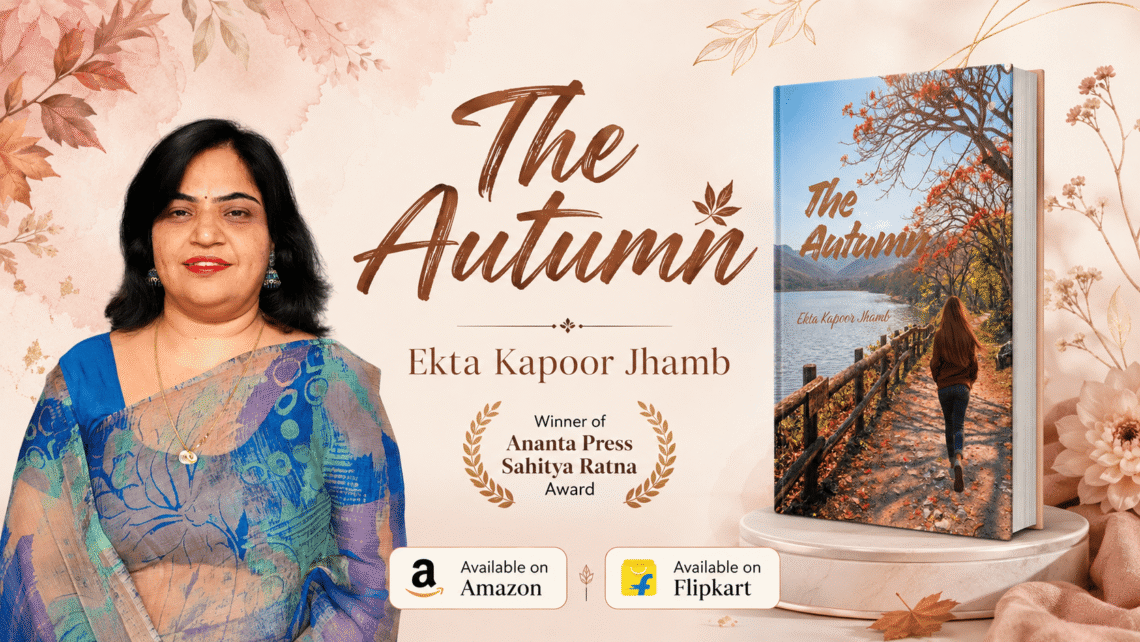
One of the most engaging ideas in The Autumn is that compatibility does not automatically create permanence. Aaradhya and Kabir are not introduced as obvious opposites who must learn to understand each other. They are described as a match. She is meticulous and fiercely intelligent; he is brilliant and responsible for some of her most cherished memories. Together, the world seems to align. Yet the relationship still struggles to remain in orbit. Ekta Kapoor Jhamb builds her novel around that contradiction, and it gives the book a psychological edge that distinguishes it from formulaic romantic fiction.
The word “match” is important because it removes an easy explanation for relational difficulty. Readers cannot simply blame a gap in intelligence, ambition, or emotional significance. Instead, the novel points toward a more realistic truth: people can be deeply suited to each other in some ways and still face pressures that alter how they connect. Family expectations, personal loss, and the pressure to conform can reshape a relationship even when affection remains. The Autumn appears interested in the stress placed on a bond over time rather than in the fantasy that the right partner makes stress irrelevant.
This makes the book especially interesting for readers who enjoy the psychology of relationships. The central question – whether love is something one holds or something one allows to change – can be approached through several familiar human tendencies. We often confuse love with continuity, continuity with success, and change with failure. Once those assumptions are in place, every shift in a relationship can feel like an emergency. The fixer responds by increasing effort. More explanation, more accommodation, more planning, more emotional labor: surely the original harmony can be restored if the correct adjustment is found. The Autumn takes that instinct seriously without automatically endorsing it.
Aaradhya is perfectly suited to embody the fixer mentality because her meticulous intelligence likely makes effort feel meaningful. In many areas of life, attention and competence produce results. The more carefully we understand a system, the better we can operate within it. Intimate relationships resist that confidence because another person is not a system. Kabir has his own history, pressures, choices, griefs, and capacity for change. The relationship between them therefore becomes a place where Aaradhya must encounter uncertainty rather than solve it. That tension gives the premise emotional sophistication.
Kabir’s description as an architect of favorite memories adds a second psychological layer. Memories can become structures in their own right. Couples often build identities around the best versions of their shared past: the first period of closeness, a place associated with happiness, a private language, or a moment when the future seemed obvious. These memories are real and valuable, but they can also create a standard against which every later season is measured. The novel’s premise invites readers to ask whether protecting the memory of a relationship is the same as responding honestly to the relationship as it exists now.
The seasonal framework provides an elegant way to examine this problem. Seasons are repetitive but not identical. They teach us that continuity includes change. A tree remains itself even though its appearance transforms across the year. By choosing autumn as the dominant metaphor, Jhamb places the story in a season where beauty and loss are visibly intertwined. The relationship between Aaradhya and Kabir can therefore be understood not only in terms of “together” or “apart,” but in terms of transition. What if the meaning of a relationship can remain important even when its form changes? That is a more nuanced question than simply asking whether love wins.
The social environment described in the book materials further increases the realism. The Autumn is set in Indore, and the characters face family expectations and pressure to conform. In Indian relationship fiction, these pressures can be especially significant because romance often exists within a dense web of family, culture, career, reputation, and obligation. Jhamb’s rooted setting allows the relationship to be understood as part of a larger social system. Aaradhya and Kabir are not isolated individuals making choices in a vacuum; their private emotional lives are inevitably affected by the worlds around them.
What makes this dynamic promising is that the author’s broader body of work is concerned with women who choose to stand rather than surrender. In The Autumn, however, “standing” does not necessarily mean refusing to move. That apparent paradox is one of the novel’s most intriguing possibilities. A person can stand for herself while allowing circumstances to change. Aaradhya’s healing is described as a process of questioning old beliefs and choosing who she wants to become. From a relationship-psychology perspective, that means her development involves differentiation: learning where her identity ends and the relationship begins.
Differentiation is important in any intimate partnership. Two people can be deeply connected without becoming responsible for managing each other’s entire emotional universe. The fixer often struggles with this boundary because stepping back can feel like abandonment. The Autumn’s central premise challenges that fear. Allowing change may not mean caring less; it may mean respecting reality enough to stop forcing it into a preferred shape. That is a thoughtful message for readers who have experienced the exhaustion of trying to keep every relationship stable at any cost.
The book also avoids a simplistic celebration of independence. Aaradhya’s bond with Kabir matters. The description emphasizes his brilliance and the beauty of the memories they share. That emphasis prevents self-recovery from becoming a slogan in which relationships are treated as disposable. The emotional difficulty comes precisely because something meaningful is at stake. Jhamb’s conceptual strength lies in holding two values together: love deserves effort, and the self also deserves protection from endless self-erasure. Mature relationship fiction lives inside that tension rather than resolving it with an easy rule.
Readers may also appreciate the way the novel connects personal loss with relational change. Loss has a destabilizing effect on identity and intimacy. It can alter priorities, emotional capacity, assumptions about the future, and the need for control. While the supplied summary does not disclose the specific development of every hardship, the inclusion of personal loss signals that Aaradhya and Kabir’s difficulties are not merely misunderstandings manufactured for dramatic convenience. Their bond is being tested by life itself. That makes the question of adaptation more credible and more affecting.
Ekta Kapoor Jhamb’s professional background in education adds another subtle strength. Her teaching has emphasized student voice, discussion, and connecting language to lived experience. The Autumn similarly appears designed to generate reflection rather than to impose a single lesson. Its key question can produce different answers depending on the reader’s own history. Someone recovering from a relationship may interpret “allowing change” as release. Someone in a long-term partnership may see it as the willingness to let both people evolve. Someone prone to over-functioning may recognize the danger of believing that love must always be repaired by personal effort.
For this reason, The Autumn feels particularly suitable for book-club conversations and readers who like to discuss emotional motives rather than merely follow events. It offers the recognizable pleasures of romance – chemistry, meaningful memory, the desire for a shared future – but places them inside a more complicated framework of identity and change. The characters’ intelligence does not protect them from emotional uncertainty; if anything, it makes their attempts to understand and manage that uncertainty more compelling.
The Autumn ultimately stands out because it does not treat a relationship as a machine that can be restored to factory settings. Aaradhya and Kabir’s story asks whether love can survive not by defeating change but by accepting that change is inevitable. That question is relevant far beyond romance. It touches family bonds, grief, ambition, identity, and the way human beings respond when life refuses to follow a plan. For readers drawn to emotionally intelligent contemporary fiction, the novel offers a strong central insight: the deepest form of care may sometimes be the willingness to stop controlling the season and learn what it is asking us to become.
Amazon purchase link: https://www.amazon.in/dp/B0H2WGRVX3